
UDPLS: Reclaiming Location Privacy Against Curious Servers and Untrusted Friends
User-defined privacy location-sharing system in mobile online social networks
The paper introduces UDPLS (User-Defined Privacy Location-Sharing), a novel architecture for mobile Online Social Networks (mOSNs) that enables privacy-preserving location sharing. It utilizes a single location server and a social network server to facilitate near-friend and stranger queries while preventing both "honest-but-curious" servers and malicious friends from accessing unauthorized user data.
TL;DR
Researchers have developed UDPLS (User-Defined Privacy Location-Sharing), a system that allows mobile social network users to share their coordinates without letting the service provider know their social circles or letting "shady" friends track their exact movements. By moving the final matching process to the user's phone, the system achieves SOTA efficiency, maintaining low latency even as your friend list grows into the thousands.
The Problem: The "Honest-but-Curious" Trap
Most modern location-based services (LBS) operate on a dangerous assumption: you either trust the server completely, or you trust all your friends completely. In reality:
- Server Snooping: Social Network Servers (SNS) want your location for ads, while Location Servers (LS) want your social graph to build user profiles.
- The Friend Attack: Just because someone is a "friend" on Facebook doesn't mean you want them knowing you're at a specific clinic or a bar at 2 AM.
- Performance Bottlenecks: Previous attempts to encrypt this data (like the MLS framework) made your phone do heavy decryption for every single friend in the area, causing massive lag.
Methodology: Decoupling and Client-Side Matching
The core genius of UDPLS lies in its architectural split. Instead of one server knowing everything, the responsibility is divided:
- The Social Network Server (SNS): Knows your identity (ID) and your friends but only sees a temporary "pseudonym" (pid) for your location.
- The Location Server (LS): Knows where "Pseudonym A" is, but has no idea that "Pseudonym A" is actually "Alice."
The Workflow
- Registration: Users get a fresh pseudonym and a public key pair.
- User-Defined Policy: You decide if you want to share "Precise Location," "Identity Only," or "Total Stealth" with specific sub-groups of friends.
- The Query: When you look for nearby friends, the LS sends back a list of nearby pseudonyms. Simultaneously, the SNS sends a list of your friends' current pseudonyms. The matching happens on your device.
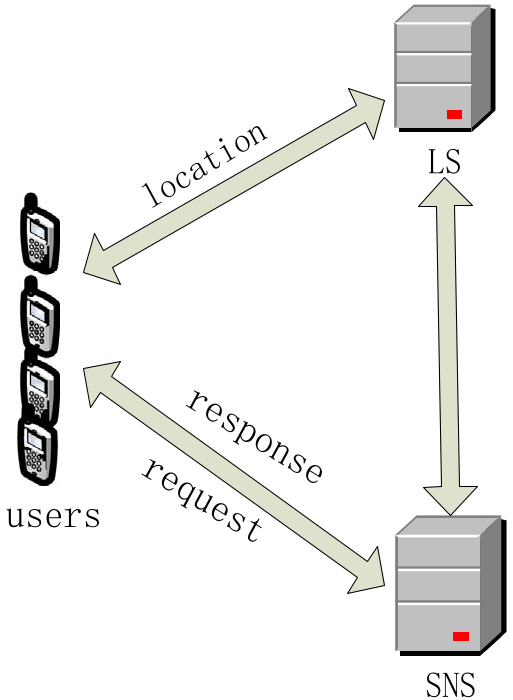 Figure 1: The UDPLS System Model showing the interaction between the User, SNS, and LS.
Why UDPLS Wins: Mathematical Intuition
In previous systems (MLS), the query time was , because each friend's data required a separate decryption/authentication step. UDPLS moves the computation to a simple Set Intersection on the client side.
The pseudonym generation uses a Linear Congruential Method, ensuring that even if an attacker sees your movements today, they can't link them to your movements tomorrow because your "ID" to the location server has changed completely.
Experimental Results: Breaking the Linear Scalability Wall
The researchers compared UDPLS against the Multiple Location Server (MLS) model. The results were stark:
- Scalability: In Scenario-5 (varying friend counts), MLS's query time spiked as the friend list grew. UDPLS remained flat and stable.
- Efficiency: While MLS took nearly 250ms for a standard query, UDPLS consistently stayed under 50ms.
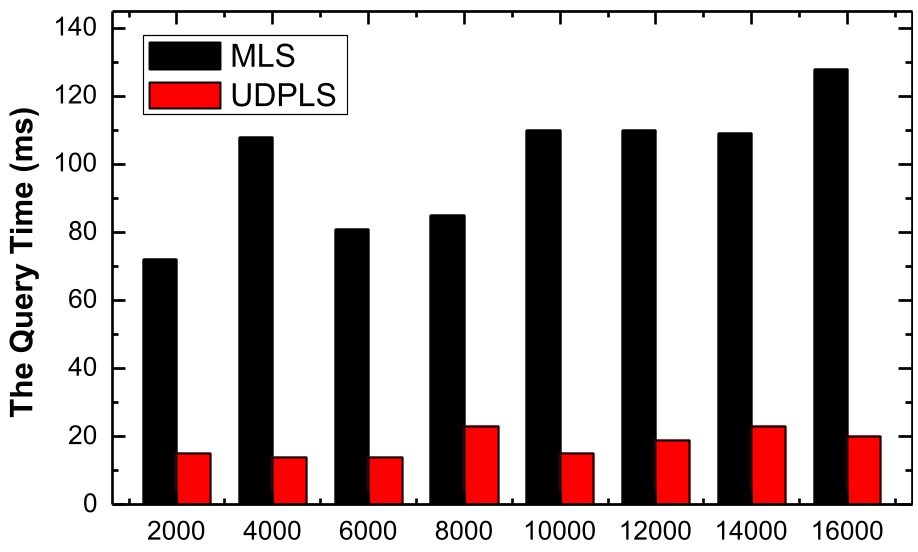 Figure 2: Performance comparison showing UDPLS (stable) vs MLS (fluctuating/increasing) as user density increases.
Critical Analysis & Conclusion
UDPLS represents a significant step toward "Zero Trust" social networking. By allowing users to define access at a granular level, it solves the social awkwardness of location sharing.
Limitations: The paper acknowledges a "traffic overhead" issue. Because the LS sends all nearby pseudonyms to the user for local matching, the data usage is higher than a centralized system.
Future Outlook: The next frontier is optimized communication. If we can combine UDPLS's client-side matching with Private Information Retrieval (PIR), we could reduce the data overhead while keeping the same ironclad privacy guarantees. This work proves that you don't have to sacrifice speed for the right to be left alone.