
GT-DBSCAN: Decoding the Hidden Rhythm of Periodic Events in Social Networks
User-driven geo-temporal density-based exploration of periodic and not periodic events reported in social networks
This paper proposes GT-DBSCAN, a flexible geo-temporal density-based clustering framework for social media analysis. It extends the traditional DBSCAN algorithm to reveal latent spatio-temporal structures of events, successfully categorizing both periodic (e.g., traffic jams) and aperiodic (e.g., natural disasters or sports events) phenomena using Twitter data.
TL;DR
Researchers have developed GT-DBSCAN, an extension of the classic density-based clustering algorithm designed to map the "where" and "when" of social media events. By introducing flexible geo-temporal distance measures—including a novel Modulo-Temporal logic—this framework can automatically identify whether a flurry of tweets signifies a recurring traffic jam, a global sports final, or an localized natural disaster.
Motivation: The Missing Link in Spatio-Temporal Analysis
In the era of Web 2.0, every tweet is a sensor reading. However, existing methods often suffer from two major flaws:
- Dimensional Isolation: They analyze geographic spread and temporal spikes independently.
- Lack of Periodicity: They struggle to distinguish between a unique event (like the Typhoon Haiyan) and a recurring pattern (like the 8 AM rush hour).
The authors' insight was to move beyond simple Euclidean distances. They recognized that to truly understand human social dynamics, a clustering algorithm must account for the periodicity of life—the fact that "time" isn't just a linear progression from an epoch, but a circular cycle of days, weeks, and months.
Methodology: The Core of GT-DBSCAN
The framework operates on a three-pronged tuple: fs (Geotag), ft (Timestamp), and fc (Content keywords). The technical breakthrough lies in the five distance measures it can toggle:
- DistG (Geographic): Uses the Haversine formula to handle the Earth's curvature for global events.
- DistT (Temporal): Linear time distance.
- DistMT (Modulo-Temporal): The "secret sauce." It applies a modulo operation (e.g.,
time mod 24h) to group events that happen at the same time of day, regardless of the date. - DistGT & DistGMT: Hybrid measures that require an event to be dense in both space and time (or periodic time) to form a cluster.
Architecture Overview
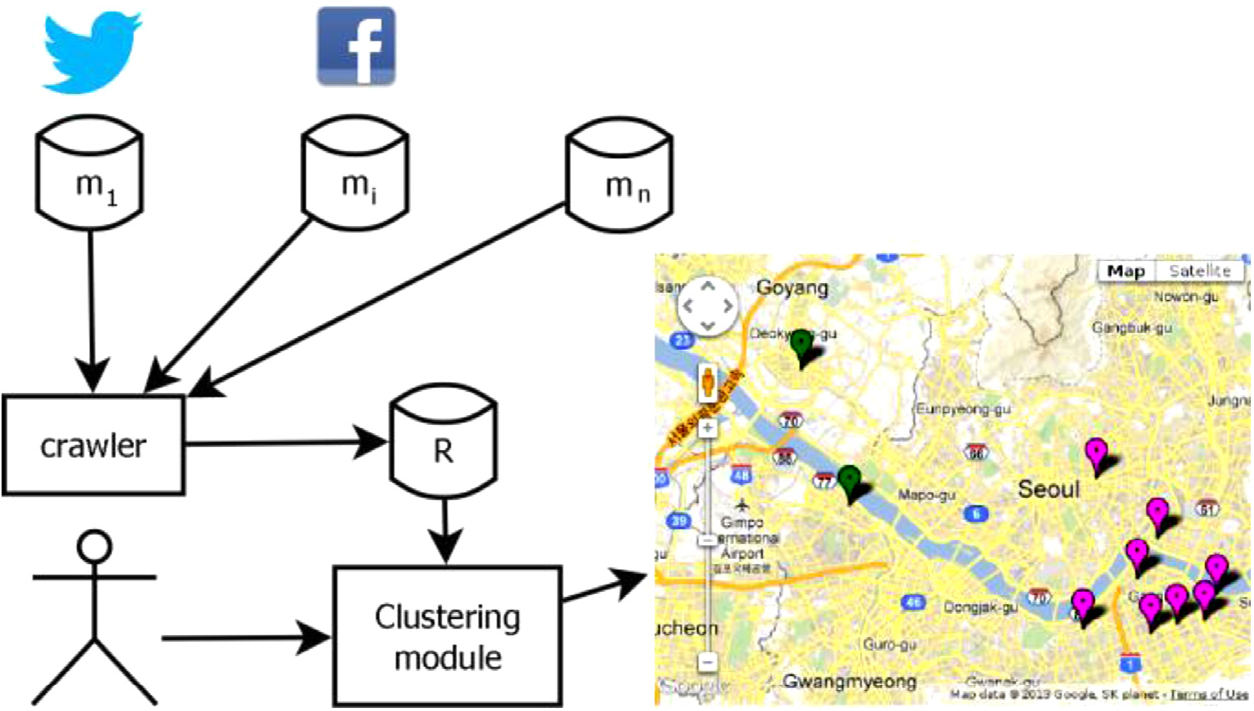 The process flows from crawling social sources to user-driven query filtering, ending in the GT-DBSCAN clustering engine.
To ensure the hybrid distance remains a valid mathematical metric, the authors utilize a Rectifier Function: This non-compensative approach ensures that a cluster is only formed if points are close in geographic AND temporal terms, preventing "dilution" where a very small distance in one dimension masks a massive gap in the other.
Experiments: Traffic, Tennis, and Trends
The system was tested on over 139,000 tweets. Key findings include:
- The Human Complaint Index: In the modulo-temporal analysis of traffic (see figure below), they identified two clear peaks. Interestingly, the afternoon peak was larger and wider than the morning, suggesting humans are more prone to reporting (or "complaining" about) traffic after a long workday.
- Global Synchronization: During the US Open 2013, the algorithm identified clusters that perfectly aligned with television broadcast times, proving that "virtual events" create temporal density across disparate geographic locations.
Visual Evidence: Patterns in the Data
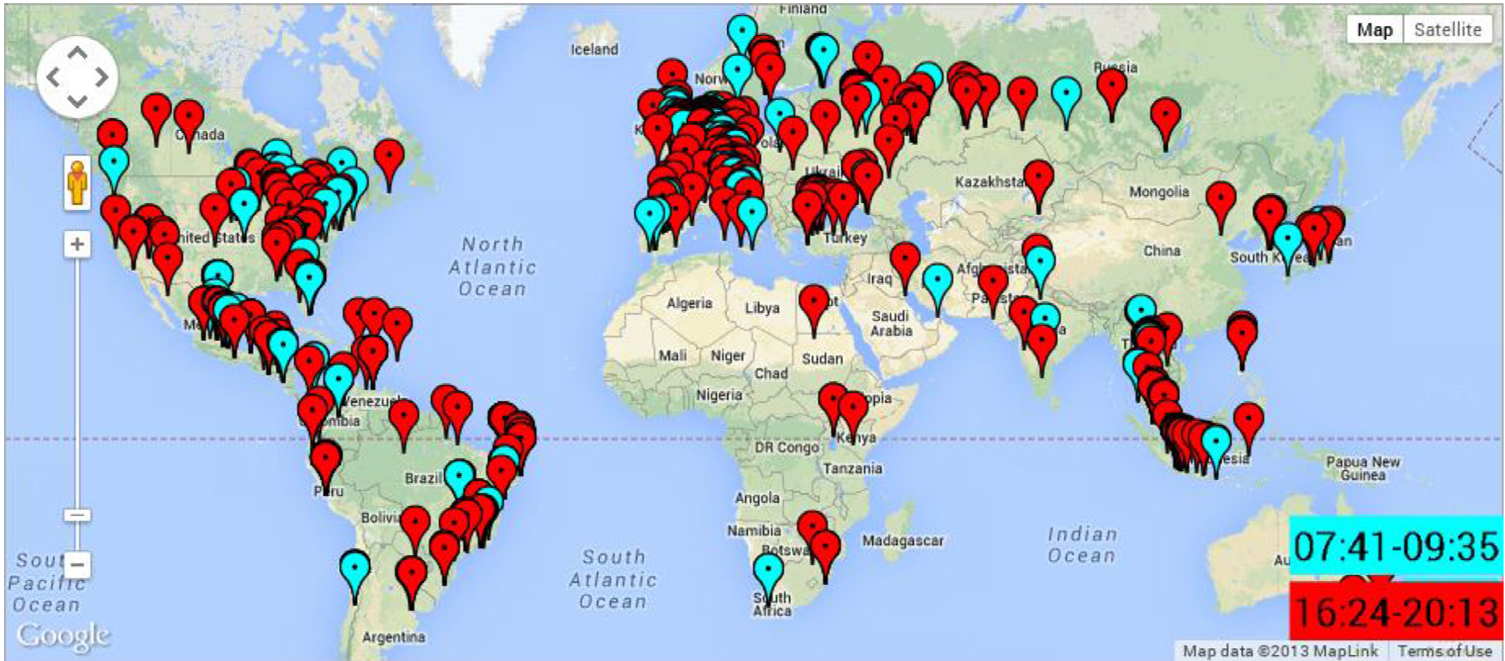 Fig 6: Modulo-temporal clustering of traffic reports showing the global morning and evening rush hour spikes.
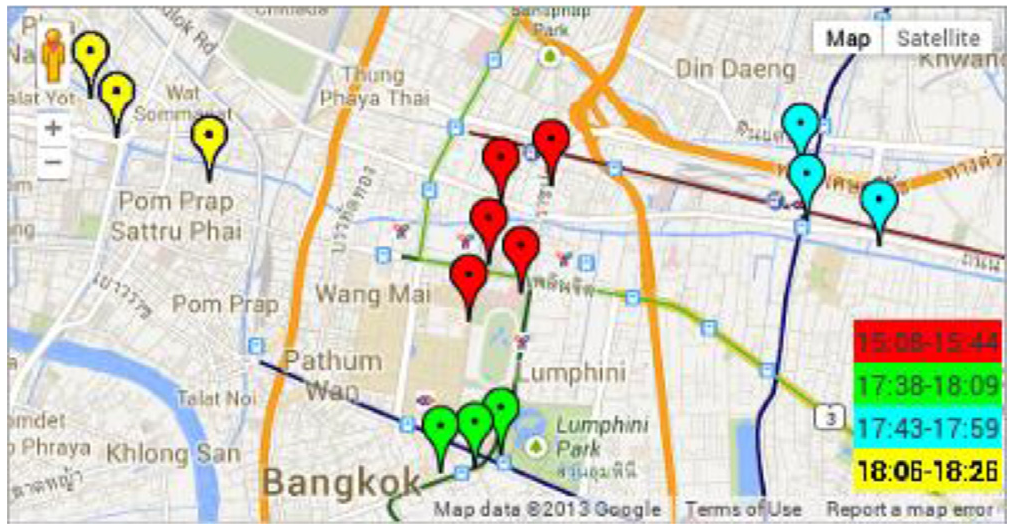 Fig 11: Periodic geo-temporal clusters in Bangkok. Only reports appearing in the same area at the same time of day form clusters.
Critical Insight & Future Outlook
The true power of this work is its User-Driven nature. Unlike "black-box" event detectors, GT-DBSCAN acts as a hypothesis verification tool. If a city planner suspects a new road layout causes congestion every Monday, they can configure GT-DBSCAN with a weekly modulo to prove it.
Limitations: The system relies on "a priori" knowledge—the user must guess the correct periodicity and scale. Future iterations could benefit from Automated Hyperparameter Optimization to detect the most likely period (e.g., using Fourier Transforms) before clustering begins.
Conclusion: By mapping the intersection of geography and cyclic time, GT-DBSCAN transforms social media noise into actionable territorial intelligence.