
PaM4OL: Bridging Relational Databases and Semantic Ontologies via Pattern Mining
User-Driven Ontology Learning from Structured Data
This paper introduces PaM4OL (Pattern Mining for Ontology Learning), a methodology for automatically constructing domain ontologies from relational databases. It combines reverse-engineered Entity-Relationship (E-R) models with association rule mining to extract concepts, relations, and complex axioms.
TL;DR
While the AI world is obsessed with extracting knowledge from text, billions of rows of expert knowledge sit trapped in relational databases. PaM4OL (Pattern Mining for Ontology Learning) is a framework that turns these databases into formal ontologies. By combining E-R model reverse engineering with association rule mining, it doesn't just copy the schema—it discovers the hidden "laws" of the data.
Context: The Structured Data Oversight
Ontology learning has historically targeted unstructured text. However, structured databases are already "mini-models" of the world. The challenge is that they are often normalized, meaning the real-world concepts are fragmented across multiple tables for efficiency. Standard mapping tools often produce "brittle" ontologies that look exactly like the technical database schema rather than the human domain it represents.
Methodology: The PaM4OL Heart
The authors propose a two-phase cycle that puts the human "in the loop" to decide the granularity of the knowledge.
1. The Translation Engine (User-Driven)
Instead of a one-size-fits-all mapping, PaM4OL offers four strategies:
- Everything Is Concept: High reification; even attributes like "Gender" become concepts. This creates a dense, highly expressive graph.
- Many Attributes as Possible: A "flattened" approach where the ontology feels more like a data dictionary.
- Weak/Strong User Decision: Allows the user to toggle specific elements, resolving the ambiguity of whether an entity without attributes should be a "Concept" or just an "Attribute."
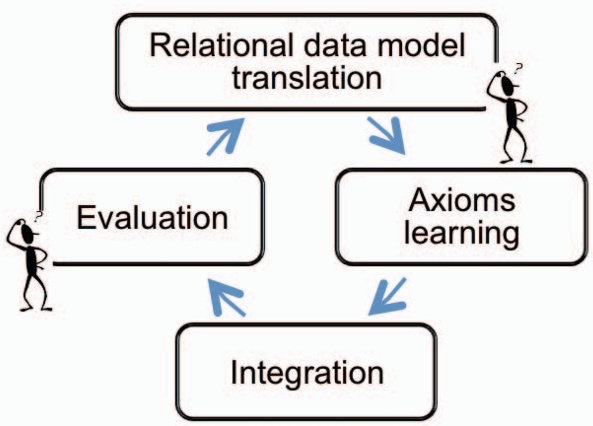
2. Axiom Discovery via Pattern Mining
This is the paper's most innovative "hook." While schema mapping gives you the structure (Actors exist, Movies exist), it doesn't tell you the rules. By running the Apriori algorithm on the actual rows of data, PaM4OL finds associations with 100% confidence to form axioms.
- Example: If every record with
awardOrganization='Hollywood Academy'also hascountry='USA', the system generates a logical axiom.
Experimental Insights: The Movies Case Study
The authors tested PaM4OL on a movie database (Actors, Studios, Awards).
Structural Flexibility
The contrast between strategies was stark:
- Everything is Concept: 38 concepts, 37 relations.
- Many Attributes: 6 concepts, 30 attributes, 4 relations.
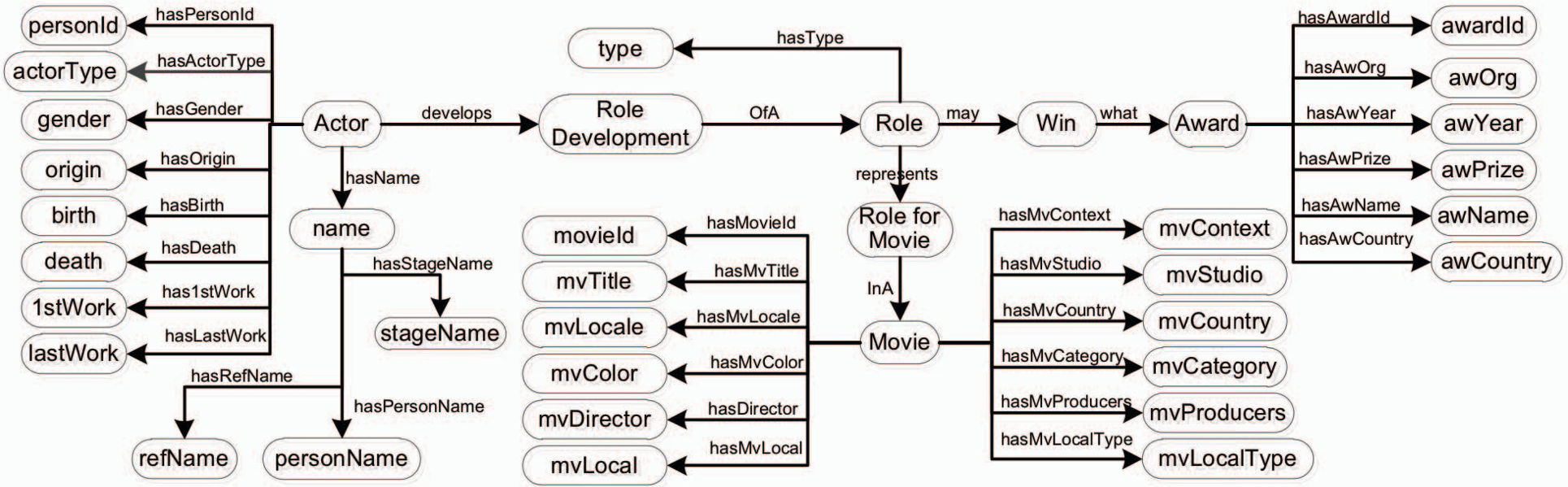 In the figure above, note how even minor attributes are reified into concepts to allow for complex cross-linking.
The Power of Axioms
The pattern mining successfully identified domain "truths" that weren't in the schema:
- Logical Constraints: "Only actresses have the 'beauty' actor type."
- Specific Correlations: "All roles performed by Sidney Toler are 'detective' characters."
However, the authors warn of False Positives. For instance, an axiom stating "all actors who died in 1936 were male" was technically true in the data but semantically irrelevant—a mere coincidence.
Critical Analysis & Conclusion
PaM4OL moves ontology learning from a passive "extraction" task to an active "discovery" task. Its strength lies in its hybrid nature:
- Top-down: From E-R schema to Ontological concepts.
- Bottom-up: From Data rows to Logical axioms.
Limitations: The reliance on 100% confidence for axioms is a double-edged sword. It avoids some noise but might miss significant probabilistic truths in messy real-world data. Furthermore, as shown in the SIDNEY TOLER example, the system cannot distinguish between a "universal law" and a "data coincidence" without human intervention.
Future Outlook: The next logical step is integrating Semantic Constraints into the mining process itself to prune irrelevant axioms before they reach the user, potentially using LLMs or external knowledge bases like Wikidata to validate these "discovered" rules.