
Beyond the Graph: How User Emotions Dictate the Pulse of Retweeting
User emotion for modeling retweeting behaviors
This paper proposes a three-stage retweeting prediction framework that integrates user emotional states to model information dissemination on Twitter. Using a Semi-supervised Graph Model (SGM) and Learn-to-Rank (ListNet), it achieves state-of-the-art performance, notably increasing precision by up to 15.2% over existing baselines.
TL;DR
Why do we retweet? While most researchers look at "who you know" or "what is trending," this paper argues we should be looking at "how you feel." By introducing a three-stage framework that detects user emotions before predicting behavior, the authors achieved an average 15.2% boost in precision over traditional content-based models. They prove that our digital echoes are deeply tied to our current psychological states—especially when we are angry.
The Missing Piece: The Psychological Filter
Information propagation research has long been dominated by two school of thoughts:
- Structuralism: It’s all about the social graph (indegree, followers).
- Contextualism: It’s about the metadata (hashtags, URLs).
However, these models treat users as rational, static nodes. In reality, a user in a "sad" mood might ignore a "happy" viral tweet from a celebrity, while a "surprised" user might instantly share an outlier event. The authors identify this Emotional Gap as the primary reason why current SOTA models hit a performance ceiling.
Methodology: The Three-Stage Emotion Framework
The paper proposes a pipeline that moves from psychological detection to behavioral prediction.
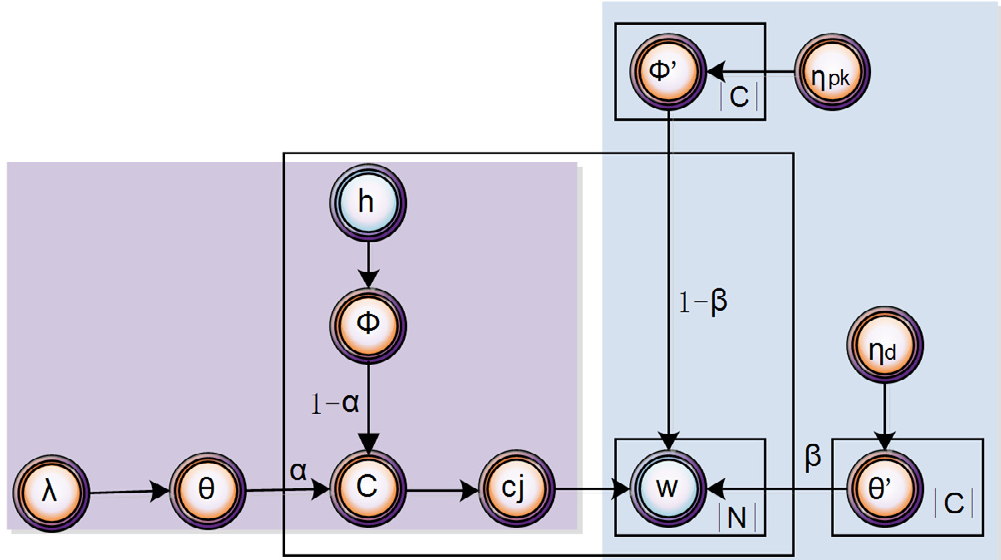
1. Emotion Detection (SGM)
The authors developed a Semi-supervised Graph Model (SGM) to handle the notorious sparsity of short-text tweets. It balances two signals:
- Emoticons: Direct indicators of mood (e.g., 😃 vs 😡).
- Word-Level Lexicons: Utilizing POMS (Profile of Mood States) to map vocabulary to six dimensions: Anger, Disgust, Fear, Happiness, Sadness, and Surprise.
2. Capturing Possible Retweets
Instead of scanning the whole network, the model uses Logistic Regression to identify "Possible Retweeted Friends." A novel feature here is SimEmotion—the cosine similarity between your current mood and your friend's mood.
3. Finding Top-N Retweets (Learn-to-Rank)
Using the ListNet algorithm, the framework ranks candidate tweets. Crucially, it introduces:
- Sentiment Valence (SV): The probability a tweet is retweeted given its specific emotional category.
- Emotional Divergence (ED): A measure of how much a user's overall timeline deviates from a neutral emotional baseline.
Experimental Insights: Anger is the Engine
The framework was tested on the Stanford Twitter Sentiment (STS) and Obama–McCain Debate (OMD) datasets.
Key Performance Gains
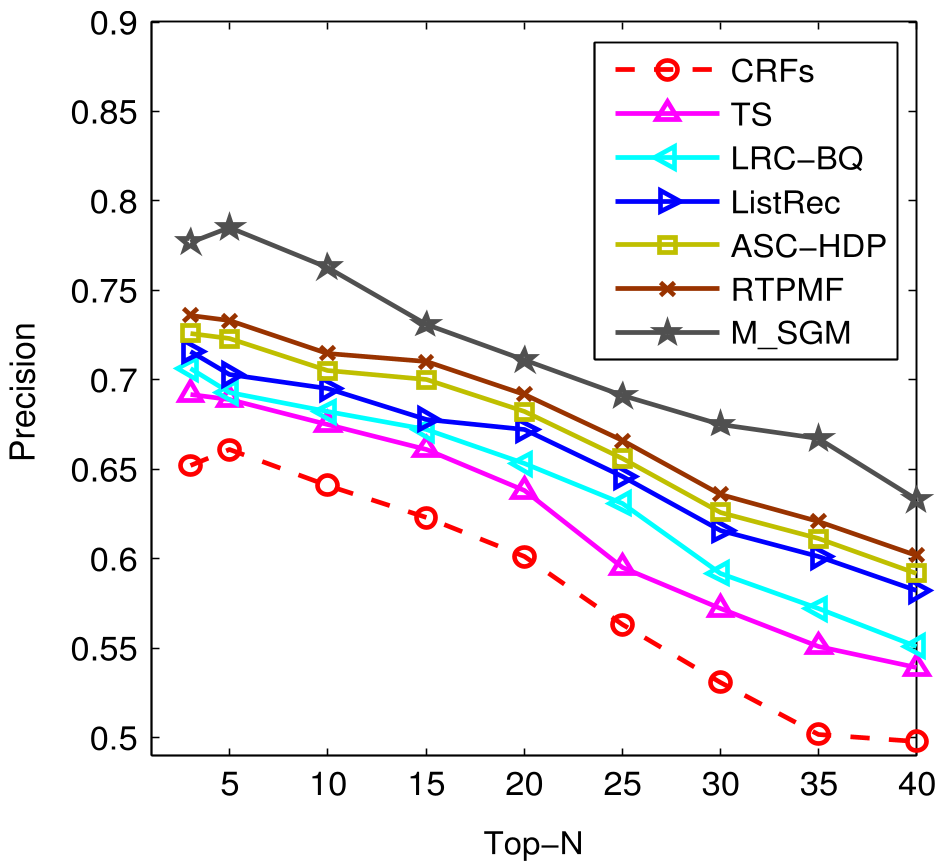
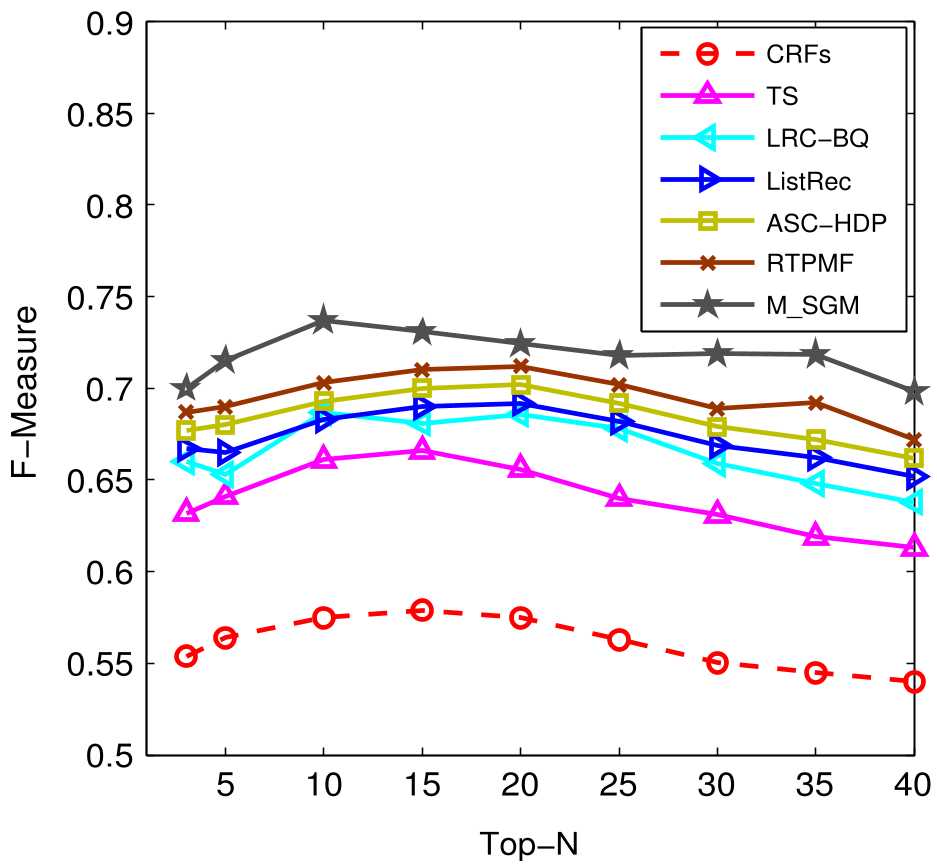
The proposed M_SGM outperformed competitive baselines like CRFs and RTPMF. As shown in the precision charts, the "emotion-aware" approach consistently stays above the competition across various N-values in Top-N recommendations.
The "Anger" Phenomenon
One of the most striking findings of the ablation study is the impact of specific emotions. The study confirms that Anger is more influential than Joy. Tweets that trigger or match an "Anger" state spread faster and more broadly, providing empirical evidence for the "outrage culture" often observed in digital sociology.
Critical Analysis & Conclusion
Takeaway
This research successfully bridges the gap between Sentiment Analysis and Behavioral Prediction. By proving that User Emotion (+ED) and Tweet Sentiment (+SV) are high-impact features, the authors have provided a blueprint for more "human-centric" recommendation engines.
Limitations & Future Work
While the SGM model is effective, it still relies heavily on manual lexicon mapping (POMS). With the rise of Large Language Models (LLMs), future iterations could likely replace the SGM stage with zero-shot emotional embedding extraction for even higher accuracy. Additionally, the study focuses on Twitter's 140-character era; applying this to long-form content (like Facebook or WeChat) would test if the "emotional consistency" rule holds over more complex narratives.
Final Thought: If you want your content to go viral, don't just optimize for the algorithm—optimize for the audience's current mood.