
Unmasking Emotional Speech: Why Pitch Isn't Everything in Synthesis
Interpretation of User Evaluation for Emotional Speech Synthesis System
The paper introduces an emotional prosody modification system for Korean speech synthesis, focusing on Anger, Joy, and Sadness. By utilizing a unit-level modifier based on K-ToBI labeling and statistical pitch contour analysis, the authors achieve high perception rates for specific emotions like Anger (80%).
TL;DR
Researchers at KAIST developed an emotional prosody modifier to transform neutral speech into Anger, Joy, or Sadness. While they successfully identified distinct pitch patterns for Anger and Sadness, the study reveals a shocking "blind spot": the emotion of Joy is remarkably independent of standard prosodic structures, making it a "ghost" in traditional speech synthesis systems.
Context & Positioning
In the landscape of Human-Computer Interaction (HCI), moving from intelligible speech to natural speech is the current frontier. This paper functions as an analytical deep-dive into the "Prosody-Emotion" mapping. It transitions from simple signal processing to a statistically grounded framework using the K-ToBI (Korean Tones and Break Indices) system.
The Core Motivation: The "Joy" Paradox
The authors noticed that while some emotions are easily mimicked by robots, others feel "uncanny" or simply unidentifiable. They hypothesized that specific emotions are tied to distinct Intonational Phrase (IP) boundary patterns.
Previous works often generalized prosody across all emotions, but this research asks: Is every emotion actually sensitive to prosody?
Methodology: The Math of Emotion
The team developed a prosody-unit-level modifier. At its heart is a pitch contour mapping function defined by a sine-based transformation:

The model adjusts four key parameters:
- Pitch Contour: Mapping specific tones (e.g., HL% for anger).
- Pitch Exaggeration: Amplifying differences to make emotions "perceivable."
- Intensity: Scaling volume shifts.
- Duration: Stretching segments without distorting fundamental frequency (f0).
Statistical Insights
By analyzing a corpus of professional actors, they found statistically dominant patterns using Chi-square tests:
- Anger: Dominated by the HL% pattern.
- Joy: Associated with LH%.
- Sadness: Linked to H%.
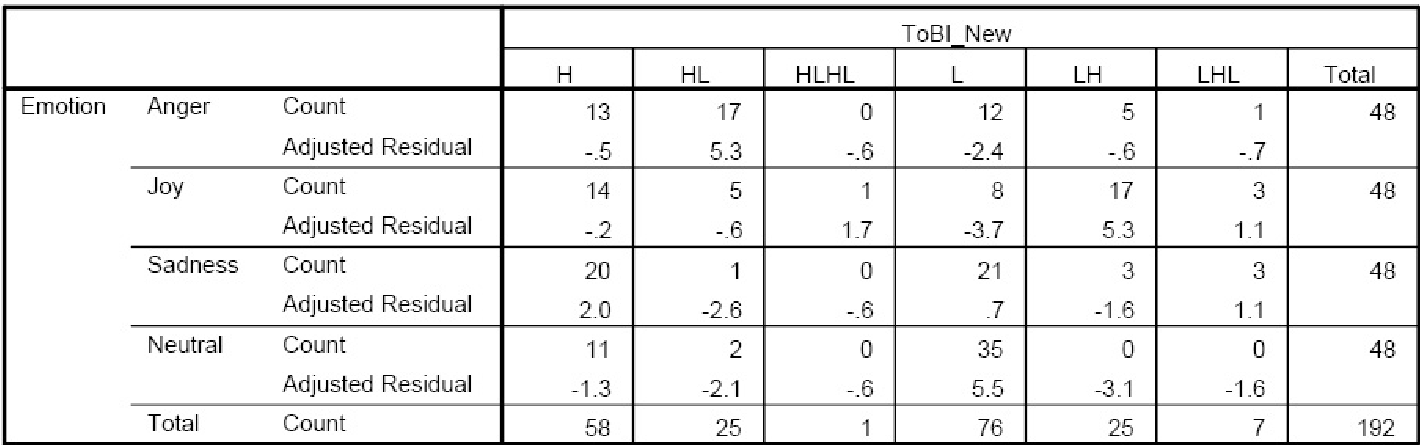
Experimental Battleground: Monotonous vs. Excited
The researchers conducted three stages of user evaluation with 14 subjects. They tested how the modifier performed when the input was "monotonous" (neutral) versus "excited."
Critical Findings:
- Anger (The Success): Consistently recognized at an 80% rate, regardless of whether the input speech was monotonous or excited. It is highly prosody-sensitive.
- Sadness (The Context-Dependent): Recognized reasonably well (58.6%) from monotonous speech, but perception dropped when the excitement level changed.
- Joy (The Failure): In the most surprising result, 0% of subjects perceived Joy from prosody-modified monotonous speech. Even when using original human voice recordings of joy, subjects often confused it with Anger.
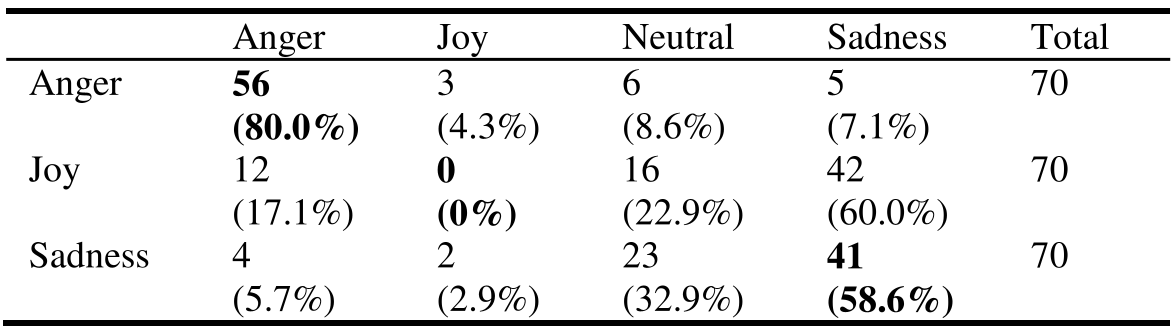
Deep Insight: The Euclidean Distance of Emotion
To quantify these errors, the authors proposed a Euclidean distance model of a tetrahedron. This allows us to see not just if a subject was "wrong," but how far the perceived emotion was from the target in a 4-dimensional category space (Anger, Joy, Neutral, Sadness).

Critical Analysis & Conclusion
This paper provides a sobering reality check for the speech synthesis community.
- Prosody is not a silver bullet: Modifying pitch and duration is sufficient for "high-arousal" negative emotions like Anger, but fails for positive ones like Joy.
- The Joy Mystery: The fact that even human-recorded Joy was poorly identified suggests that Joy might be more dependent on spectral quality (voice timbre, breathiness) or linguistic context than simple prosody.
Future Outlook: For developers of AI voice assistants, this suggests we need to move beyond f0-contour modification. Future SOTA models must investigate voice quality parameters (spectral tilt, glottal flow) to truly "smile" through synthesized speech.