
User Experience First: Scaling Secure Task Assignment in Spatial Crowdsourcing
User experience-driven secure task assignment in spatial crowdsourcing
The paper introduces a User experience-driven Secure Task Assignment (USTA) framework for Spatial Crowdsourcing (SC). It proposes two privacy-preserving online strategies, SKM-EG and SKM-AG, which utilize a secure Kuhn-Munkres algorithm on encrypted bipartite graphs to minimize average waiting time while protecting worker and task locations/speeds.
TL;DR
This research tackles the conflict between user experience and data privacy in spatial crowdsourcing (e.g., Uber, Meituan). By shifting the optimization goal from travel distance to average waiting time and implementing a Secure Kuhn-Munkres (SKM) algorithm on encrypted data, the authors achieve optimal task matching without exposing worker or requester locations and speeds.
Perspective Shift: Waiting Time over Distance
In traditional Spatial Crowdsourcing (SC) research, the platform's primary goal is often to minimize total travel distance or costs. However, from a user-experience standpoint, distance is a deceptive metric. A worker 1km away stuck in traffic is less valuable than a worker 2km away moving at high speed.
The authors argue that Average Waiting Time is the true North Star for user retention. To calculate this, the platform needs:
- Task Locations
- Worker Locations
- Worker Velocities
These are highly sensitive pieces of PII (Personally Identifiable Information). If the platform is compromised or untrustworthy, users and workers are at risk of stalking or data mining.
Methodology: Bridging Optimization and Cryptography
1. The Secure Division Hurdle
Calculating travel time () requires division. In the world of homomorphic encryption (like Paillier), addition and multiplication by constants are "easy," but division is notoriously difficult and computationally expensive.
The authors' "Aha!" moment was transforming the division problem into a Least Common Multiple (LCM) problem. Instead of performing , they scale speeds using the LCM of all available worker speeds, maintaining the relative order of travel times (Inequation Consistency) without requiring actual floating-point division on ciphertexts.
2. Encrypted Graph Construction
The paper proposes two methods:
- SKM-EG (Exact Graph): Uses a Crypto Cloud Provider (CCP) to help compute square roots of distances while keeping the values masked with random noise.
- SKM-AG (Approximate Graph): Avoids square roots entirely by using squared values and scaled speeds, providing a faster, albeit slightly less precise, matching.
 Travel Time Formula (1): The fundamental metric requiring secure computation.
3. Secure Kuhn-Munkres (SKM)
The Kuhn-Munkres algorithm is a standard for finding perfect matchings in weighted bipartite graphs. The authors redesigned it to work within a "Semi-Honest" model where:
- The SC Platform handles the graph logic but never sees the weights.
- The CCP performs comparisons on masked values but never sees the actual distances.
Experimental Validation
The team tested their approach against various "Greedy" strategies (G-MT/G-MD).
Key Findings:
- Effectiveness: SKM-EG and SKM-AG consistently outperformed distance-based and greedy time-based strategies in reducing user waiting time.
- Efficiency: While SKM is more computationally intensive than greedy algorithms, the running time remains practical ( seconds for 100x100 matching), making it suitable for batch-based online assignment.
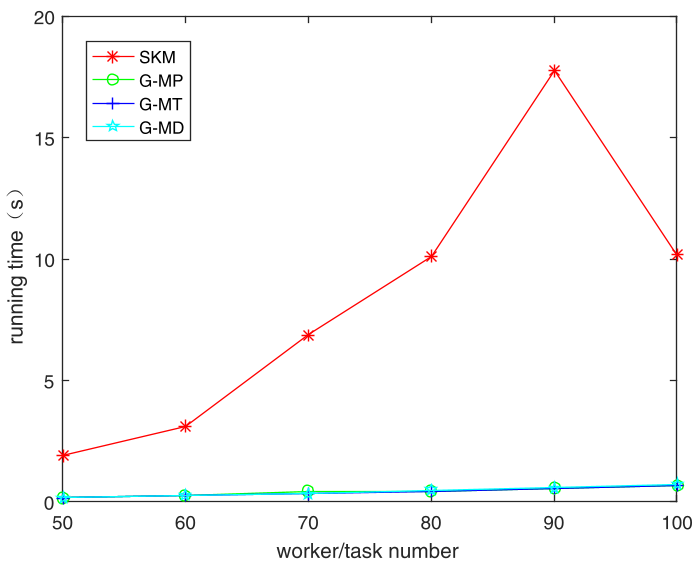 Experimental Results: Comparing average waiting times across different worker/task volumes.
Critical Insight & Conclusion
This paper's value lies in its scalability. By solving the "ciphertext division" bottleneck via the LCM strategy, it opens the door for real-time SC platforms to adopt sophisticated, privacy-preserving optimization algorithms.
Future Outlook: While the semi-honest model is a strong start, future iterations could look into Verifiable Computation to ensure the CCP or SC Platform doesn't deviate from the protocol. Furthermore, integrating State-Space Models or Reinforcement Learning could move the platform from local (periodical) optima to global temporal optima.
Takeaway for Engineers: If your optimization requires division in an encrypted space, look for ways to scale your variables to a common denominator to transform the problem into integer multiplication.