
Bridging the Gap: Why Current Text Mining Tools are Failing the Academic Community
Investigating the User Experience in the Process of Text Mining in Online Social Networks
This paper presents an exploratory qualitative study investigating the User Experience (UX) of researchers performing text mining on Online Social Networks (OSNs). Utilizing the Underlying Discourse Unveiling Method (UDUM), the study identifies critical usability gaps in current tools and proposes a foundational framework for "Oráculo," an integrated text mining tool designed to improve research effectiveness.
TL;DR
Researchers are increasingly turning to Online Social Networks (OSNs) as a data goldmine, but the tools available to mine this data are stuck in the past. This paper identifies a massive "usability gap" where even experienced researchers struggle with fragmented workflows and hostile interfaces. The authors propose a shift toward integrated, intuitive frameworks like Oráculo to democratize data science for non-programmers.
Background: The Hidden Struggle of Data Collection
While AI and Machine Learning have advanced at a breakneck pace, the User Experience (UX) of the tools used to feed these models—the data collection and text mining suites—has largely been ignored. Most academic tools are built by developers for developers, leaving sociologists, journalists, and educators "held hostage" by complex server configurations and script-based workflows.
The Core Friction: Why Researchers are Dissatisfied
The study utilizes the Underlying Discourse Unveiling Method (UDUM) to peak behind the professional curtain. The findings reveal a landscape of frustration:
- Interface Hostility: Tools are often perceived as "loose, undocumented, and confusing" buttons on a screen.
- The Scripting Tax: Researchers often abandon GUI tools entirely, opting to write Python scripts. While more powerful, this creates an elitist barrier where only those with high computational literacy can perform modern research.
- Tool Incompatibility: Use Gephi for networks, Tableau for charts, and custom scripts for cleaning. The "switching cost" between these disparate environments leads to data silos and conversion errors.
Methodology: The "Oráculo" Framework
The authors break down the text mining process into a cyclic journey: Collection → Pre-processing → Indexing → Mining → Visualization → Analysis.
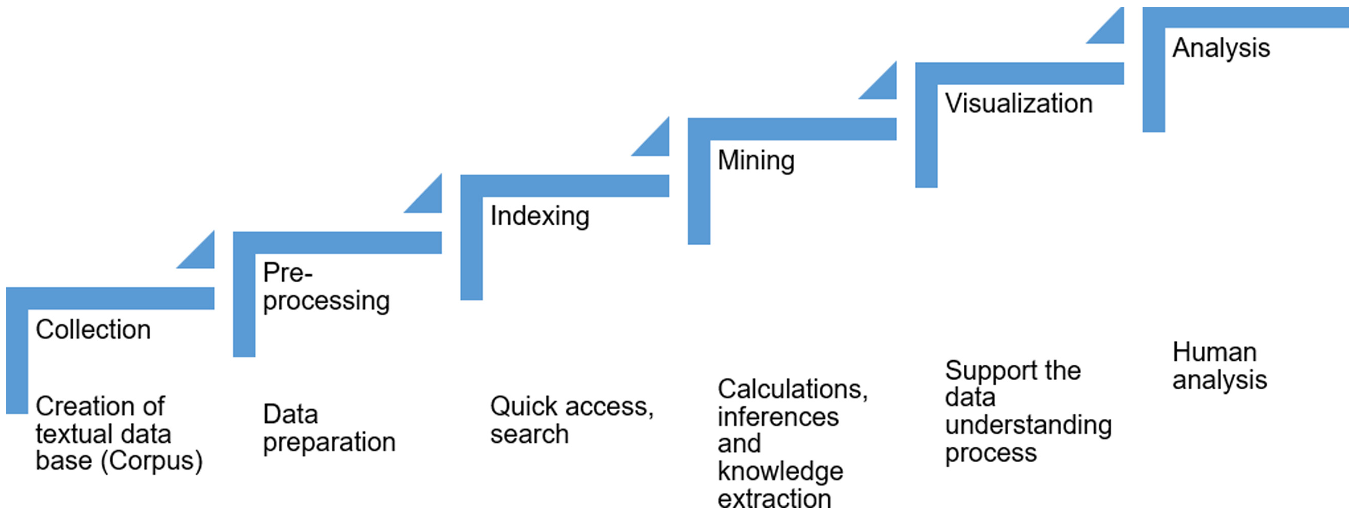
The proposed Oráculo framework aims to unify these stages. The "Secret Sauce" identified isn't just better algorithms, but Integrated Flexibility. Users demanded the ability to:
- Toggle between Real-time and Retroactive collections.
- Perform Pre-processing (like removing accents or "cedillas") during the collection phase.
- Preview data via Word Clouds or stats before the full download completes.
User Personas: Designing for Everyone
A standout contribution of this paper is the definition of two distinct personas that tool designers must satisfy:
- Persona 1 (The Proficient): Caetano, a CS expert who wants scripts' power but in a more "efficient and pleasant" interface to save time.
- Persona 2 (The Lay Researcher): Paula, a Journalism student who is "frustrated" and "dependent on others" because existing tools are too opaque.
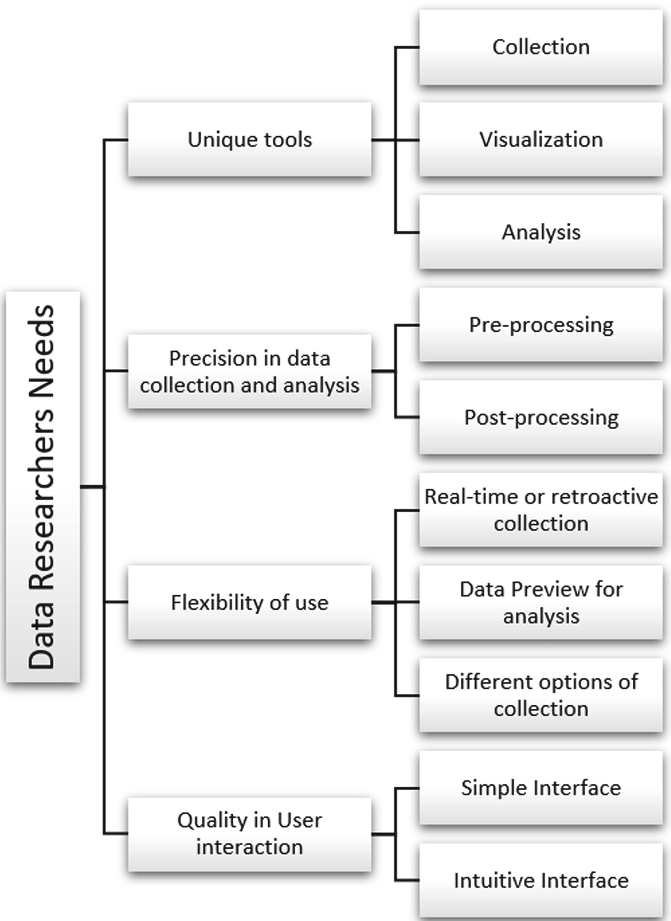
Critical Insight: Efficiency vs. Learning Cost
The authors argue that "Efficiency of Use" is not just about how fast a computer runs an algorithm, but how fast a human can navigate the interface. If a researcher spends 3 hours reading tutorials to perform a 10-minute data pull, the tool is a failure from an HCI perspective.
Conclusion & Future Outlook
This paper serves as a wake-up call for the Text Mining (TM) and Human-Computer Interaction (HCI) communities. The next step for the authors—and the industry at large—is the development of functional prototypes that treat Usability as a First-Class Citizen.
As OSN data becomes more central to public policy and social understanding, the tools to extract that data must become as accessible as a web browser. The "Oráculo" project represents a promising move toward this democratic future of data science.