
CUIL: Mastering Identity Linkage by Capturing the Mesoscopic Heart of Social Networks
User Identity Linkage Across Social Networks via Community Preserving Network Embedding
The paper introduces CUIL (Community-based User Identity Linkage), a novel framework that bridges user accounts across social networks by leveraging both microscopic node proximity and mesoscopic community structures. It utilizes M-NMF for network embedding and a Back-Propagation Neural Network (BPNN) to learn the cross-network mapping, achieving state-of-the-art performance in identity linkage.
TL;DR
Connecting user accounts across different social platforms—like finding the same person on Twitter and Foursquare—is a challenging task known as User Identity Linkage (UIL). While most methods look at immediate friends (local structure), CUIL (Community-based User Identity Linkage) looks at the bigger picture: Communities. By preserving both local friendships and broad community affiliations through specialized network embeddings, CUIL achieves a massive leap in accuracy, particularly when data is sparse or labeled "anchor" accounts are rare.
The Missing Piece: Why Proximity Isn't Enough
Social networks are not just collections of individual links; they are hierarchical. In the world of Graph Theory, current SOTA methods primarily focus on Microscopic Proximity (is User A friends with User B?). However, they neglect the Mesoscopic Structure—the communities based on shared interests, hobbies, or professions.
The intuition is simple: If two people are in the same "tech-enthusiast" community on Twitter, they are highly likely to belong to a similar cluster on Foursquare. Ignoring this community context makes models vulnerable to noisy or missing edges.
Methodology: The CUIL Architecture
The authors propose a three-stage pipeline to bridge the gap between platforms:
1. Cross Network Extension
To combat data sparsity, CUIL utilizes known "anchor links" (users already identified on both platforms) to infer missing connections. If User A and User B are linked on Platform 1, and their counterparts are not yet linked on Platform 2 but share a common neighbor, CUIL strengthens these bonds.
2. Community Preserving Embedding
This is the core innovation. Instead of simple Random Walks, CUIL uses M-NMF (Community Preserving Network Embedding). It optimizes a joint objective function:
- Proximity Modeling: Captures 1st and 2nd-order similarities.
- Community Modeling: Maximizes modularity to ensure nodes in the same community have similar vector representations.
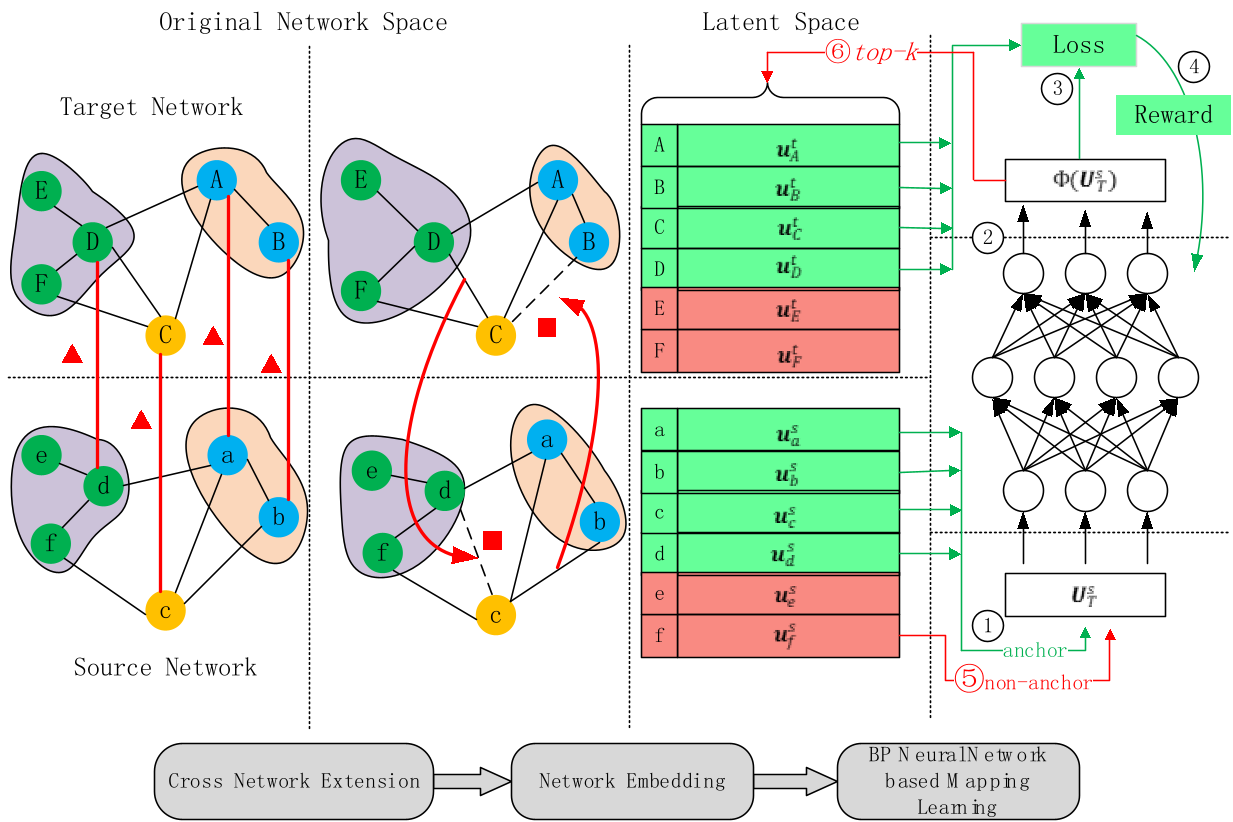
3. Non-linear Mapping Learning
Once embeddings are generated for both networks, a 4-layer Back-Propagation Neural Network (BPNN) learns a mapping function . This translates vector spaces from the source to the target, allowing the model to "project" a Twitter user into the Foursquare space to find their match.
Experimental Breakthroughs
The team tested CUIL on a real-world dataset of Twitter and Foursquare users (approx. 1,600 anchor users).
- The Accuracy Gap: CUIL reached a Precision@1 of 46.6%, compared to 35.2% for DeepLink and 22.0% for IONE.
- Efficiency with Sparse Data: Even when only 10% of anchor nodes were used for training, CUIL's Precision@30 remained significantly higher than its competitors, proving that community structures provide a strong "global" signal that requires less supervision.
- Convergence: CUIL reaches its peak performance in roughly 300,000 iterations, whereas previous methods like IONE required up to 6 million to stabilize.

Critical Insight & Conclusion
CUIL's success demonstrates that User Identity Linkage is not just a matching problem, but a structural alignment problem. By successfully embedding community modularity into the loss function, the authors have provided a blueprint for more robust social graph analysis.
Limitations: While powerful, the method currently relies on undirected and unweighted graphs. Real-world social networks are often directed (following vs. mutual friends), and incorporating edge weights (interaction frequency) could be the next frontier for this architecture.
Takeaway: If you want to identify users across platforms, don't just look at who they know—look at where they belong.