
RFTRS: Why Your Cloud Usage Defines Your Social Influence
An evaluation of user importance when integrating social networks and mobile cloud computing
The paper introduces RFTRS, a novel multi-dimensional scheme for evaluating user importance in the integrated domain of Social Networks (SNs) and Mobile Cloud Computing (MCC). By combining structural SN metrics with behavioral MCC data, it achieves a more holistic assessment of "influential users" compared to traditional centrality measures.
TL;DR
As Social Networks (SNs) and Mobile Cloud Computing (MCC) converge, the definition of an "important user" is changing. This paper proposes RFTRS, a comprehensive framework that evaluates users not just by who they know (topology), but by how they use resources (requests and storage). The result is a more accurate map of influence for social marketing and system security.
The Blind Spot in Traditional Network Analysis
For decades, we have relied on algorithms like PageRank or Betweenness Centrality to find the "VIPs" of a network. These methods are mathematically elegant but context-blind. In a world where social interactions happen through cloud platforms, a user who is "central" in a graph but never uploads data or makes requests is a "ghost" in the system.
The authors argue that the integration of SN and MCC creates a dual-identity for users: they are both social entities and resource consumers. Ignoring the latter leads to suboptimal resource allocation and missed opportunities in social influence modeling.
Methodology: The Five Pillars of RFTRS
The RFTRS scheme (Reputation, Fractal, Topological, Request, and Storage) creates a composite score for each user.
1. The Social Layer (The "Who")
- Reputation Importance: Derived from the probability of a node being chosen based on interaction weights.
- Fractal/Topological Importance: Uses "Fractal Views" to select a focus node and calculate global vs. local importance by reducing irrelevant context.
2. The Cloud Layer (The "How")
- Request Importance: Quantifies how often a user interacts with cloud services (Inference: high requests = high trust/activity).
- Storage Importance: Measures the volume of data a user commits to the cloud (Inference: high storage = high dependency/influence over shared data).
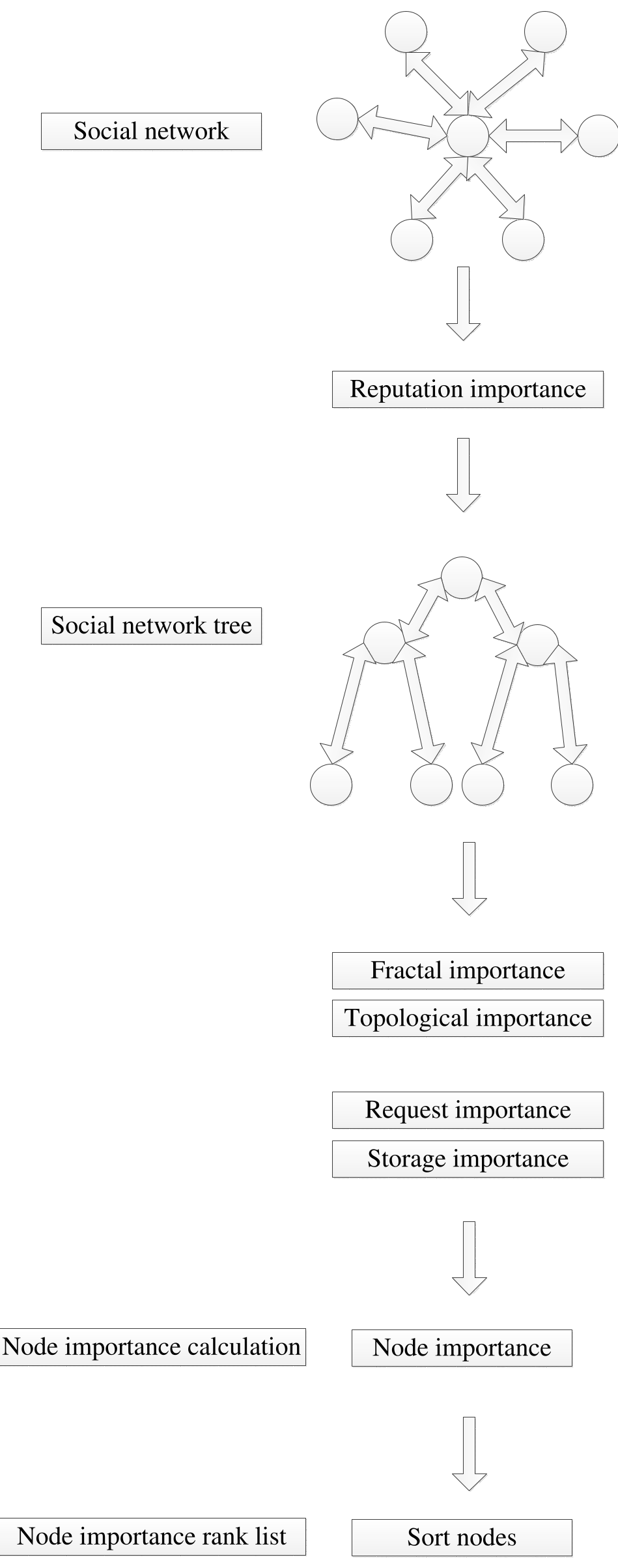 The image above illustrates the RFTRS workflow, transitioning from social graph analysis to cloud metric integration.
Experimental Insights: A Case Study on Jupiter Cloud
The authors tested RFTRS against 20 real users on the Jupiter Cloud. By tracking actual interactions and resource consumption (requests and MBs stored), they compared RFTRS against "The Big Five" (DR, CR, BR, PR, and TFRank).
Key Findings:
- Rank Displacement: Users who appeared moderately important in social topology (e.g., User 11) shifted significantly when their high cloud storage and request rates were factored in.
- Holistic Evaluation: RFTRS showed the highest similarity to Degree Ranking (DR) but diverged enough to prove that cloud metrics add a non-redundant layer of information.
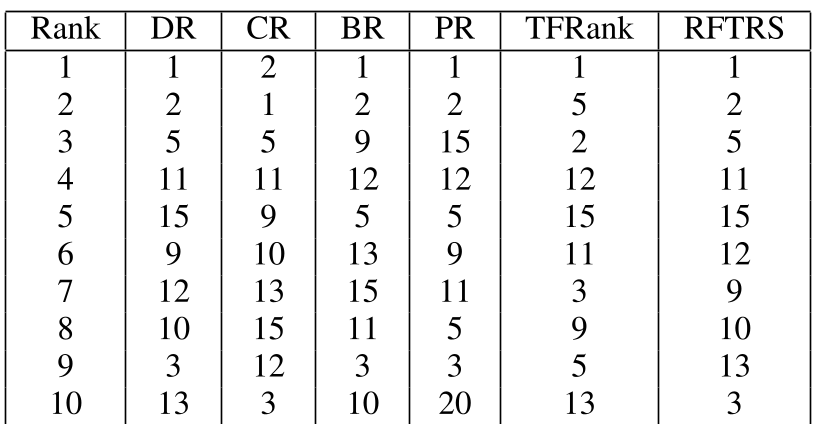 Ranking comparison showing how RFTRS yields distinct results from traditional SN algorithms.
Future Outlook and Limitations
The RFTRS scheme is a vital first step in cross-domain user modeling. However, the current model assigns equal "weight" to social and cloud factors by simply multiplying them. Future research could explore weighted RFTRS, where the importance of "storage" vs. "topology" is adjusted based on the specific application (e.g., social gaming vs. enterprise colloration).
Final Takeaway: In the integrated SN-MCC era, influence is a currency backed by both social connections and digital assets. RFTRS provides the first "exchange rate" for this new economy.