
SRFRM: Solving User Interest Imbalance in Social Recommendation via Fitness Adaptation
User Interests Imbalance Exploration in Social Recommendation: A Fitness Adaptation
The paper introduces the Social Regulatory Factor Regression Model (SRFRM), a social recommendation framework that addresses the "Interest Imbalance" between rating contexts and social networks. By leveraging linear transformation matrices within a matrix co-factorization structure, SRFRM allows different latent factor dimensions for users, items, and social trusts, achieving a new SOTA on Epinions and Douban datasets.
TL;DR
Social recommendation often assumes that why you "like" a product is the same reason you "trust" a friend. This paper, "User Interests Imbalance Exploration in Social Recommendation: A Fitness Adaptation," proves this assumption wrong. By introducing a "Regulatory Factor" mechanism, the authors allow different granularities for rating and social spaces, delivering a massive 20%+ improvement in accuracy over traditional Matrix Factorization (MF) methods.
Background: The "Same Space" Trap
In the early 2010s, social recommendation was dominated by Co-Factorization. The logic was simple: if User A follows User B, they must share similar tastes. Models like SoRec and SoReg forced these users into a shared latent feature space of dimension .
However, the authors identified a critical "Interest Imbalance":
- Rating Context: High intensity, product-specific, focused on utility.
- Social Context: High sparsity, focused on reputation or personal relationship.
Forcing these into the same -dimensional vector causes overfitting on the sparser side and underfitting on the denser side.
Methodology: The Social Regulatory Factor Regression Model (SRFRM)
The core innovation is Fitness Adaptation. Instead of forcing to equal a rating, the authors insert "bridge" matrices.
1. Architecture Overview
As shown in the architecture diagram below, the model maintains a central User Latent Matrix , but uses transformation matrices and to regulate how that user's interests map to items versus friends.
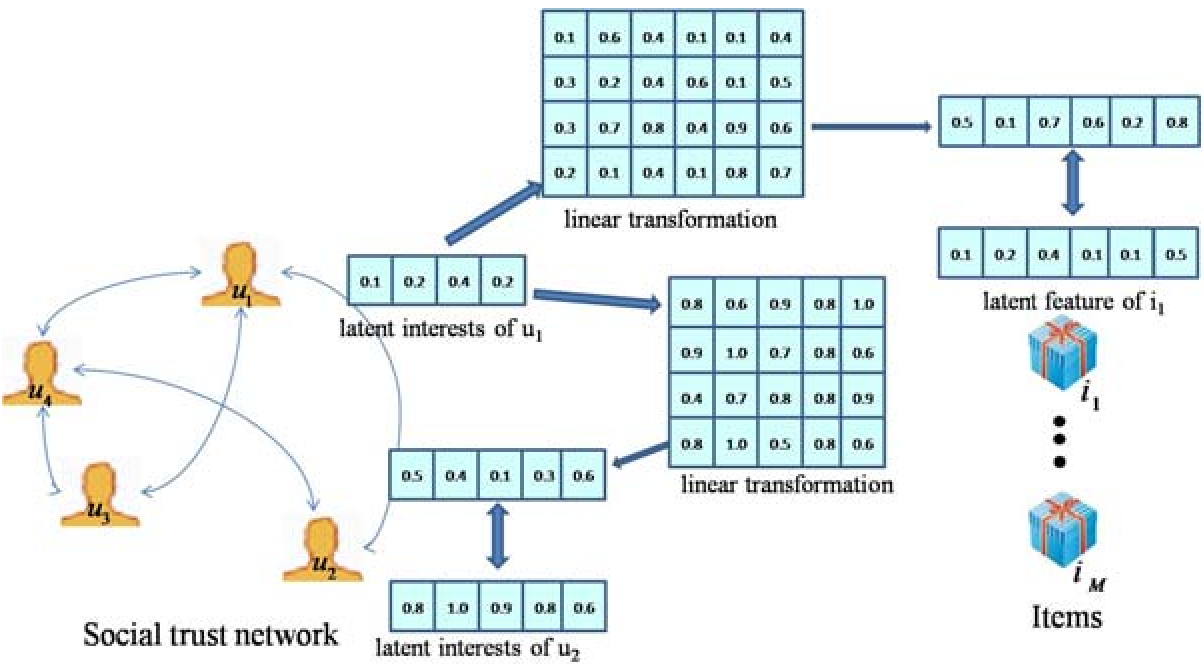 Figure 1: The SRFRM architecture where latent interests are linearly transformed to fit items and trustees separately.
2. The Mathematical Intuition
The prediction for a rating becomes: And the social trust prediction becomes:
By decoupling these via and , the system can handle different dimensionalities ( for users, for items, and for friends). This is "Fitness Adaptation"—making the latent factors "fit" the specific context.
Experimental Validation
The authors tested SRFRM on Epinions (high trust data) and Douban (high rating data).
SOTA Comparison
The results were conclusive: SRFRM consistently outperformed PMF, SoRec, and SoReg.
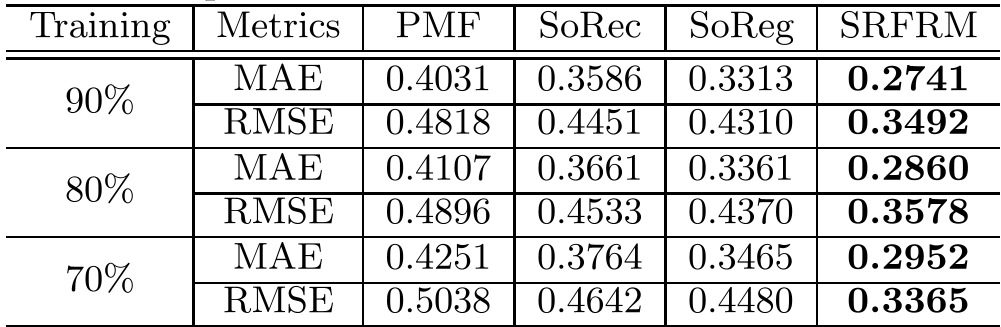 Table: RSME/MAE comparison on the Epinions dataset showing SRFRM's dominance.
Dimensionality Insights
One of the most profound findings (visualized in the paper's surface plots) is that user interests are more related to item profiles () than social trust relations (). Users have more fine-grained and extensive interests when consuming products (movies, books) than when forming social trust links.
Critical Analysis & Conclusion
Takeaway
The genius of this paper lies in its rejection of the "one-size-fits-all" latent space. By recognizing that social networks and recommender systems are different "interest spaces," it provided a mathematically sound way to bridge them without losing specificity.
Limitations
- Linearity: The model uses linear transformations (). In 2024, we would likely replace these with non-linear Neural Networks or Attention Mechanisms.
- Manual Tuning: The dimensions require grid searching, which is computationally expensive.
Future Outlook
This work paved the way for modern Multi-Task Learning (MTL) in RecSys, where different heads of a network handle different interaction types while sharing a backbone representation. If you are building a system that combines "follows," "likes," and "purchases," the lesson is clear: don't force them into the same box—transform them to fit.