
Beyond Keywords: Decoding Homophily through the Forest Model
Analysis of user keyword similarity in online social networks
The paper introduces a "Forest Model" based on semantic analysis to measure user similarity in Online Social Networks (OSNs). By leveraging WordNet ontologies to link user-entered keywords, it provides a quantitative framework to evaluate homophily beyond simple string matching, reaching SOTA-level insights into network topology and social connectivity.
TL;DR
This study moves beyond simple word-matching to understand social connectivity. By treating user interests as nodes in a semantic "Forest," the authors quantify how similar friends actually are. The big reveal? While your friends share your passions, your "friend-of-a-friend" is likely no more similar to you than a total stranger.
Executive Summary
In the world of Online Social Networks (OSNs), the adage "birds of a feather flock together" (homophily) is often cited but rarely measured with semantic precision. This paper addresses the gap by introducing a Forest Model—a hierarchical framework that uses WordNet ontologies to map the distance between user interests. The work situates itself as a bridge between the "Small World" experiments of Milgram and modern graph theory, providing a method to calculate Inter-Profile Similarity (IPS) that transcends literal text overlaps.
The "Soccer vs. Football" Problem: Why Simple Matching Fails
The authors identify a major bottleneck in OSN analysis: users use different words for the same things. A user interested in "soccer" and one in "football" would show zero similarity in a binary matching system. Furthermore, their data shows that 87% of keywords appear less than 5 times in the dataset, following a power-law distribution. This sparsity makes traditional statistical correlation nearly impossible without a semantic anchor.
Methodology: The Forest and the Trees
The core contribution is the Forest Model. Instead of a flat list, keywords are organized into hierarchical trees ().
1. Forest Generation
The authors utilize four heuristics to grow these trees using WordNet:
- Base: Exact matches only.
- HM: Includes Holonyms (whole-part) and Meronyms (part-whole).
- SS: Includes Similars and Synonyms.
- All: A comprehensive reach including Hypernyms, Hyponyms, and Derived terms.
2. Quantifying Similarity
To turn these trees into metrics, they define two types of similarity:
- Weak Similarity (): The fraction of keyword pairs that share any tree in the forest.
- Strong Similarity (): A more nuanced metric where the weight of a match decays exponentially based on the distance to the Least Common Ancestor (LCA) in the tree.
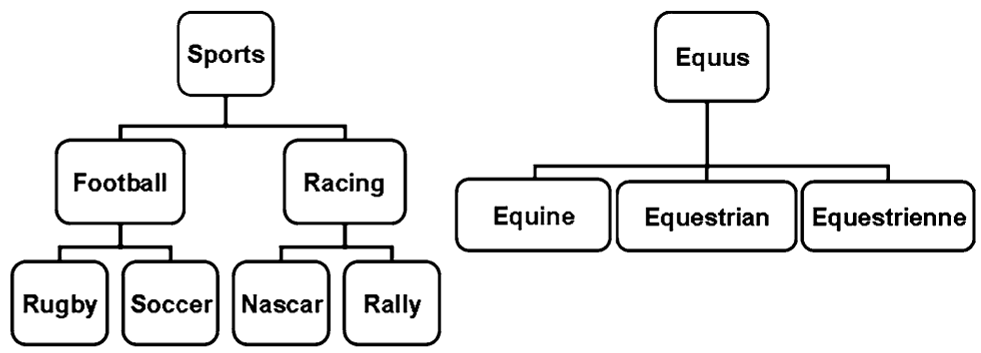 Figure: The conceptual Forest Model showing how disparate terms like 'soccer' and 'racing' are anchored by 'sports'.
Experimental Insights: The "Similarity Plateau"
The authors tested their model on 1,265 Facebook profiles. The results provide a fascinating look at the limits of social influence:
- Direct Friends are Unique: There is a clear "spike" in similarity for direct friends ( hop).
- The 2-Hop Plateau: Strikingly, the similarity between users separated by 2 hops (friend-of-a-friend) is virtually identical to that of users 3, 4, or 5 hops away.
- The Popularity Penalty: As a user's Node Degree (number of friends) increases, their average similarity to their friends decreases. This suggests that "social butterflies" bridge different interest groups rather than deepening a single niche.
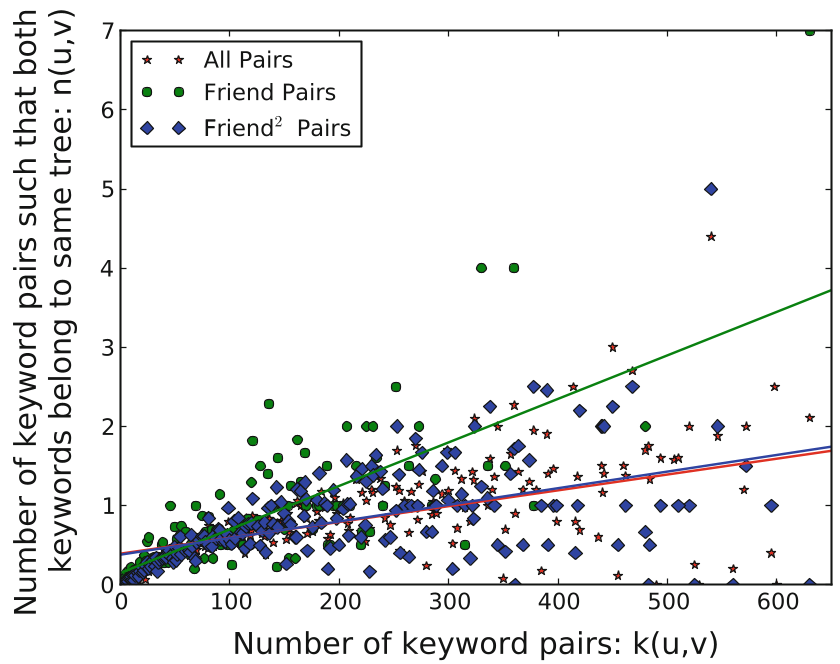 Figure: Comparison across heuristics shows that as we move from 'Base' to 'All', we capture a much higher percentage of latent human connection.
Critical Analysis & Future Outlook
The Forest Model was a pioneer in bringing semantic depth to social graphs. Its primary strength lies in its Inductive Bias—the assumption that human interests are hierarchical.
Limitations:
- Context Sensitivity: WordNet sometimes struggles with polysemy (e.g., 'stern' as a ship's rear vs. 'stern' as an adjective).
- Temporal Dynamics: Interests change over time, which a static forest model doesn't capture.
The Road Ahead: The authors suggest that this similarity metric could revolutionize Link Prediction. Instead of predicting friends based on who has the most mutual contacts, we can predict friends based on "Semantic Proximity." In an era of AI, one could easily see this evolving into embedding-based social search, where the "Forest" is replaced by a high-dimensional Latent Space.
Conclusion
This paper proves that while we are indeed "linked" to the whole world, we are "similar" only to our immediate circle. The topological distance in a social network acts as a filter: the first hop is a semantic leap, but everything beyond that is a vast, relatively uniform sea of diversity.