
Decoding the Tweet: Why Domain Expertise Matters in Altmetrics
User Motivation Classification and Comparison of Tweets Mentioning Research Articles in the Fields of Medicine, Chemistry and Environmental Science
This paper presents a machine learning-based approach to classify user motivations for tweeting research articles, focusing on the fields of Medicine, Chemistry, and Environmental Science. Using a Support Vector Machine (SVM) classifier, the study achieves 85.2% accuracy in categorizing tweets into six distinct motivation classes, revealing significant cross-disciplinary differences in how research is propagated on social media.
TL;DR
Is a tweet about a medical breakthrough the same as a tweet about a new chemical catalyst? According to this study, absolutely not. By building an SVM-based classifier with 85.2% accuracy, the researchers demonstrate that while most scholarly tweets are simple "shares," specific fields like Chemistry are heavily driven by self-promotion (19%), whereas Medicine sees much higher public interaction.
Background: Beyond the Raw Count
For years, the "Altmetric Attention Score" has been a badge of honor for researchers. However, a high score doesn't always mean your paper is changing the world—it might just mean you have a very active Twitter bot or a dedicated PR department. The core problem is that raw counts lack context. This paper seeks to peel back the layers by identifying the motivation behind the tweet.
Methodology: Engineering Intuition
The researchers didn't just look at word frequency. They recognized that the "identity" of the tweeter and the "resemblance" of the tweet to the paper's metadata are key indicators of intent.
The Feature Matrix
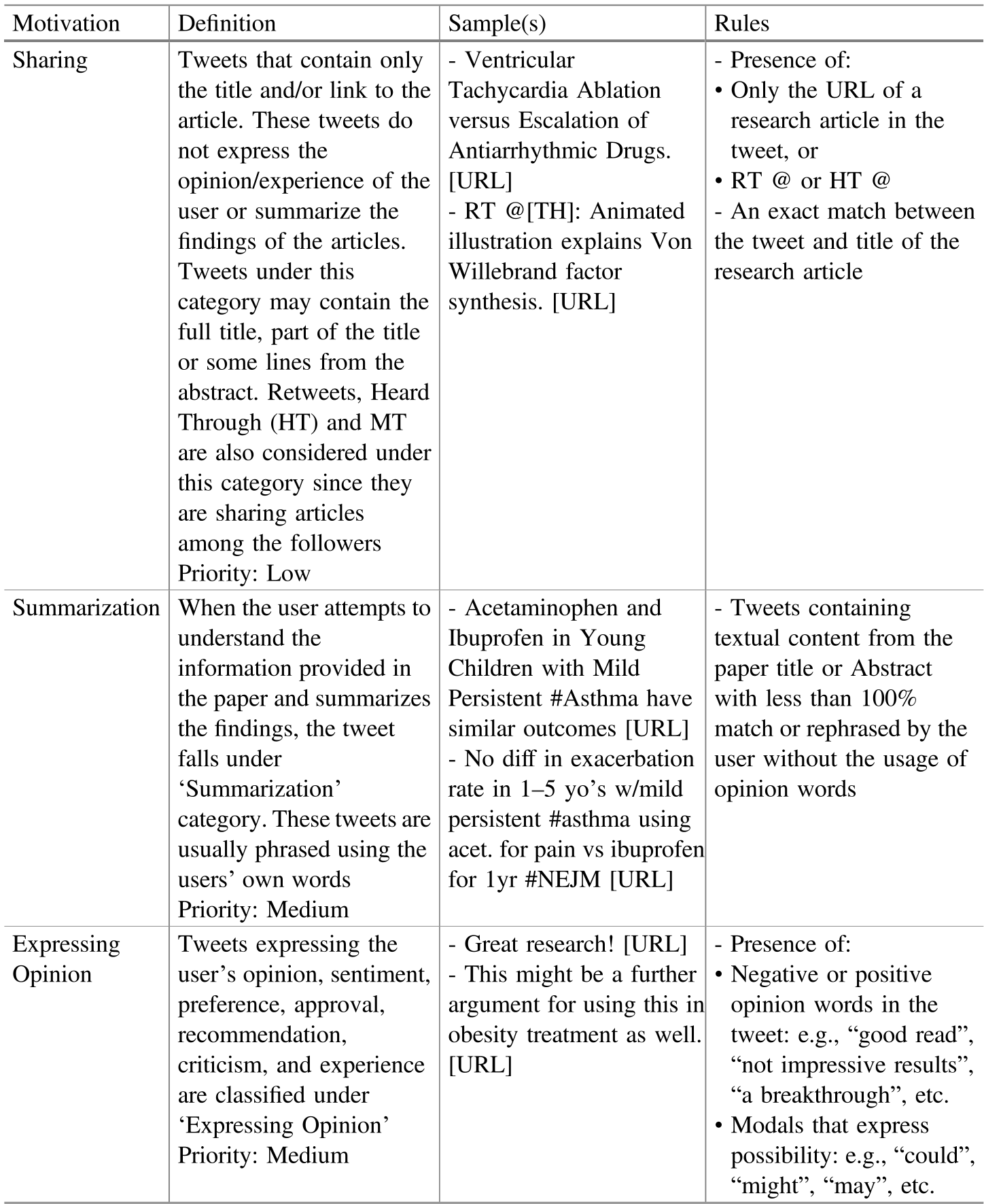
To distinguish between someone summarizing a paper and someone just posting the title, they used:
- Fuzzy Matching: Comparing the tweet text against the paper's title and abstract.
- Identity Verification: Checking if the Twitter handle belongs to the journal's publisher or the paper's authors (detecting Promotion).
- Linguistic Cues: Identifying specific phrases like "full text" or "open access" (detective Access) and question marks (detecting Interaction).
Experiments & Results: The Domain Divide
After training the model on the Medicine domain—chosen for its high volume of public interest—the authors applied it to Chemistry and Environmental Science.
Key Findings:
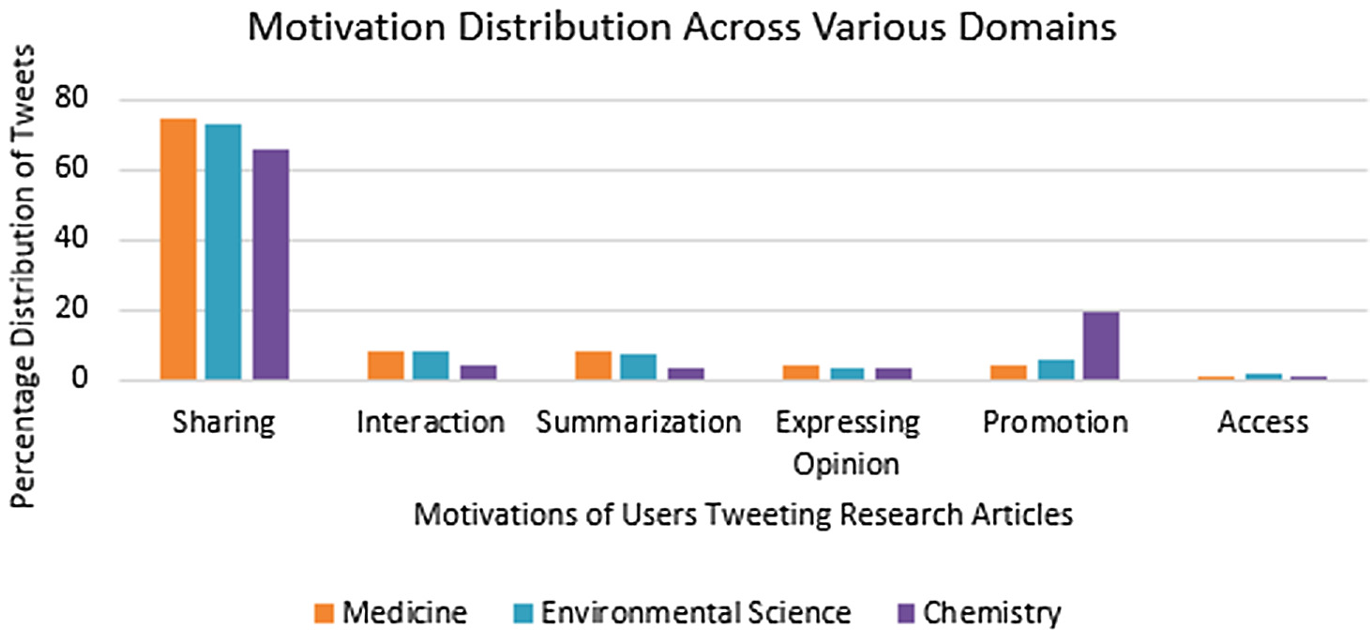
- Medicine (The Public Square): Dominated by "Sharing" (74.3%), but with significant "Interaction" and "Opinion." This reflects the high stakes of health research for the general public.
- Chemistry (The Expert Island): A staggering 19% of tweets were Promotion. Because Chemistry research is often highly specialized, it requires expert knowledge to digest, leading to lower "Summarization" and "Interaction" from the general public.
- Environmental Science: Mirroring Medicine, this field showed a strong trend of public engagement, likely due to the immediate relevance of climate and ecological issues to non-specialists.
Performance Metrics
The SVM classifier outperformed Naive Bayes and Logistic Regression, particularly in identifying Promotion (Precision: 0.98) and Sharing (Recall: 0.93). The main challenge remains distinguishing between Summarization and Opinion, where linguistic overlaps often confuse both human coders and machines.
Critical Analysis & Conclusion
This paper provides a vital correction to the "more is better" philosophy of social media metrics. The Chi-square test performed by the authors confirmed a statistical dependence between the domain and the motivation, proving that Altmetrics are context-dependent.
Takeaway for Researchers:
- Medicine/Environment: Your Altmetric score likely reflects public curiosity or concern.
- Chemistry/Math: Your score might simply reflect your professional network's visibility.
Limitations: The study relies on 2016 data, which predates the massive shifts in Twitter (X)'s API policies and the rise of Large Language Models (LLMs) that could now automate these summaries even more convincingly. Future work should look at the role of AI-generated tweets in distorting impact metrics.