
User-Oriented Views: Bridging the Gap Between Complex Medical Data and Clinical Reality
4304_User-oriented views in health care information systems.
The paper presents a methodology for designing an object-oriented clinical information system called GCH-OODM (Granular Clinical History—Object Oriented Data Model). It features an advanced view mechanism to provide tailored data perspectives for diverse healthcare roles (doctors, nurses, GPs) and supports the management of multimedia and temporal clinical data.
TL;DR
Managing medical records is a balancing act between structural integrity and user flexibility. This paper introduces a sophisticated Object-Oriented Database (OODB) methodology that uses dynamic view schemas to serve different medical roles (e.g., surgeons vs. nurses) while handling the "messy" temporal and multimedia aspects of clinical data. It moves away from static database rows toward a living, perspective-driven representation of the patient.
The Problem: The "One-Size-Fits-All" Medical Record Failure
In a hospital, a ward nurse needs to see medication schedules and daily vital signs. Conversely, a cardiologist in a catheterization lab (cath-lab) needs high-resolution angiographic videos and the patient’s procedural history.
Existing systems often force all users into the same interface or data structure. This leads to information overload for some and data gaps for others. Furthermore, clinical data is inherently temporal—events happen at specific points or over intervals, and our knowledge of when they happened is often "fuzzy" or recorded at different granularities (e.g., "April 1995" vs "March 12, 1995, at 21:30").
Methodology: Perspectives as First-Class Citizens
The authors don't just build a database; they build a view-derivation hierarchy.
1. Business Process Modeling (SOM)
Before coding, the authors used the Semantic Object Model (SOM) to map out how a patient moves through a PTCA (angioplasty) treatment. This allowed them to identify exactly what information each "Client" and "Server" (staff and departments) requires at each specific task-event trigger.
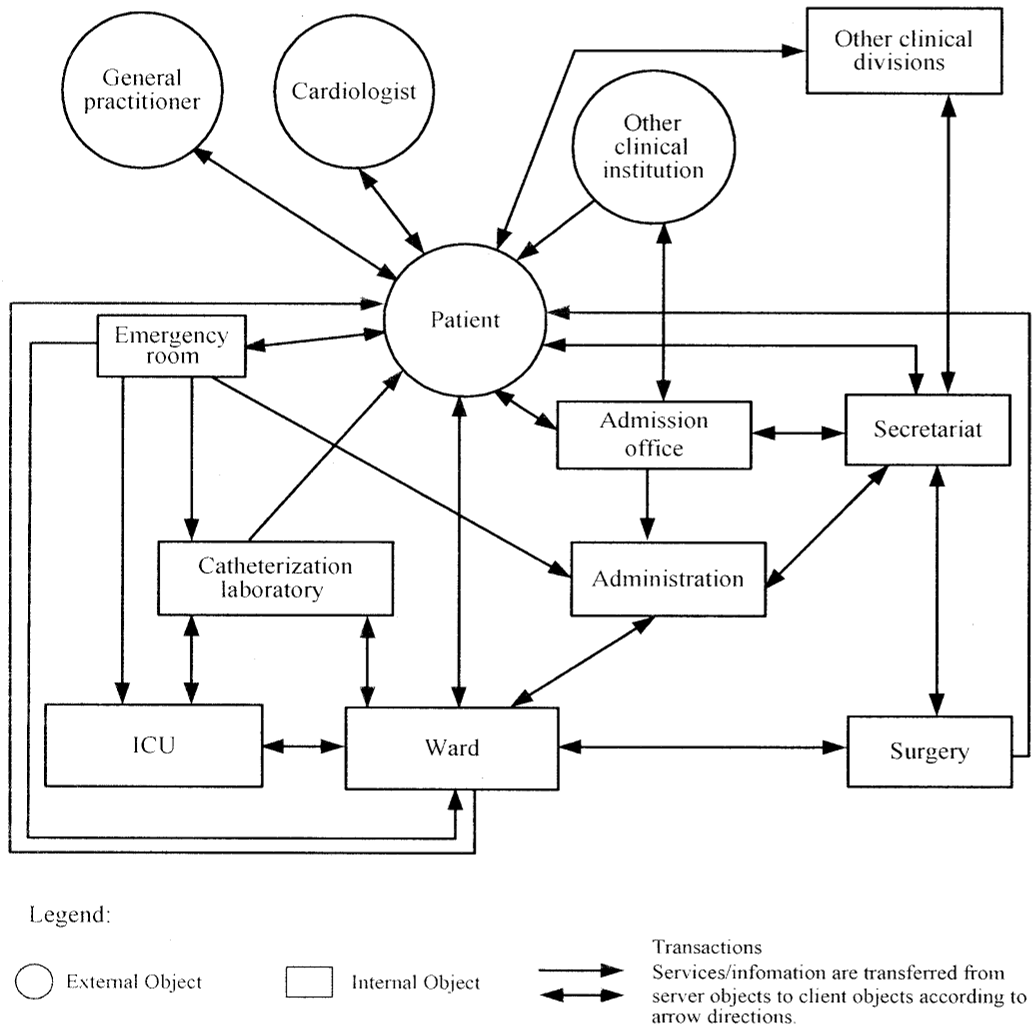 Fig 1: The interaction schema identifying the flow of data between patients, laboratories, and clinical divisions.
2. The Three Pillars of Views
To solve the flexibility issue, the system introduces three types of views:
- Virtual Views: On-demand filters that hide or transform attributes (e.g., a "Secretary View" that hides medical data but shows demographics).
- Materialized Views: Stored views that can be "capacity-augmenting." This is crucial: it allows researchers to add new data fields (like a specific study parameter) to a view without altering the underlying core database schema.
- Aggregation Views: These pull data from multiple sources (Therapy, Diagnosis, Exams) into a single "Clinical History" summary.
3. Handling Time and Multimedia
The model, GCH-OODM, treats time as a complex object. It supports:
- Valid Time: The duration the clinical fact is actually true.
- Granularity: The ability to compare a vague date (year only) with a precise timestamp using a specialized three-valued logic.
Experiments & Results: The PTCA Prototype
The system was tested using data from PTCA patients. By implementing role-oriented schemas, the system provided:
- Cath-lab Physician Schema: Focused on coronary artery stenoses and angiographic images.
- General Practitioner (GP) Schema: Facilitated remote browser-based access for outside doctors to monitor their referred patients.
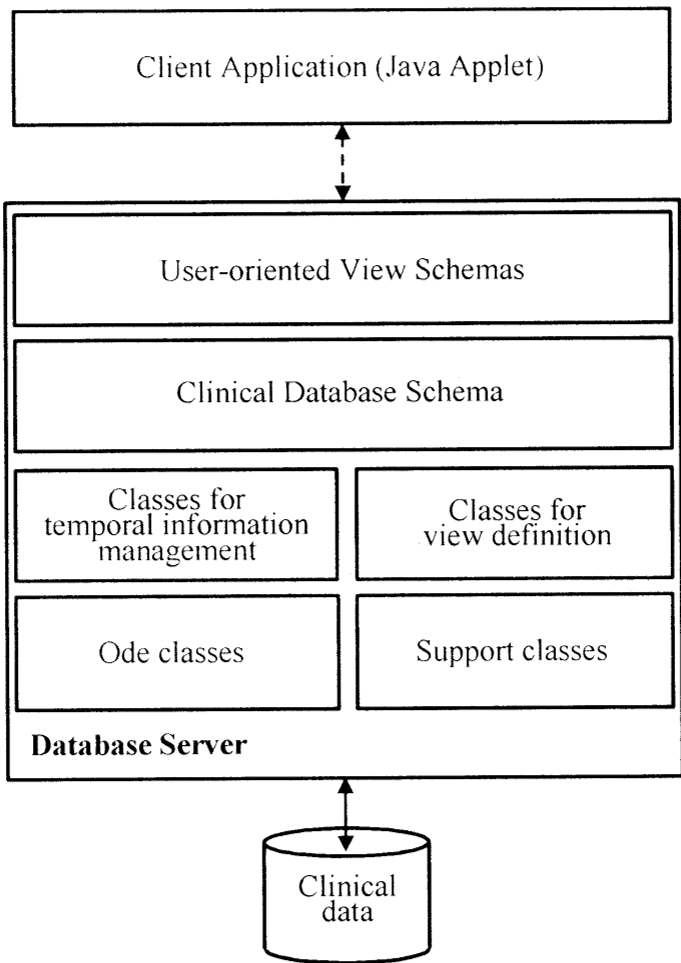 Fig 2: The modular architecture showing the separation between the OODBMS core (Ode), temporal/view libraries, and the user-facing Java applets.
The results proved that the View-Derivation hierarchy could successfully enforce security (Discretionary Access Control) while ensuring that updates in one view (like a pulse rate change) were instantly reflected across all other authorized views.
Critical Analysis & Conclusion
Takeaways
This research provides a rigorous academic framework for what we now call Data Personalization. By mathematically defining how views relate to base classes, the authors achieve logical data independence: the database can evolve, and new study requirements can be met without breaking existing clinical workflows.
Limitations
While the prototype is robust in logic, the paper acknowledges that:
- Performance overhead: Managing consistency between multiple materialized views and base classes in real-time can be computationally intensive as the database scales.
- Security: While role-based access is modeled, deeper encryption and SHTTP/SSL protocols were secondary to the structural design at this phase.
Future Outlook
As we move into the era of AI-driven healthcare, the concept of a "User-Oriented View" becomes even more relevant. Future systems may use these view schemas to feed specific data subsets to machine learning models for predictive diagnostics, ensuring that models only "see" relevant, high-quality clinical subsets.