
Beyond Keywords: Personalizing Anti-Spam via User Preference Ontologies
Constructing a User Preference Ontology for Anti-spam Mail Systems
This paper introduces a user preference-based anti-spam system that utilizes an ontology to model individual user behaviors and preferences. By moving beyond traditional content-only filtering, the authors employ association and classification mining (ID3) combined with a novel rule optimization method (LSRP) to accurately predict four types of user email responses: Reply, Delete, Store, and Spam.
TL;DR
The battle against spam has long been a game of "cat and mouse" focused on content analysis. This paper shifts the paradigm by introducing a User Preference Ontology. Instead of asking "Is this mail spam?", the system asks "How would this specific user respond to this mail?" By using data mining and logic optimization, the authors build a system that achieves high accuracy while ensuring the filtering logic is human-comprehensible.
Problem & Motivation: The Subjectivity of Spam
Current SOTA filters like SVMs and Naive Bayesian Classifiers are statistically impressive but lack a crucial element: Individual Context. A marketing email from a credit card company might be "Ham" (legitimate) to a customer service representative but "Spam" to a student.
The authors identify two major gaps in prior work:
- Lack of Formal Representation: Most systems don't formally "know" why they filter something beyond statistical weights.
- Over-complexity: Collaborative filters (P2P) are not standalone and raise privacy concerns.
The insight here is that user behavior—categorized as Reply, Delete, Store, or Spam—is a function of the user's demographic and declared interests (e.g., Age, Gender, Interests in Jobs/Finance).
Methodology: The Core Architecture
The proposed system operates through a three-stage pipeline: Data Mining -> Rule Optimization -> Ontological Inference.
1. Data Mining & Feature Selection
Using the ID3 algorithm, the authors extracted rules from a dataset of 3,600 user responses. They used Information Gain to select the most relevant features: ECat (Email Category), Age, RHit (Required Hits/Filter Strength), Adults, Games, and Jobs.
2. Logic Synthesis based Rule Pruning (LSRP)
This is the technical highlight. Inspired by Karnaugh Maps used in digital logic design, the authors developed LSRP to merge rules. If two rules differ by only one attribute value but result in the same response, they are merged, and the redundant attribute is removed.
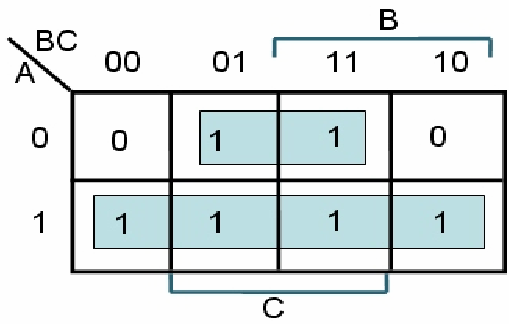 Figure: The K-map logic used to simplify boolean expressions, which inspired the LSRP method.
3. Ontology Construction
The optimized rules are translated into Web-PDDL axioms. This formalization allows the system to use OntoEngine, a first-order logic reasoner, to perform forward-chaining and determine the user's likely action on a new email.
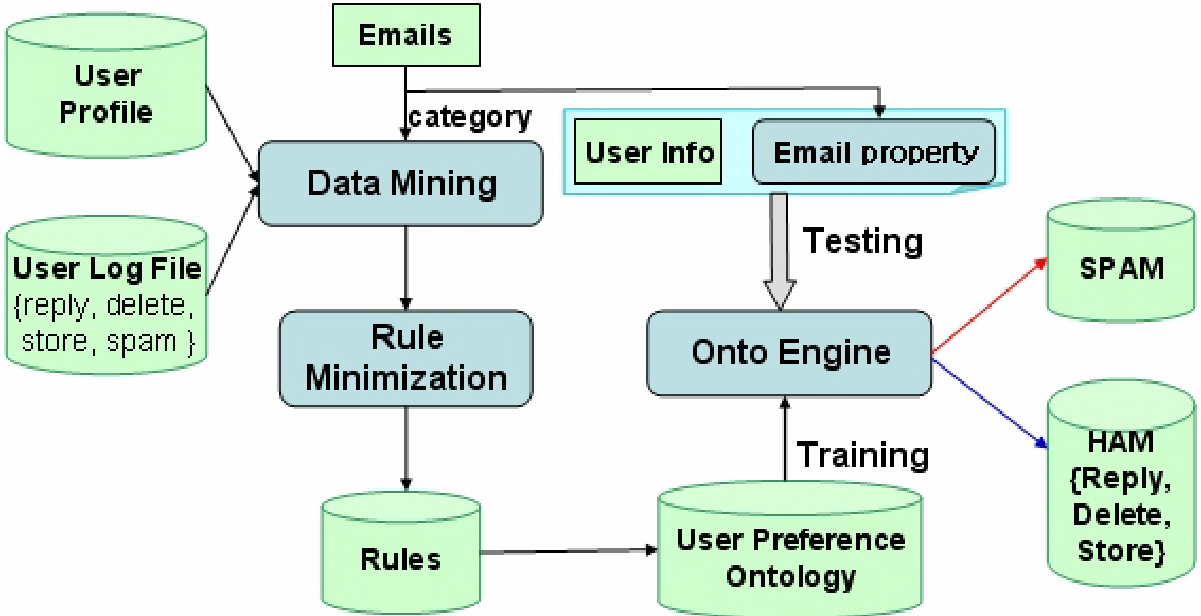 Figure: The overall architecture showing the flow from user profiles to ontological reasoning.
Experiments & Results
The authors evaluated the system using three metrics: Axiom Accuracy, Capacity, and Matched Term Ratio (mt).
- Comprehensibility: LSRP improved the Matched Term Ratio by 15.2%. This means the rules are shorter and easier for a human to audit.
- Efficiency: The number of axiom rules was reduced from 89 to 77.
- Predictive Power: For specific categories like "Adult" content, the axiom accuracy reached 85%.
Interestingly, the results showed that even for "Adult" emails—widely considered universal spam—a small percentage of users (15%) did not categorize them as such. This validates the need for personalized, preference-based filtering.
Critical Analysis & Conclusion
Takeaway
The paper successfully demonstrates that Ontologies provide a bridge between raw data mining and explainable AI. By formalizing "preference," we move from black-box filtering to a transparent system where a user can say, "Oh, I see why this was blocked; it's because I set my interest in 'Jobs' to False."
Limitations
- Dataset Scale: The study was limited to 90 college students. A more diverse demographic might result in more complex (and less easily pruned) rule sets.
- Dynamic Updating: The paper doesn't deeply explore how the ontology evolves in real-time as a user's interests change over years, not just weeks.
Future Work
The authors suggest extending this to real-time systems. In the age of LLMs, one could imagine this ontology being dynamically generated from natural language prompts, combining the formal reasoning of Web-PDDL with the semantic flexibility of modern AI.