
Deciphering Social Dynamics: A Hypernetwork Approach to User Ratings
User ratings analysis in social networks through a hypernetwork method
This paper proposes a hypernetwork-based method to analyze user rating behaviors in social networks, specifically targeting Douban's book, movie, and music datasets. By treating users as hyperedges and objects as nodes, the authors develop new topological metrics and a collaborative filtering algorithm that outperforms traditional bipartite graph projections in capturing complex multi-user interactions.
TL;DR
This research moves beyond simple link-based social graphs to Hypernetworks, where a single "hyperedge" (a user) can encapsulate multiple "nodes" (books, movies, music). By introducing novel topological metrics like Hyperedge Strength and the SuperSim similarity metric, the study provides a more robust framework for identifying opinion leaders and delivering precise personalized recommendations in dense Social Networking Sites (SNS).
Background: The Limits of Traditional Graphs
In the Web 2.0 era, User-Generated Content (UGC) is the lifeblood of platforms like Douban or Facebook. Traditionally, researchers used bipartite graphs (users connected to items) or one-mode projections (users connected to users if they like the same item). However, these methods are "lossy"—they simplify complex, simultaneous multi-item interactions into binary links.
The authors argue that Hypergraph Theory is the natural solution. In a hypergraph, an edge (hyperedge) isn't just a line between two points; it's a "container" that can hold any number of nodes, perfectly representing a user’s entire collection of reviewed items as a single entity.
Methodology: Redefining Network Topology
The core contribution lies in extending standard network metrics to the "Hyper" domain to account for connection weight and complexity.
1. New Topological Indicators
- Node Strength (): Unlike simple degree, this considers the weight () or the number of hyperedges shared between nodes.
- Hyperedge Hyperdegree (): Measures the "volume" of a hyperedge (how many items a user has rated).
- Hyperedge-Hyperedge Distance (): Calculates the shortest path between users via shared item nodes, used to find "Opinion Leaders" who sit at the center of information propagation.
2. The SuperSim Algorithm
To solve the "Data Sparsity" problem in collaborative filtering, the authors propose SuperSim: This hybrid approach ensures that users are considered similar only if they both rate items similarly (Pearson) and share a significant portion of their library (Jaccard).
 Figure 1: Comparison between Bipartite Graphs, Projections, and the proposed Hypergraph model.
Empirical Evidence: Books vs. Movies vs. Music
The authors processed six years of Douban data. Their findings reveal fascinating differences in how we consume different media:
- Movies are the most "Social": The movie hypernetwork exhibited the shortest average distance between users and the highest connectivity. This suggests movie tastes are more interconnected and prone to "opinion leadership."
- The Power-Law Cutoff: While most network nodes follow a power law (a few items get all the attention), the Douban data showed an exponential cutoff. This is a physical constraint: users have limited time and cannot watch or review every movie, preventing the "long tail" from extending indefinitely.
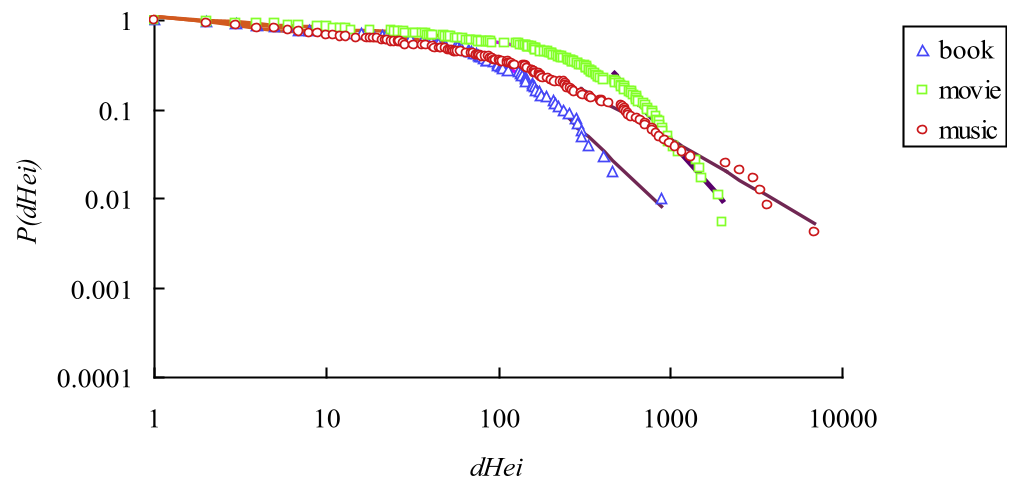 Figure 2: Cumulative probability distribution of node hyperdegrees across the three datasets.
Critical Insights & Conclusion
The value of this work is its ability to identify Opinion Leaders—users with the shortest average distance to all other hyperedges. These aren't just people who rate a lot of items; they are the "bridges" in the hypernetwork.
Limitations & Future Work
While robust, the study primarily uses a static hypernetwork. In reality, social networks are dynamic—interests shift over time. A future frontier for this research is Temporal Hypernetworks, which could account for the "decay" of influence as a user becomes less active or their tastes evolve. Additionally, integrating modern Deep Learning (GCNs) with these hypernetwork metrics could further push the boundaries of recommendation SOTA.
Takeaway: If you want to understand a community, don't just look at who talks to whom; look at the "hyper-groups" they form through shared consumption.