
URB: Boosting Cache Hit Ratios through Social Proximity in Mobile Networks
A User-Relationship-Based Cache Replacement Strategy for Mobile Social Network
The paper introduces URB (User-Relationship-Based) cache replacement strategy specifically for mobile social networks. By integrating social closeness metrics with the classic LRU algorithm, it optimizes data retention based on the social proximity between data generators and requesters.
TL;DR
The URB (User-Relationship-Based) strategy is a hybrid cache replacement algorithm designed for the social media era. By combining the temporal intuition of LRU with a Social Closeness Value, it ensures that data generated by your closest friends stays in your phone's cache longer, leading to a significantly higher hit ratio and reduced server latency.
Problem & Motivation: The Context Gap
Most mobile applications follow a "Cloud and Terminal" architecture. Due to limited bandwidth and unstable wireless networks, caching is essential. However, traditional algorithms like LRU (Least Recently Used) or FIFO are "socially blind."
In an era where we primarily consume user-generated content (Twitter, WeChat, Facebook), your likelihood of accessing a data block is not just about when it was last seen, but who created it. Current methods fail to exploit the high correlation between social ties and data access frequency, leading to unnecessary cache evictions of relevant content.
Methodology: Bridging Social Graphs and Cache Blocks
The authors define a new Cache Block Model that attaches a Gid (Generator ID) and a CV (Closeness Value) to every piece of cached data.
1. The Closeness Value (CV)
The relationship strength between the requester () and the generator () is modeled via a social graph. The path value is the product of direct link weights: Following the "Six Degrees of Separation" theory, the authors limit path lengths to 3 to maintain computational efficiency on mobile devices.
2. Hybrid Priority Scoring
The core of the replacement logic is the Cache Block Priority Value (): where . This formula allows the system to balance "Social Relevance" with "Temporal Recency."
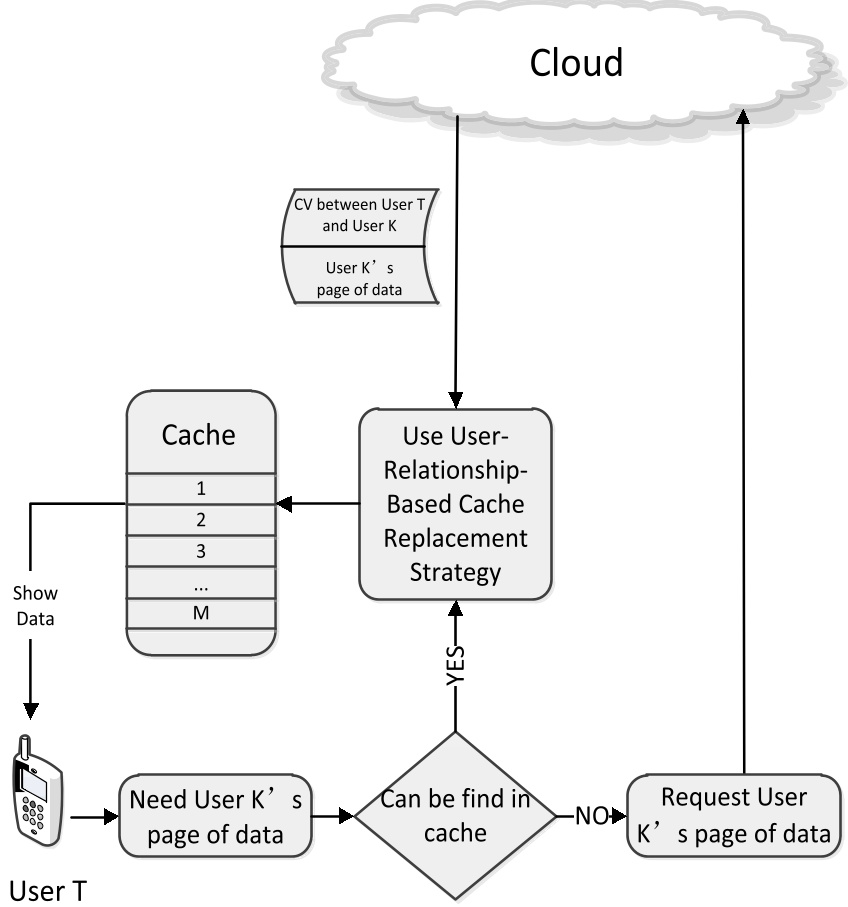 Fig 1: The URB workflow, illustrating the interaction between the mobile terminal and the cloud server to fetch Closeness Values.
Experiments & Results
The researchers tested the algorithm using a dataset of 2.4 million Twitter items and simulated user requests following Zipf’s Law (the 80/20 rule of data access).
Key Findings:
- Optimal Weighting: The study found that setting social closeness weight to 0.7 () yielded the highest hit ratio, suggesting social ties are a stronger predictor of re-access than time alone in social apps.
- Performance vs. LRU: URB consistently maintained a higher hit ratio compared to standard LRU across various scenarios.
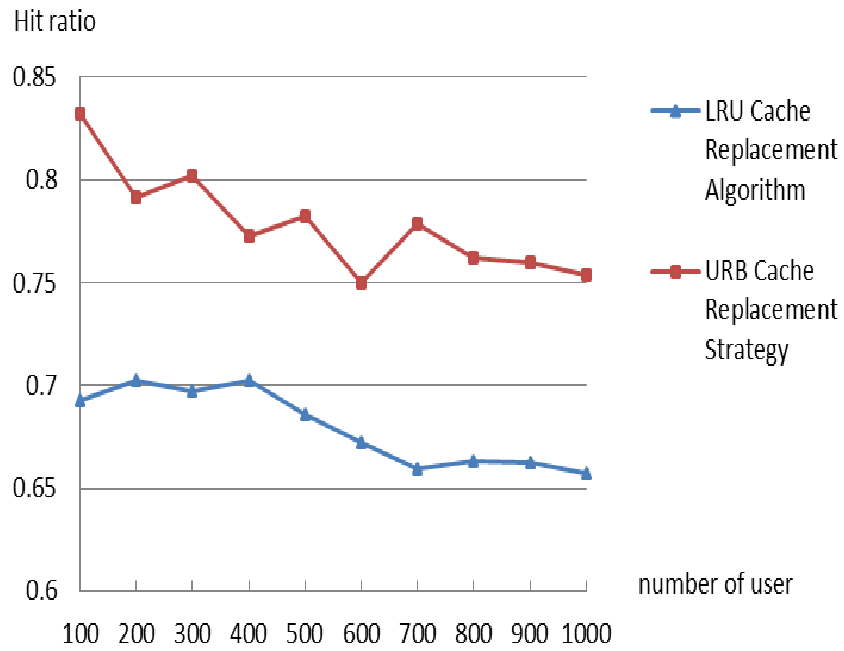 Fig 2: Comparison of Cache Hit Ratios. URB demonstrates a clear advantage over the baseline LRU algorithm.
Critical Analysis & Conclusion
Takeaway
URB is a pragmatic upgrade to existing mobile infrastructures. It acknowledges that in social computing, the Inductive Bias should include the social graph.
Limitations
- Server Overhead: The model requires the cloud server to calculate and return a Closeness Value with every data request, which could introduce latency if the social graph is massive.
- Privacy: The paper assumes the mobile terminal can access/handle generator IDs, which might raise privacy concerns in certain regulatory environments.
Future Outlook
Future iterations could use Reinforcement Learning to dynamically adjust and based on the specific app type (e.g., a news app might weight LRU higher, while a messaging app weights CV higher).