
EURB: Decoding Social Influence through the Lens of Rating Behaviors
User-Service Rating Prediction by Exploring Social Users' Rating Behaviors
The paper proposes EURB (Exploring Users’ Rating Behaviors), a recommendation framework that enhances user-service rating prediction by modeling fine-grained behavioral patterns. It leverages a unique "rating schedule" and interpersonal diffusion factors within a unified Probabilistic Matrix Factorization (PMF) framework to outperform existing SOTA models on Yelp and Douban datasets.
TL;DR
Most recommender systems know what you like, but they don't know how you behave. This paper introduces EURB (Exploring Users’ Rating Behaviors), a model that goes beyond simple interest matching. By introducing the concept of a Rating Schedule (your weekly "habit" of rating) and modeling Behavioral Diffusion (how your actions ripple through your social circle), the authors have significantly boosted the accuracy of rating predictions while making the underlying Matrix Factorization more efficient.
Problem & Motivation: The Missing Temporal Habit
Collaborative Filtering (CF) is built on the "birds of a feather flock together" principle. Standard social-based recommendations assume that if I trust you, I will like what you like. However, the authors argue that social influence is more nuanced. Prior work ignored:
- Temporal Habits: Two users might like the same movies, but one rates sporadically while another has a "Saturday night" rating ritual.
- Diffusion Dynamics: Influence isn't flat; it depends on whether we share mutual friends and how soon I follow your rating.
The motivation here is to transform these "extra-rating" behaviors into mathematical constraints that guide the latent feature learning process.
Methodology: The Rating Schedule and Diffusion
The core innovation lies in how the authors define a user's "behavioral signature."
1. The Rating Schedule
Think of this as a "curriculum" for ratings. The authors create a 5x7 matrix (5 rating levels across 7 days of the week).
- Intuition: If two users share similar rating schedules, they likely share a similar lifestyle or consumption pattern, making their latent features more likely to align.
2. Interpersonal Rating Behavior Diffusion
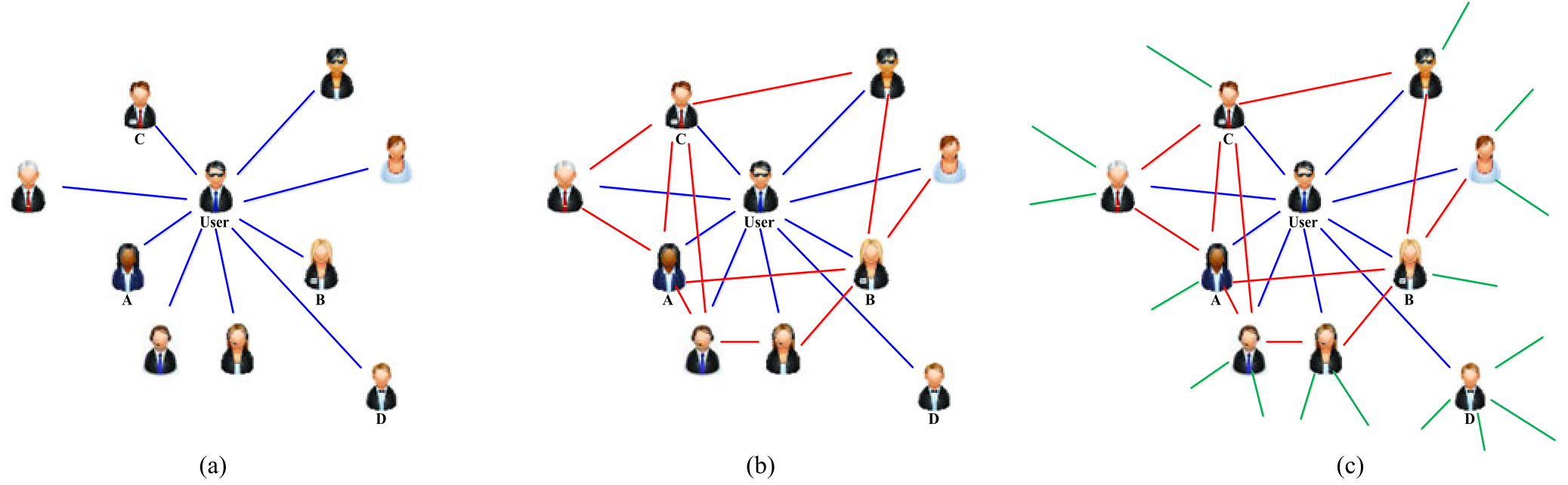
Not all friends are equal. The paper splits social connections into:
- Direct Friends: Immediate connections.
- Mutual Friends: The glue that confirms a "close" relationship.
- Indirect Friends: The outer reach of influence.
The diffusion coefficient factors in the expertise of the friend and the temporal gap between their ratings. If you rate a restaurant 5 stars today and I do the same tomorrow, the "diffusion" is smooth and strong.
Model Architecture
The authors fuse four factors—personal interest, interest similarity, behavioral similarity, and diffusion—into a unified Probabilistic Matrix Factorization framework.
 Note: The unified MF framework integrates social constraints directly into the user latent vector .
Experiments & Results
The researchers tested EURB on two massive datasets: Yelp (local services) and Douban (movies).
SOTA Comparison
Compared to standard Matrix Factorization (BaseMF) and social-aware models like CircleCon and ContextMF, EURB consistently showed lower RMSE and MAE. In the Douban dataset, it achieved a notable lead in accuracy.
 Figure: MAE comparison across different categories in Yelp. EURB (Purple) consistently sits at the bottom, indicating the highest accuracy.
Efficiency Gains
A major highlight is the Time Complexity. By mathematically fusing the interpersonal factors () before applying the constraint, the model requires fewer computations per iteration.
- Result: Average training time per iteration dropped from 0.2334 min (Original EURB) to 0.1369 min, a 41% speedup with negligible loss in accuracy.
Critical Analysis & Conclusion
The real value of this work is the realization that metadata is a behavior. By treating the "timestamp" and "friendship structure" as active components of a behavior rather than just passive context, the model captures a deeper level of "user-item-social" interaction.
Takeaway
- For Researchers: Behavioral schedules are a powerful inductive bias for user modeling.
- For Engineers: Fusing social weights before injecting them into the loss function is a valid way to scale social recommenders without exploding the computational budget.
Limitations: The model relies on the availability of timestamps and social graphs, making it less applicable to anonymous or privacy-restricted platforms. Future work might explore how to infer these behavioral schedules using deep learning (e.g., RNNs/LSTMs) rather than manual matrix construction.