
Bridging Reality and Digital: Influence Maximization in Location-Based Social Networks
Using crowdsourced data in location-based social networks to explore influence maximization
This paper investigates the Influence Maximization (IM) problem in Location-Based Social Networks (LBSNs) by proposing a dual-layer network model that accounts for information spread in both online social networks and the physical world through "words of mouth." The authors utilize crowdsourced data from Brightkite and Gowalla to develop a heuristic "Activation Position Selection" algorithm that identifies the optimal geographical location to launch an event for maximum impact.
TL;DR
Most marketing strategies focus on catching high-profile "Influencers" on Twitter or Facebook. However, this paper argues that true influence is a hybrid phenomenon: it starts online, moves to physical "words of mouth" at coffee shops or events, and then jumps back online. By analyzing real-world movement data from Brightkite and Gowalla, the authors propose an Optimal Activation Position Selection algorithm to find exactly where in a city you should launch an event to trigger a viral cross-world explosion.
The Missing Link: Why Online-Only Models Fail
Historically, Influence Maximization (IM) was treated as a graph problem: find nodes in a social network that reach the most people. But in the age of Location-Based Social Networks (LBSNs), we check in at stadiums and malls.
The authors identify a critical gap: Physical Proximity Influence. You might not be "friends" with the person sitting next to you at a conference, but if they show you a cool new app on their phone, you are influenced. Prior SOTA (State-of-the-Art) methods ignore this "offline" edge. Furthermore, the paper proves that high-influence users are often geographically dispersed (see Fig. 8), making it impossible to "catch" them all at once without a strategic geographical starting point.
Methodology: The Two-Layer Graph
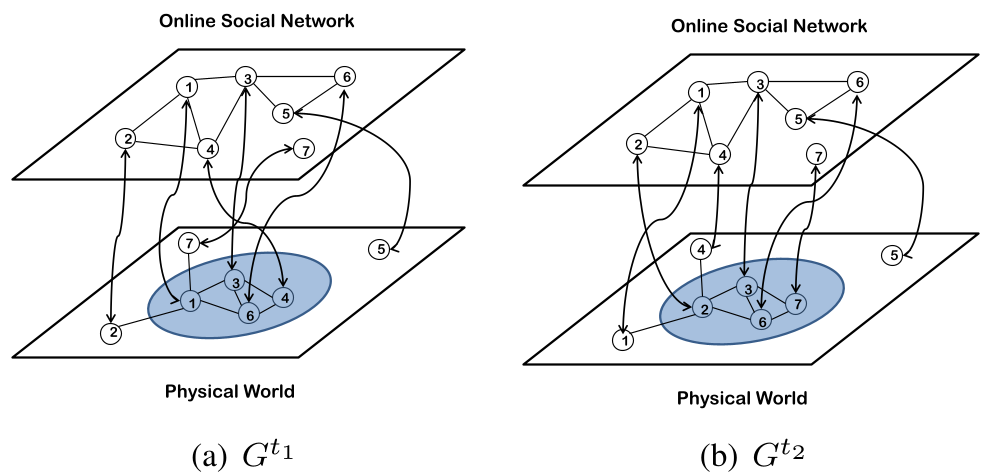
The core innovation is a dynamic network model that treats user relationships as a dual-layer structure:
- Online Friendship Layer (): The static social graph (who follows whom).
- Physical World Layer (): A dynamic geometric graph where edges exist if two users are within a radius at time .
The Cross-Propagation Effect
The authors theorize that influence isn't a one-way street. It jumps between layers:
- Online -> Physical: You see a tweet about a pop-up shop, go there, and tell your neighbors.
- Physical -> Online: You see an event in person, then post a "check-in" or photo, influencing your digital friends who live elsewhere.
The probability of infection depends on Interest Matching (Jaccard similarity between user interests and event types) and Dwell Time (how long a user stays in the influenced physical zone).
Finding the "Sweet Spot" (Problem Formulation)
The "Activation Position Selection" problem asks: In a area, where is the single best coordinate to start an event?
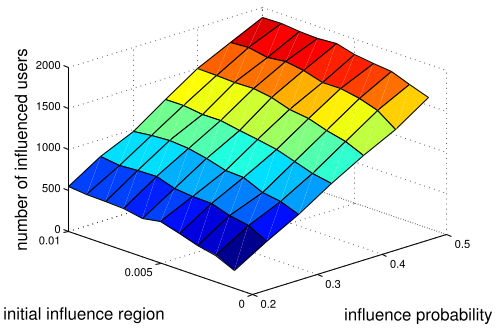
Since the influence function is non-monotonic and "jagged" (as shown in Fig. 9), standard gradient descent doesn't work. The authors developed a Heuristic Roulette-Wheel Algorithm.
To solve the high computational cost of simulating thousands of spread scenarios, they introduced a proxy objective function : This formula prioritizes areas that contain users with many online friends and users whose physical neighbors have many online friends.
Experimental Results
Using subsets of the Brightkite and Gowalla datasets (concentrated in high-density areas like New York and Philadelphia), the paper validates several key insights:
- Hybrid Influence is Stronger: Models that include physical contact result in significantly higher final infection rates compared to online-only models.
- Density Influence: Fig. 13 shows that simply picking the most crowded spot doesn't guarantee the widest spread. Influence depends on the social connectivity of the people in that crowd.
Critical Insight & Conclusion
The real value of this work is the formalization of Cross Propagation. In a world where digital and physical lives are increasingly blurred, models that treat them as separate silos are obsolete.
Takeaway: If you are launching a product, don't just look for "Online Influencers." Look for "Bridge Users"—those who frequent high-traffic physical locations and have high online degrees. The "Optimal Activation Position" is the geographical coordinate where these bridge users are most likely to convene.
Limitations: The model assumes users follow a random waypoint movement model for gaps in check-in data, which may not capture the habitual nature of human commuting (e.g., home-to-work patterns). Future work should integrate more realistic mobility models into the layer.