
Vaccinating a Population is a Programming Problem: Evolving Human-Readable Mitigation Strategies
Vaccinating a Population is a Programming Problem
The paper proposes a Genetic Programming (GP) framework to discover optimal vaccination strategies within social networks, modeled as a programming problem. Using an SEIR epidemic model on Erdős-Rényi graphs, the system evolved strategies that significantly outperform baseline heuristics like random vaccination or simple degree-based targeting.
TL;DR
During a pandemic, vaccines are a finite resource. This paper shifts the perspective of public health policy from medical intuition to a programming optimization problem. By using Genetic Programming (GP), the researchers evolved strategies that analyze social graph topologies to decide who gets vaccinated. The result? Interpretable "if-then" rules that outperform traditional heuristics and adapt to the underlying social structure.
The Motivation: Moving Beyond Intuition
In the early stages of a pandemic like COVID-19, decision-makers often rely on broad categories—vaccinate the elderly, healthcare workers, or "hot spots." However, these strategies rarely account for the topology of human contact.
The authors argue that if we represent a community as a graph (nodes as people, edges as contacts), finding the best mitigation strategy becomes a search for the most efficient algorithm to prune the graph. The challenge is twofold:
- The Lead Time: We need strategies that work while the disease is spreading.
- Interpretability: A "black box" AI won't fly in public health; officials need to understand why a certain group is being targeted.
Methodology: Evolution in the Sandbox
The researchers built a simulation environment using the SEIR (Susceptible, Exposed, Infectious, Removed) model, which captures the "exposed but not yet infectious" period—a critical factor for COVID-19.
1. The Genetic Programming Engine
Instead of training a neural network, they used GP to evolve expression trees. Each leaf in the tree is a graph metric (like DEG for degree or NB_INF for number of infected neighbors), and each node is an operator (arithmetic or Boolean).
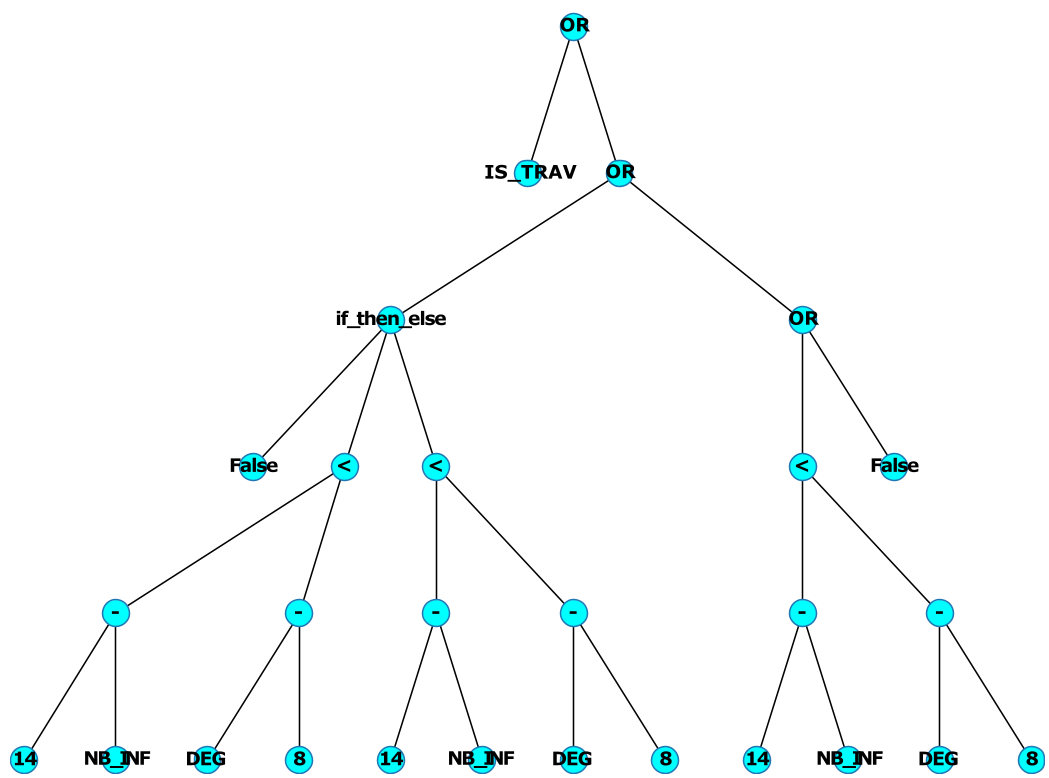 Fig 1: A sample evolved tree (F1 strategy) before simplification. It combines traveler status with neighbor infection rates.
2. Key Graph Measures
The GP system had access to:
- Degree (DEG): How many contacts a person has.
- Travelers (IS_TRAV): Nodes that act as bridges between different social clusters (calculated via modularity maximization).
- Neighbor State (NB_INF): Real-time data on how many "friends" of a node are already sick.
Results: Evolved Wisdom
The GP discovered several "noteworthy" strategies that proved remarkably robust. One highlight was strategy F1:
IS_TRAV or ((14 - NB_INF) < (DEG - 8))
Why does this work? (The Physical Intuition)
As shown in the logic bounds below, F1 develops a sophisticated threshold:
- If you are a traveler, you get vaccinated immediately to prevent inter-community jump.
- For others, the more neighbors you have (
DEG), the fewer infected neighbors (NB_INF) are needed to trigger a vaccination. - Interestingly, it avoids "wasting" vaccines on nodes where every neighbor is already infected, as those individuals are likely already exposed.
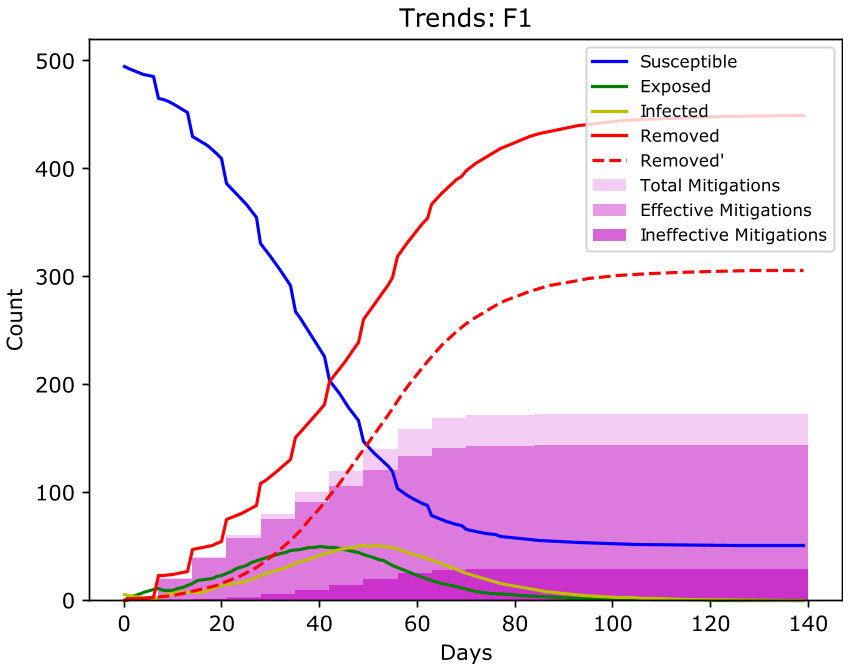 Fig 2: The admissible decision space for the F1 strategy. The shaded area shows where vaccination is triggered based on Degree vs. Infected Neighbors.
Performance Comparison
The researchers compared GP strategies against baselines like "Targeting High Degree Nodes" and "Random Vaccination."
- Flattening the Curve: GP strategies were significantly better at maintaining a large "Susceptible" population.
- Topology Matters: A strategy optimized for one graph (Static) performed differently on another (Non-static), emphasizing that public health policy must be data-driven and community-specific.
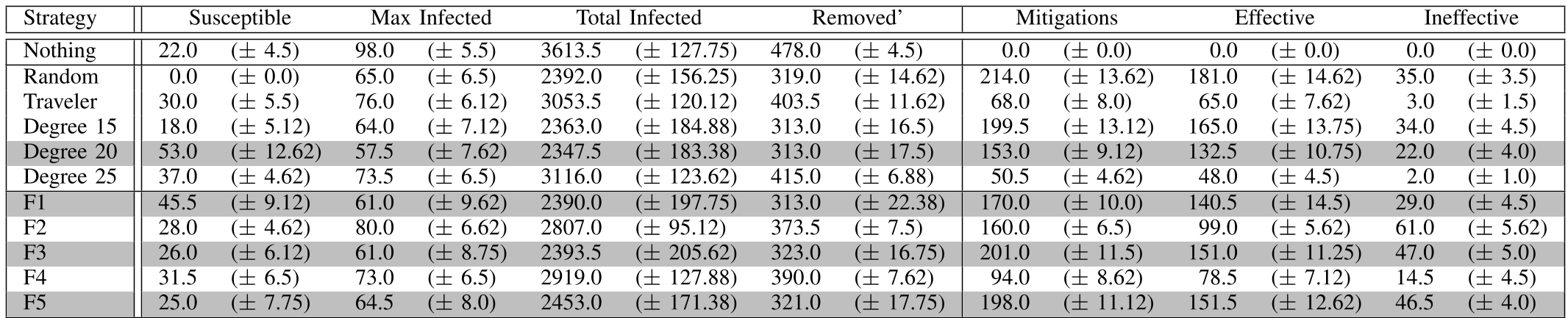 Table: Performance of various strategies across multiple metrics like Max Infected and Total Mitigations used.
Critical Analysis & Conclusion
The power of this research lies in its Interpretability. Unlike a deep learning model, the output is a simple formula that a policy-maker can read and validate.
Limitations:
- The study used Erdős-Rényi (ER) graphs, which are "truly random" but don't perfectly mimic the "small-world" or "scale-free" nature of real human networks.
- The SEIR model assumes we know who is susceptible vs. exposed, which is difficult without mass testing.
The Takeaway: Vaccination is not just a medical challenge—it is a computational one. By treating the population as a programmable network, we can move from "guessing" who to protect to "calculating" the optimal firewall against disease.
The code is available at convergencelab/eCov-GP.