
Value Cards: Bridging the Gap Between ML Code and Social Consequence
Value Cards: An Educational Toolkit for Teaching Social Impacts of Machine Learning through Deliberation
The paper introduces Value Cards, a deliberation-driven educational toolkit designed to teach computer science students and practitioners the social impacts of Machine Learning (ML). By utilizing a structured deck of Model, Persona, and Checklist cards, it facilitates group discussion on FATE (Fairness, Accountability, Transparency, and Ethics) topics, achieving significant improvements in students' understanding of technical trade-offs in real-world contexts like recidivism prediction.
TL;DR
As AI systems move into high-stakes domains like criminal justice and lending, the "Accuracy-first" mindset of traditional CS education is becoming a liability. "Value Cards" is a new educational toolkit that uses structured deliberation to teach students how to navigate the painful trade-offs between performance and social fairness. By simulating a "public deliberation," it transforms abstract metrics into human impacts.
The Problem: The "Accuracy" Trap
In the vacuum of a Jupyter notebook, a model with 90% accuracy looks like a success. However, in the context of recidivism prediction (predicting if a defendant will re-offend), that 10% error isn't just noise—it's people's lives.
Current CS education often fails because:
- Decontextualization: Technical definitions of (False Positive Rate) and (False Negative Rate) are taught as math, not as social costs.
- Homogeneity: Student cohorts often lack the diverse lived experiences to naturally "see" how a model might disadvantage specific groups.
- Lack of Negotiation Skills: Engineering training rarely prepares students to handle conflicting stakeholder requirements (e.g., the safety of the community vs. the liberty of the individual).
Methodology: The Value Cards Toolkit
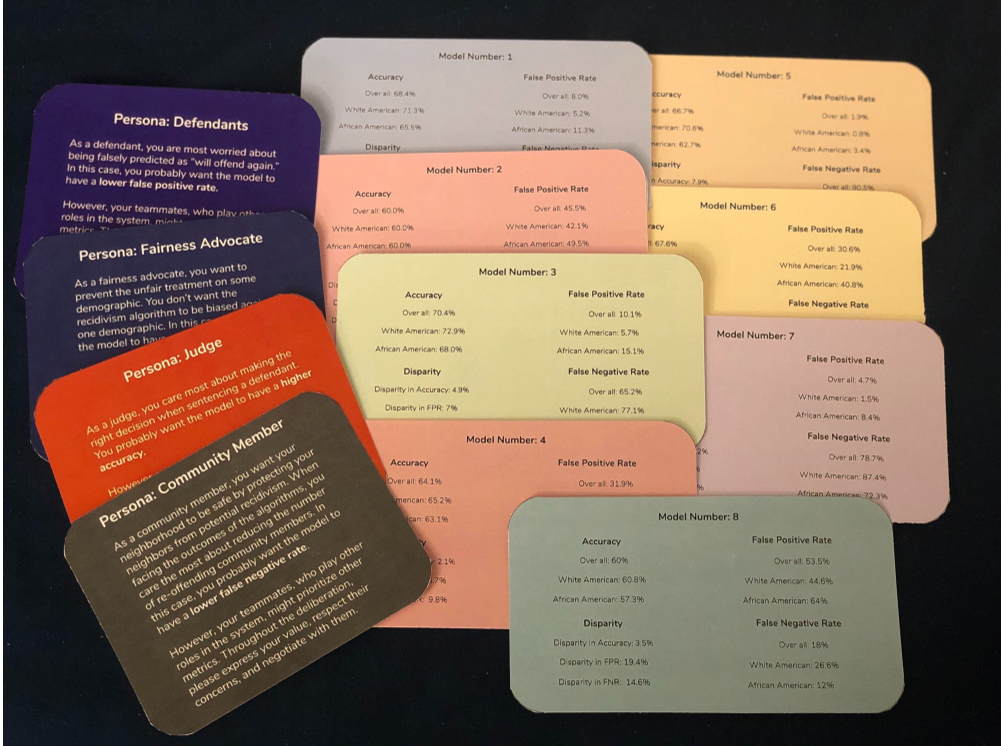
The researchers developed a toolkit comprising three distinct types of "scripts" to guide student thinking:
- Model Cards: These present 8 different AI models, each with a unique "flavor" of trade-off (e.g., one favors high accuracy but high disparity; another minimizes False Positives but misses more crimes).
- Persona Cards: Students are assigned roles—Judge, Defendant, Community Member, or Fairness Advocate. This forces "Perspective Taking," an essential cognitive shift for ethical design.
- Checklist Cards: These provide a step-by-step heuristic for analyzing societal values and potential harms, ensuring the discussion doesn't get "stuck" in a loop.
Insights from the Classroom
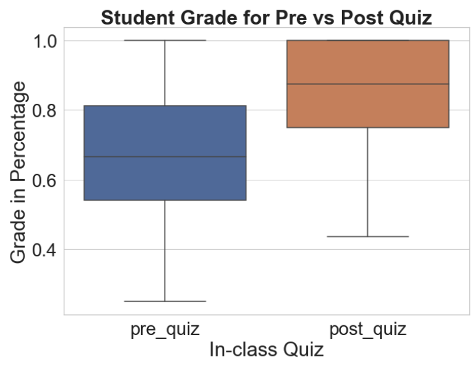
The authors tested the toolkit at Carnegie Mellon University. The results were telling:
- Beyond the Math: Students stopped seeing as a variable and started seeing it as "the risk of destroying an innocent life."
- The Consensus Challenge: Interestingly, 4 out of 14 teams could not reach a consensus on which model to use. This wasn't a failure—it was a success. It demonstrated to students that some ethical trade-offs are "tragic" and have no perfect technical solution.
- Tool Complexity: The study found that giving too many tools (Checklist + Persona) could lead to "over-scripting," where students spent more time managing the cards than talking to each other.
Critical Analysis: Why This Matters
The most profound takeaway is the effectiveness of Persona-based deliberation. By forcing a student to be the defendant, and another to be the community member, the "Pareto Frontier" of model optimization becomes an arena of social negotiation.
However, the paper also notes a "Side Effect": Persona cards can make students stubborn. When you are assigned a role, you fight for that role's "win," sometimes at the expense of total system empathy. This suggests that future versions of the toolkit might benefit from "Role Swapping" halfway through the exercise.
Conclusion
The "Value Cards" project proves that ethics in AI isn't a "soft skill" to be tacked on—it is a rigorous process of understanding trade-offs. For the next generation of AI engineers, learning to deliberate might be just as important as learning to backpropagate.
Paper: Value Cards: An Educational Toolkit for Teaching Social Impacts of Machine Learning through Deliberation (FAccT '21)