
Value Strength: Rethinking Information Diffusion Through Network Science
The value strength aided information diffusion in online social networks
The paper introduces "Value Strength," a novel metric from network science designed to optimize information diffusion in online social networks. By prioritizing nodes that act as unique "informational bridges" rather than those with the most mutual friends, the proposed scheme significantly enhances information coverage ratios across diverse network topologies, including the real-world Flickr dataset.
TL;DR
Information in social networks doesn't just spread through big "hubs"; it spreads through "bridges." This paper proposes Value Strength, a metric that calculates the unique informational value a node adds to its neighbor. By focusing on nodes that connect distinct groups, the authors achieve significantly higher information coverage ratios across Scale-Free and Small-World networks compared to traditional strength metrics.
Problem & Motivation: The Paradox of Density
Most information diffusion strategies focus on "strong ties"—high-degree nodes or close circles of friends. However, these approaches often suffer from Informational Redundancy: in a tight-knit community, everyone already knows the same thing.
The authors argue that existing metrics like Tie Strength (mutual interests) and Partial Strength (asymmetric influence) fail to capture the "Bridge" role. A node might have fewer friends, but if those friends belong to a completely different cluster, that node is far more valuable for global diffusion than a popular node trapped in a local clique.
Methodology: Highlighting the Value Strength
The core innovation is the Value Strength (V_v) formula. Unlike Jaccard-like metrics that measure similarity, Value Strength measures uniqueness.
Core Logic
If node wants to send information to node , the value of this link is defined by how many of 's friends are not already friends with .
This means the strength is high when introduces to a nearly entirely new audience.
 In the figure above, node 'c' acts as a critical bridge. While it might have fewer connections than hub nodes, it provides the only path to an entire sub-community.
Experiments & Results: Covering More Ground
The researchers tested this against traditional models in three distinct environments:
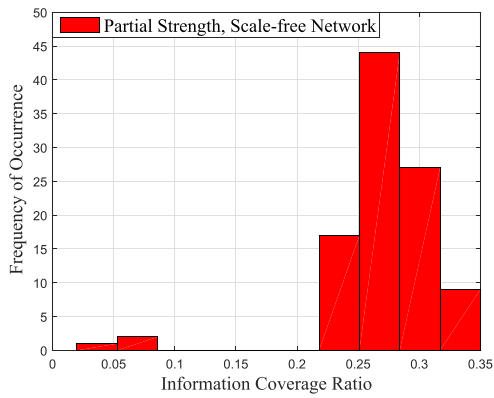
- Small-World Networks: In networks with human-like clustering, Value Strength shifted the coverage distribution significantly to the right, increasing average coverage from 26% to 35%.
- Scale-Free Networks: In networks dominated by super-hubs (like Twitter/X), Value Strength proved more robust, preventing information from getting stuck in "hub-echo chambers."
- Real-World Flickr Dataset: Testing on a massive graph of over 80,000 users and 5 million edges, the "Strong-Prior Value Strength" scheme consistently outperformed all other selection strategies.
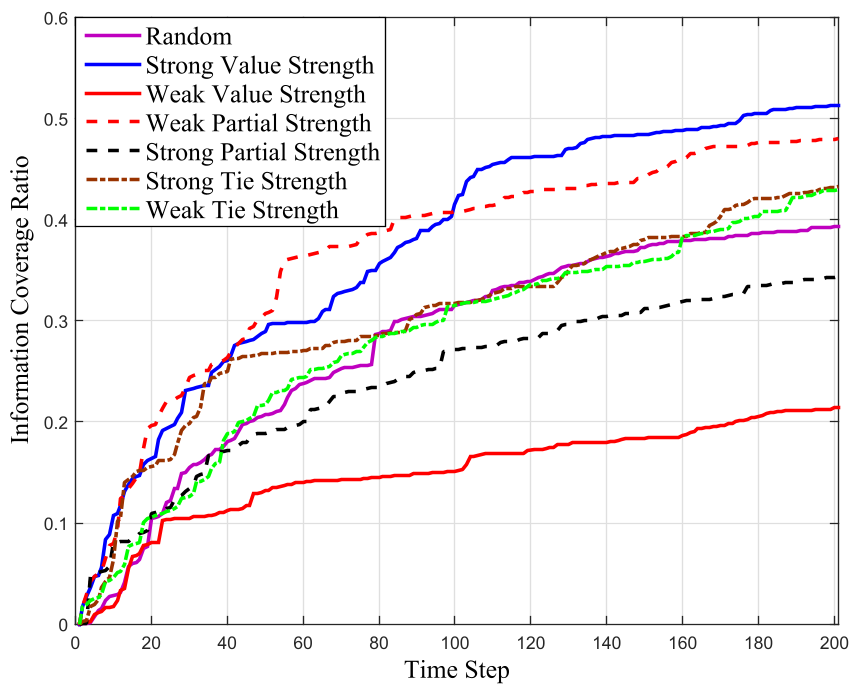 As shown, the Value Strength strategy (top curve) dominates the information coverage ratio over time compared to traditional partial strength methods.
Critical Analysis & Conclusion
Takeaway
The research successfully moves beyond the "influence = popularity" myth. It provides a mathematical foundation for the sociological intuition that "weak ties" (bridges) are the true engines of large-scale information diffusion.
Limitations
- Computation Cost: Calculating the difference set for every edge in a billion-node network like Facebook might be computationally expensive.
- Dynamic Nature: Real networks evolve; the "value" of a bridge node may change as new links are formed, which this static model doesn't fully address.
Future Outlook
Integrating "Value Strength" into Graph Neural Networks (GNNs) as an attention weight could revolutionize how we predict viral content or mitigate the spread of misinformation by identifying hidden "bottlenecks" in social media topology.