
CSR Model: Decoding the Viral Mechanics of Online Rumors through Social Reinforcement
A variant epidemic propogation model suitable for rumor spreading in Online social network
The paper proposes a specialized rumor-spreading model for Online Social Networks (OSNs) that adapts the SIR epidemic framework into a "Credulous-Spreader-Rational" (CSR) model. By incorporating weighted social reinforcements and network topology (Small-World), it demonstrates that rumor propagation is highly sensitive to the initial density of rational individuals.
TL;DR
Researchers have modified the traditional SIR epidemic model to better fit the landscape of Online Social Networks (OSNs). By introducing the CSR (Credulous-Spreader-Rational) framework and "social reinforcement" (where the more times you hear a rumor from influential friends, the more likely you are to believe it), the study reveals that the final reach of a rumor depends critically on the initial percentage of "Rational" users who act as a firebreak against misinformation.
Problem & Motivation: Why Epidemic Models Need an Upgrade
The spread of a virus like SARS and the spread of a "fake news" story on Twitter seem similar, but they have fundamental differences:
- Zero Transmission Cost: In OSNs, "infecting" someone is as easy as clicking "Share."
- Social Reinforcement: Unlike a biological virus, your probability of "catching" a rumor increases if multiple friends tell you the same thing (the "Echo Chamber" effect).
- The Rational Barrier: In biological models, you become "Recovered" (R) after being sick. In rumors, some people are "Rational" (R) from the start—they verify facts and never become spreaders.
The authors argue that existing models overlooked these social nuances, particularly how a person's social "weight" (their number of connections) influences the credibility of the rumor they pass on.
Methodology: The Credulous-Spreader-Rational (CSR) Framework
The authors define three states for users in a network:
- Credulous (C): Susceptible individuals who easily believe and share rumors.
- Spreader (S): Active agents who distribute the rumor to their neighbors.
- Rationals (R): The "immune" population who counteract the rumor upon contact.
The Secret Sauce: Weighted Social Reinforcement
The transition from Credulous to Spreader isn't a fixed probability. Instead, it follows a dynamic function: Where:
- : The number of times the user has been contacted.
- : The weight (degree) of the node, suggesting that influencers have a higher "infection" power.
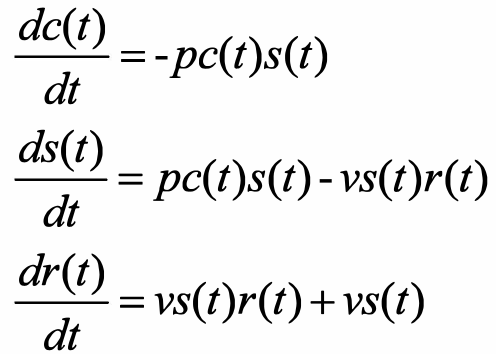 Above: The differential equations governing the CSR state transitions.
Experiments & Results: The Power of Initial Rationals
The authors conducted simulations on Watts-Strogatz (Small-World) networks, which mimic real-world social structures (high clustering and short paths).
Key Findings:
- Sensitivity to Initial Conditions: The "Rumor Effectiveness" is extremely sensitive to how many Rationals are present at T=0.
- The 0.1 Threshold: When the initial density of Rationals is near 0.1 (10% of the population), the rumor’s ability to "go viral" is almost entirely suppressed.
- Acceptance Probability Influences: As the acceptance probability increases (high social reinforcement), the final density of Rationals (people who have heard the rumor) approaches 1, meaning the rumor saturates the network.
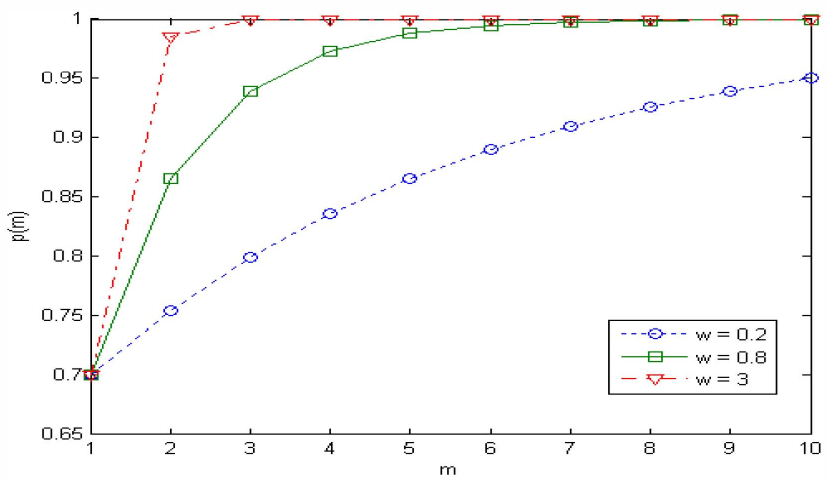 Figure 1: How the cumulative contacts (m) and node weight (w) drive the probability of believing a rumor.
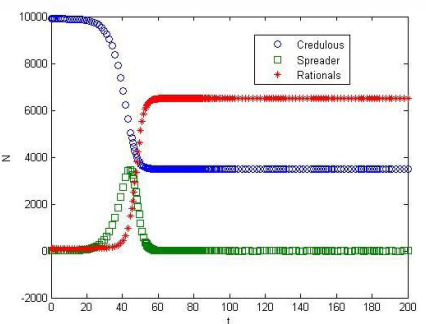 Figure 3: Rumor effectiveness (final minus initial rationals) against probability . Note how higher initial Rational density flattens the curve.
Critical Analysis & Conclusion
Takeaway
This paper shifts the focus from "how fast a rumor spreads" to "who can stop it." It mathematically proves that a small minority of skeptical, rational users can effectively "vaccinate" a social network against misinformation.
Limitations & Future Work
While the model uses Small-World networks, real OSNs are often Scale-Free (Power-Law degree distribution), meaning a few "Super-spreaders" hold massive sway. The authors admit that future research must investigate how these hubs influence the CSR model. Furthermore, the model assumes "Rational" status is permanent, whereas, in reality, even rational people might eventually succumb to a persistent rumor.
Final Thought: In the digital age, being a "Rational" isn't just a personal trait—it's a critical structural component of a healthy information ecosystem.