
VENETA: Reclaiming Social Discovery via Decentralized Friend-of-Friend Detection
VENETA: Serverless Friend-of-Friend Detection in Mobile Social Networking
The paper introduces VENETA, a decentralized mobile social networking platform featuring a serverless Friend-of-Friend (FoF) detection system. It leverages real-world contact lists and Bluetooth proximity to identify social connections without requiring centralized servers or costly Internet access.
TL;DR
VENETA is a pioneering mobile social networking platform that enables users to find "Friends of Friends" (FoF) in their immediate physical proximity without using a central server. By combining Bluetooth ad-hoc communication with a privacy-preserving cryptographic protocol, it allows two strangers to discover if they share a common contact in their phone’s address book without revealing their entire contact list.
Background: The Cost of Mobility
In the mid-2000s, social networking was booming, but mobile versions were hampered by expensive data rates and a lack of location-aware features. To explore a social neighborhood (finding who your friends know), you typically needed a massive central database (like Facebook or LinkedIn). VENETA shifts this paradigm to the P3 (People-to-People-to-Geographic-Place) concept: decentralizing the graph and using the phone's address book as the "ground truth" for social links.
The Core Challenge: Privacy in Ad-Hoc Discovery
The intuitive way to find a common friend is simple: exchange contact lists. However, privacy is the "snag." Even hashing phone numbers (e.g., SHA-1) is insufficient because an adversary can pre-compute hashes for all possible 7-digit phone numbers (a rainbow table attack).
To solve this, the authors implement a protocol based on Commutative Encryption.
Mathematical Intuition
The protocol relies on the property: .
- Alice encrypts her contacts with her private key and sends them to Bob.
- Bob encrypts his contacts with his private key and sends them to Alice.
- Alice encrypts Bob's received set with her key .
- Bob encrypts Alice's received set with his key .
- They compare the double-encrypted values. If a value matches, the original phone number was in both books.
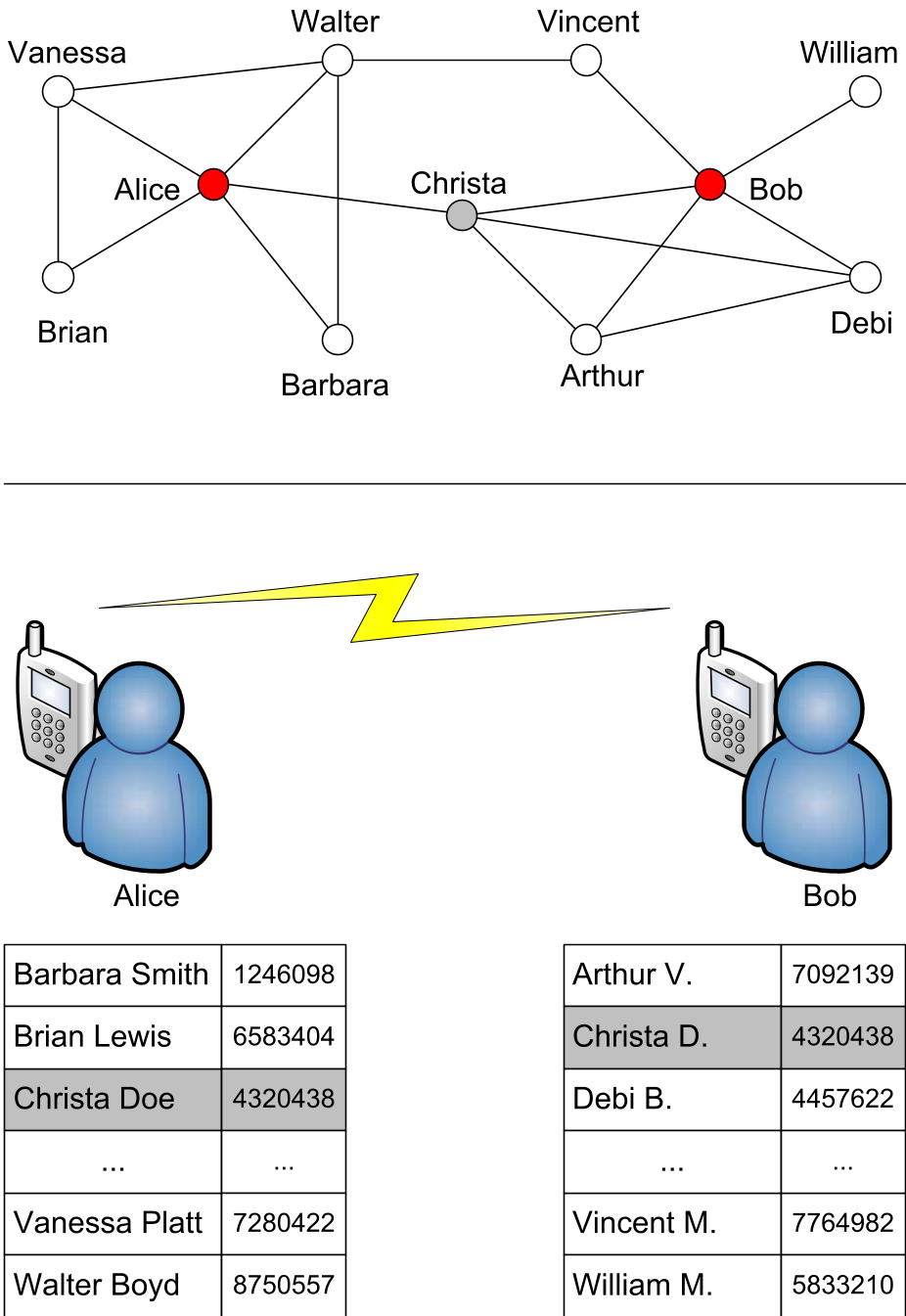 Figure 1: The logic of decentralized FoF detection via local proximity.
Methodology: System Architecture
VENETA isn't just a protocol; it's a full stack implemented on J2ME (Java Microedition).
- Proximity Detection: Uses Bluetooth to find nearby nodes.
- Contact Matching: Executes the Private Set Intersection (PSI) protocol using 1024-bit primes for security.
- Epidemic Routing: Provides a multi-hop messaging service (up to 3 hops), allowing users to chat in dense environments (like stadiums) without SMS costs.
- Identity: Uses the last 7 digits of phone numbers as globally unique identifiers, normalized to handle international prefix variations.
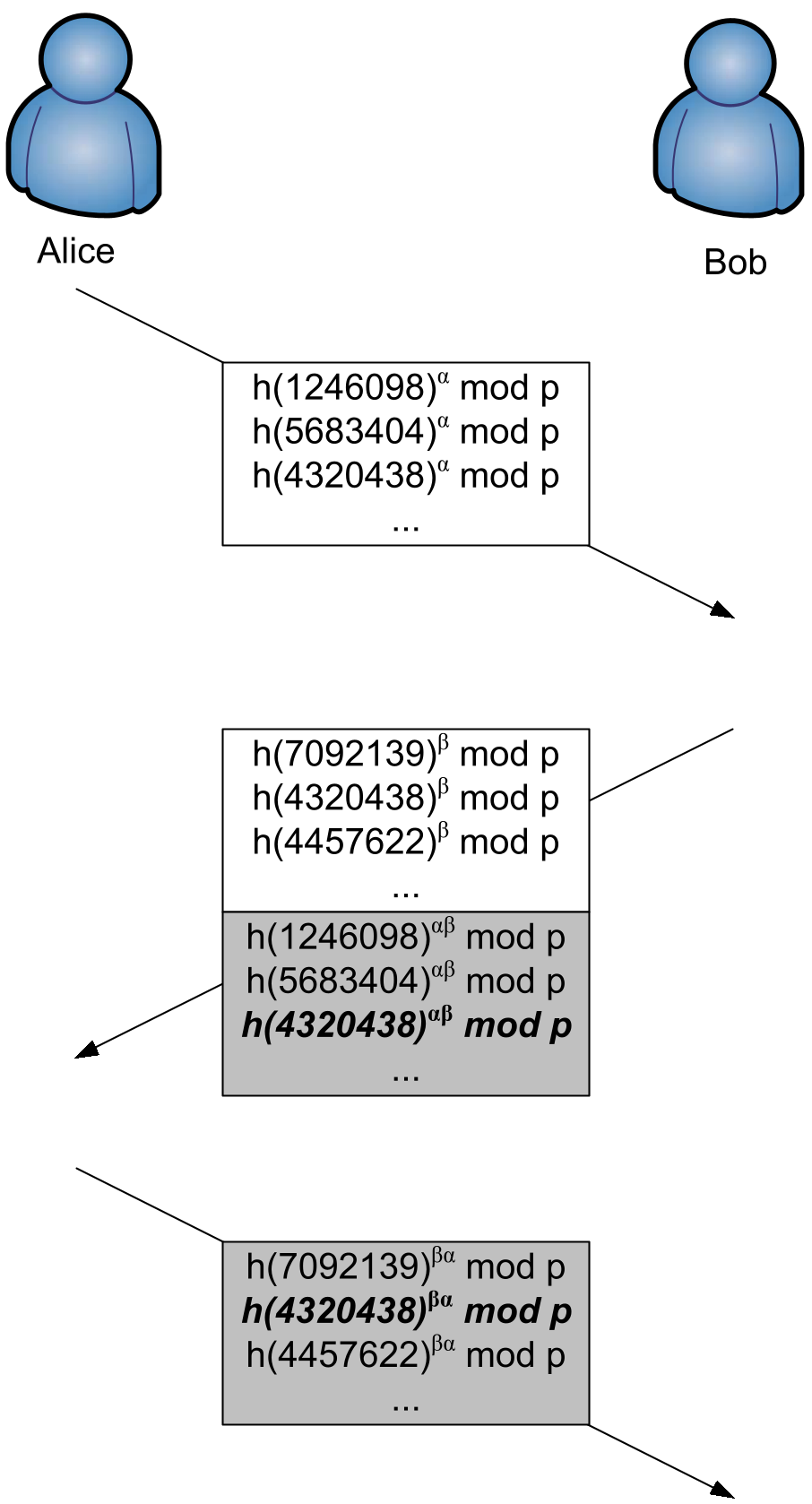 Figure 2: Step-by-step cryptographic exchange between Alice and Bob to identify "Christa" as a common contact.
Experimental Insights & Application
The authors highlight that FOO/FoF discovery is a more powerful "matchmaking" signal than simple user profiles (interests/hobbies). In a social network, a common friend implies a high level of trust and shared context (clustering coefficients).
Key Features of the VENETA Platform:
- Profile Matching: Traditional age/gender filtering for initial "ice-breaking."
- Decentralized Messaging: A "cheap alternative to SMS" for static scenarios like conferences or classrooms.
- Server-Optional Mode: While a server exists for global location tracking (via JSR-179), the core social discovery remains local and free.
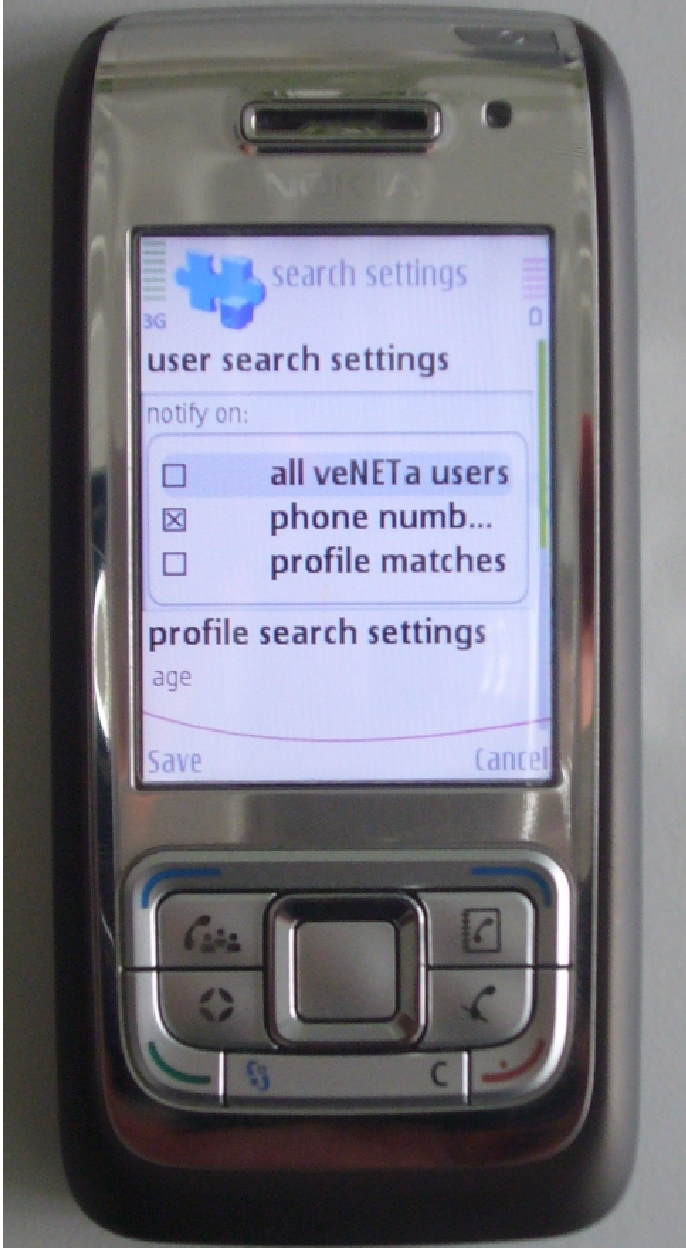 Figure 3: VENETA interface showing notifications for nearby users and contact matches.
Critical Analysis: A Look Back from the Future
From a modern perspective, VENETA was ahead of its time. It anticipated the privacy-first, decentralized movement (Web3/Local-First software).
Limitations:
- Bootstrapping: Even with real-world contacts, finding a friend-of-friend in a crowd requires high application adoption.
- Active Adversaries: While the protocol handles "honest-but-curious" users, a malicious user could potentially probe for specific contacts, though the authors argue the "utility" of such an attack is low.
- Hardware Constraints: Modern iOS/Android "sandboxing" makes background Bluetooth contact-book scanning much harder than it was on J2ME/Symbian.
Conclusion
VENETA proves that social graphs don't need to be siloed in a central database to be useful. By leveraging the data we already carry (our contacts) and the people we physically meet, we can build a "Social Serendipity" engine that is both private and free of charge.