
Vertex-Pursuit in Hierarchical Social Networks: How to Stop the Flow?
Vertex-Pursuit in Hierarchical Social Networks
This paper investigates "Seepage," a pursuit-evasion game on Directed Acyclic Graphs (DAGs) representing hierarchical social networks (e.g., Twitter, terrorist cells). It proposes a generalized stochastic model for DAGs with specified degree sequences and derives rigorous bounds for the "green number"—the minimum resource rate required to block an intruder from reaching network sinks.
Executive Summary
TL;DR: This research tackles the mathematical challenge of disrupting information flow—whether it's viral gossip on Twitter or instructions within a terrorist cell—modeled as the pursuit game Seepage on Directed Acyclic Graphs (DAGs). By comparing "Regular" vs. "Power Law" social hierarchies, the authors find that irregular, power-law networks (like most modern OSNs) are significantly harder to guard near the source than their uniform counterparts.
Context: This work bridges the gap between static graph theory (min-cuts) and dynamic pursuit games, positioning itself as a rigorous mathematical foundation for "dynamic counterterrorism" and information interception.
The Problem: Static Analysis in a Dynamic World
Traditional methods for breaking network connectivity often ask: "Which set of nodes, if removed, disconnects the source from the targets?" This is the classic min-cut problem. While useful, it lacks a temporal dimension. In the real world, "interceptors" (the Greens) and "information" (the Sludge) act sequentially.
The Seepage game introduces this dynamism:
- The Sludge starts at a source node and moves "downhill" toward sinks (targets).
- The Greens protect a limited number of nodes () per turn.
- Once protected, a node is blocked forever.
The central question is the Green Number (): What is the minimum rate of node protection required to guarantee the Sludge never reaches a target at depth ?
Methodology: Modeling the Hierarchy
The authors propose a stochastic DAG model where nodes are organized in layers. They focus on two specific degree distributions (the "Inductive Bias" of the network):
- Random Regular DAGs: Every node has a fixed out-degree . This represents an old-school corporate hierarchy or a strictly organized cell.
- Random Power Law DAGs: The degree distribution follows . A few "hub" nodes have massive influence, while most have very little—mirroring the structure of Twitter or a celebrity's sphere of influence.
The Core Logic: The "Sludge-Cut"
To prove the limits of protection, the authors define a Sludge-Cut. This is a combinatorial argument determining if the Greens can force the Sludge into a "dead end." If the local neighborhood of a node resembles a tree with high in-degrees, the Greens gain a tactical advantage.
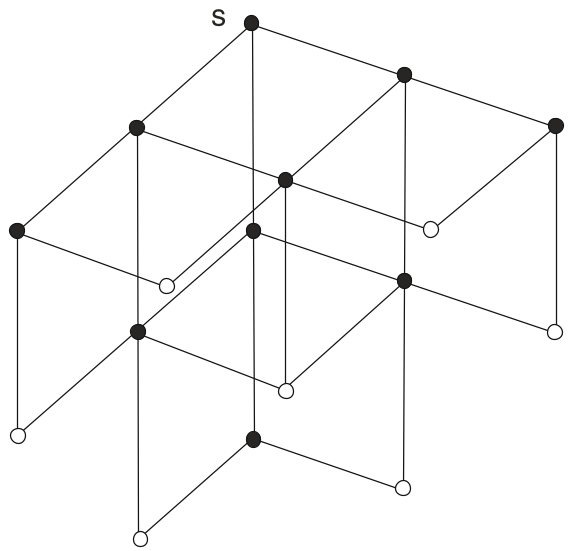 Figure 1: A sample DAG illustrating the flow from source to sinks.
Key Insights & Results
1. Regular Graphs: The "Constant Danger"
In a -regular DAG, the research proves that for most context depths, the green number is approximately .
- Insight: Near the source, you need more resources. But once the Sludge moves past the first few layers, the cost of defense stabilizes.
- Result: for a vast interval of .
2. Power Law Graphs: The "Elite Protection"
Power law networks behave entirely differently. The green number is significantly larger at early layers (near the "influencer" or "leader") and drops as the Sludge moves toward the periphery.
- Insight: This validates the "structural resilience" of decentralized but hierarchical networks (like Al Qaeda or viral Twitter threads). Intercepting a message is hardest when it is closest to the high-degree source.
Numerical Approximations
The authors provide values for the constant , which relates to the density of edges between layers as the network grows.
| (Degree) | 3 | 4 | 5 | 10 | 20 |
|---|---|---|---|---|---|
| Value | 0.895 | 1.62 | 2.26 | 4.98 | |
| Success Prob () | 0.591 | 0.802 | 0.895 | 0.993 | |
| Table: Convergence of edge density in d-regular stochastic DAGs. |
Critical Analysis & Conclusion
Takeaway: This paper provides a crucial mathematical proof for what we intuitively feel: hierarchies with "super-spreaders" (Power Law) are much more resilient to targeted, step-by-step interception than uniform hierarchies.
Limitations:
- The model assumes the Sludge only moves one step per turn (the "seepage" aspect). In some networks, information "teleports" (retweets, broadcast), which would fundamentally change the game.
- The graph is acyclic (DAG). While hierarchies are often DAGs, real-world social networks often contain cycles (reciprocity), which complicates the "downhill" movement.
Future Work: The authors suggest exploring different degree sequences and addressing the "gap" in tight bounds for regular graphs at specific logarithmic depths. For practitioners, this framework could eventually be used to calculate the "cost of containment" for misinformation campaigns.