
Simulating the Shark in the Social Sea: Analyzing Violent Extremist Networks (VEN)
Violent extremist network representation and attack the network course of action analysis in social simulation
The paper presents a framework for representing Violent Extremist Networks (VENs) within the "Cultural Geography" (CG) multi-agent social simulation. It integrates Social Network Analysis (SNA) and Bayesian Belief Networks (BBN) to evaluate the impact of kinetic and non-kinetic "Attack the Network" courses of action (COAs) on civilian population attitudes.
TL;DR
This research tackles the "wicked problem" of countering extremist networks by treating them as complex adaptive systems. Using the Cultural Geography (CG) model, the authors demonstrate that surgical strikes against specific network hubs can be more effective than broad interdictions, which often trigger unforeseen negative responses in the civilian population.
Background: Decoupling the Network from the Populace
Violent Extremist Networks (VENs) do not exist in a vacuum; they move through the social network of a culture like "sharks through water." To defeat them, stabilizing forces must understand not just the "sharks" but the "sea" (the civilian populace). The difficulty lies in the heterogeneity of human attitudes—even a seemingly uniform population reacts unpredictably to military intervention.
Methodology: The Cognitive and Structural Engine
The paper outlines a sophisticated two-part architecture for social simulation:
1. The Cognitive Module (The "Sea")
Population entities are governed by Bayesian Belief Networks (BBNs) based on the Narrative Paradigm. Every agent has a unique internal state that determines how they interpret events (e.g., an explosion or a leaflet campaign). Their intent to act is further refined by the Theory of Planned Behavior (TPB), considering individual attitudes and perceived social norms.
2. VEN Agent Patterns (The "Sharks")
The authors propose four levels of agent sophistication for VEN members:
- Simple Reflex: If population support is high, commit violence.
- Model-Based Reflex: Considers the outcome of previous actions before deciding.
- Goal-Based: Reasons backward from a desired state (e.g., reducing government support to 10%).
- Utility-Based: Uses cost-benefit analysis to maximize the expected value of an action.
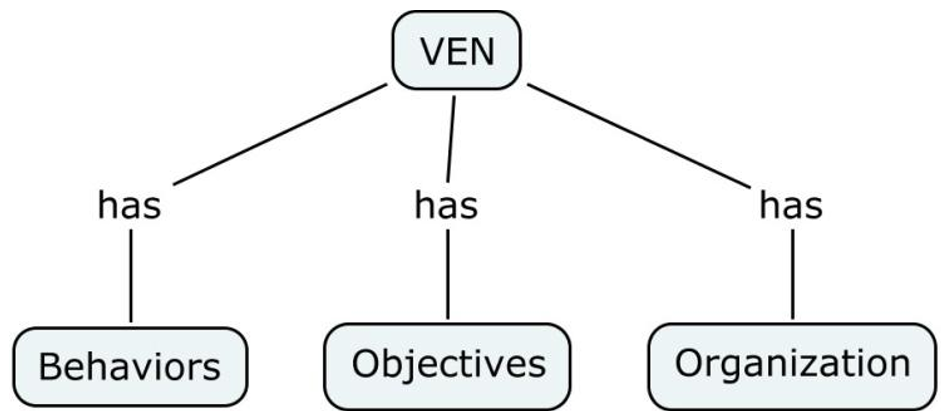 Figure 1: Top-level VEN representation within the social simulation.
Case Study: The Iraq 2008 Scenario
The study modeled an urban area of 400,000 people. The VEN was represented as a scale-free network of 15 agents. Using Social Network Analysis (SNA), the researchers identified key "hubs" (nodes 2 and 3) and a "media node" (node 10).
Eight distinct Courses of Action (COAs) were tested, ranging from "do nothing" to "fragment the network and interdict media."
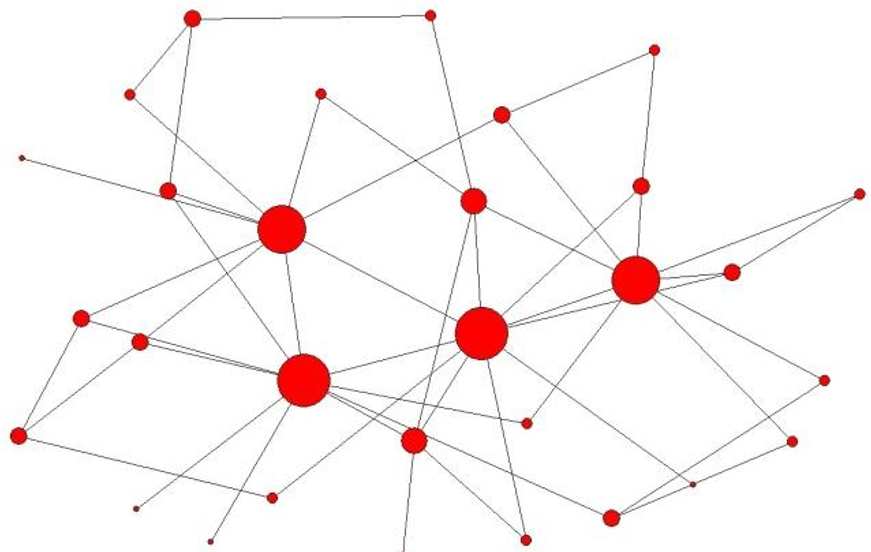 Figure 2: Network structure of the VEN, with nodes sized by their "degree" (connectedness).
Surprise in the Results: Less is More?
The results from the Design of Experiments (DOE) provided a counter-intuitive insight:
- COA 3 (Targeting only hub node 3): Resulted in the highest aggregate population satisfaction regarding security.
- COA 8 (Removing nodes 2, 3, and media): Resulted in much lower satisfaction and a collapse in constructive community communication.
The visualization of the communication networks (using the Clauset-Newman-Moore algorithm) showed that aggressive interdiction can "silence" a population or drive them into isolated, potentially radicalized clusters, rather than fostering a sense of security.
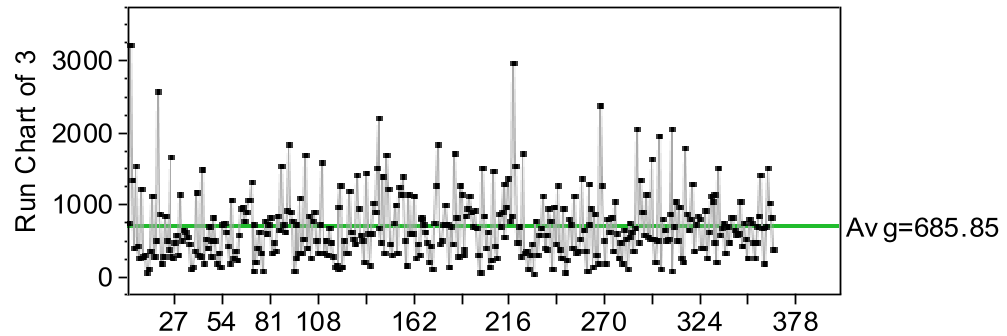 Figure 3: Visualization of potential futures for security stances across 8 different COAs.
Critical Insight & Conclusion
The power of this simulation lies in its ability to uncover second-order effects. By focusing solely on kinetic "decapitation" of a network, military planners might inadvertently destroy the very social structures that maintain civilian stability.
Takeaway: Effective counter-insurgency requires a "surgical" touch. Social simulations like the CG model serve as a critical "wind tunnel" for testing policies before they are implemented in the real world, where the costs of failure are measured in lives, not data points.
Limitations: The current model uses a static social network structure. Future work must incorporate dynamic restructuring, as extremist networks are notorious for rapidly replacing killed or captured leaders.