
MLICM: Revolutionizing Multi-Location Promotion via Viral Marketing in LBSNs
Promoting a bundle of locations via viral marketing in location-based social networks
The paper introduces the Multi-Location-aware Independent Cascade Model (MLICM) to solve the "Multi-location Promotion Problem" in Location-based Social Networks (LBSNs). It utilizes a CELF-based greedy algorithm and an MIA-based heuristic to efficiently select k seed users that maximize the reach of a bundle of locations.
TL;DR
Retail chains often face the challenge of promoting several new branches simultaneously. Traditional "one-location-at-a-time" models are computationally expensive and ignore the synergy of bundle advertising. This paper introduces MLICM, a specialized propagation model that optimizes the selection of seed users to maximize the reach of a bundle of locations, achieving up to 451% better performance than traditional heuristics on real-world datasets.
Problem & Motivation: The Retail Chain Dilemma
In Location-based Social Networks (LBSNs) like Foursquare or Facebook Check-ins, "Influence Maximization" is the go-to strategy for viral marketing. However, existing SOTA methods have a blind spot: Bundling.
If a brand opens five new stores, a naive approach would select seeds for each store independently. This fails because:
- Redundancy: The same influential user might be targeted multiple times.
- Profit Metric: Retailers care about the number of unique users who visit at least one location in the bundle, not the raw total of check-ins across all stores.
- Complex Propagation: Each location in a bundle has a different "attractiveness" or propagation probability based on its specific coordinates.
Methodology: The MLICM Framework
The authors propose the Multi-Location-aware Independent Cascade Model (MLICM). This model treats a check-in not just as an offline activity, but as an online signal that triggers information flow to friends.
1. Model Architecture
MLICM defines the influence spread as the expected number of users who check-in at one or more locations . The propagation is governed by:
This formula captures the probability that at least one location's info reaches user .
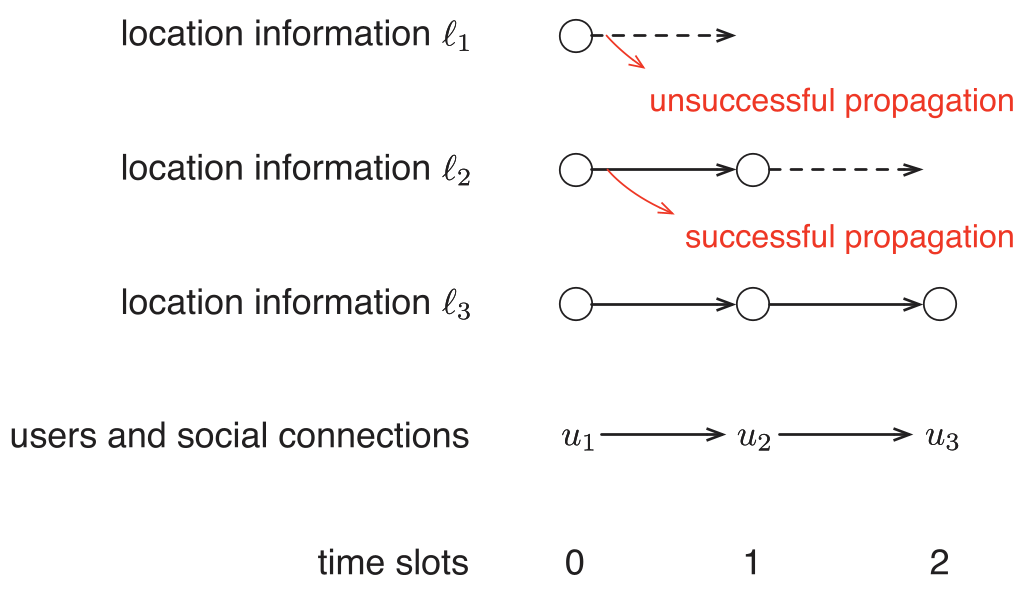 Figure 1: Example of information propagation where user u1 acts as a seed for a bundle of three locations.
2. Efficiency Breakthroughs
Calculating influence spread is #P-hard. To make this practical for large-scale networks (like Gowalla with 196k users), the authors integrated two core optimizations:
- MIA-based Heuristic: Instead of full Monte-Carlo simulations, they use Maximum Influence Arborescence (MIIA/MIOA) trees to approximate the "main paths" of influence.
- CELF (Cost-Effective Lazy Forward): Since the influence function is proven to be submodular, they use a lazy-evaluation max-heap to prune the search space for seed selection, recomputing marginal gains only when a user is a top candidate.
Experiments & Results
The researchers tested their approach against common baselines including MaxDegree (MD), Degree Discount (DD), and ShortDistance (SD).
Key Findings:
- Effectiveness: On the Brightkite dataset, MLICM (with ) outperformed the Distance-aware heuristic (MDD) by 13.78% and the Random baseline by over 331%.
- Scalability: The running time scales linearly with the number of seeds and the size of the location bundle (), making it viable for industrial use.
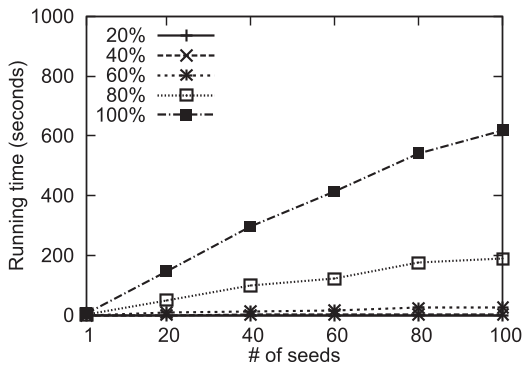 Figure 2: Influence spread comparison across different seed sizes (k) on Gowalla and Brightkite datasets.
Critical Analysis & Conclusion
Takeaway
MLICM successfully bridges the gap between theoretical influence maximization and the practical needs of multi-unit retail businesses. The primary contribution lies in the derivation of submodularity for the multi-location probability function, which allows for robust approximation guarantees.
Limitations & Future Work
- Temporal Decay: The current model assumes a static social graph. Future iterations could incorporate temporal decay, as the "freshness" of a check-in signal fades over time.
- Competition: The model assumes a single entity promoting locations. Incorporating competitive viral marketing (e.g., store bundle A vs. store bundle B) would be a natural next step.
In conclusion, by shifting the focus from "single-node influence" to "bundle-set reach," this paper provides a scalable blueprint for modern LBSN marketing.