
Beyond the Graph: Rethinking Viral Marketing for Physical Locations in LBSNs
16751_Exploiting Viral Marketing for Location Promotion in Location-Based Social Networks.
This paper addresses the "Location Promotion Problem" in Location-Based Social Networks (LBSNs). It proposes a Location-aware Independent Cascade Model (LICM) and introduces novel Distance-based Mobility Models (DMMs) to derive propagation probabilities by capturing individual check-in behaviors and spatial-categorical preferences, significantly outperforming static models on real-world datasets like Gowalla and Brightkite.
Executive Summary
TL;DR: In the world of Location-Based Social Networks (LBSNs), a friend's recommendation is only effective if the target location fits into your physical orbit. This paper identifies the "Location Promotion Problem" and replaces static social influence models with a dynamic Location-aware Independent Cascade Model (LICM). By shifting the focus from "who you know" to "where you go" via Distance-based Mobility Models (DMMs), the researchers provide a robust framework for businesses to select the best "seed" users to spark a visiting trend.
Positioning: This work is a pivotal transition from purely topological influence studies (like the classic Kempe et al. ICM) to spatio-temporal behavior modeling, bridging social network analysis with human mobility science.
The "Static" Fallacy in LBSNs
Why does a viral tweet about a new restaurant in New York fail to bring in customers from Los Angeles? Traditional influence maximization assumes propagation probability () is a fixed value based on friendship strength.
In LBSNs, the authors argue that is query-dependent. It is not just about user influencing user ; it is about whether user is physically likely or willing to travel to location . Existing models failed because:
- They ignored Individual Mobility: Everyone has a unique "activity space."
- They lacked Geographic Context: The distance between a user's current location and the target store is the ultimate bottleneck.
Methodology: The Power of Distance
The core innovation lies in the Distance-based Mobility Model (DMM). While prior works used Gaussian-based models (GMMs), these were often too rigid to capture the "long-tail" nature of human movement.
The Two-Layer Architecture of DMM
The probability of a user checking in at target is modeled as:
- Stationary Distribution (): Represents the probability of user being at an existing visited location . The authors use Random Walk with Restart (RWR) to establish these "home bases."
- Distance Preference (): A Pareto distribution representing how likely the user is to travel a certain distance. This captures the "Heavy-Tail" phenomenon: most movements are short, but occasional long-distance trips occur.
Category-Aware Sophistication
The authors further refine this by adding Categorical Preferences. If the target is a "Restaurant," the model weights the user's history and distance preferences specifically within that category, solving the data sparsity issue where a user might have many check-ins but few for a specific venue type.
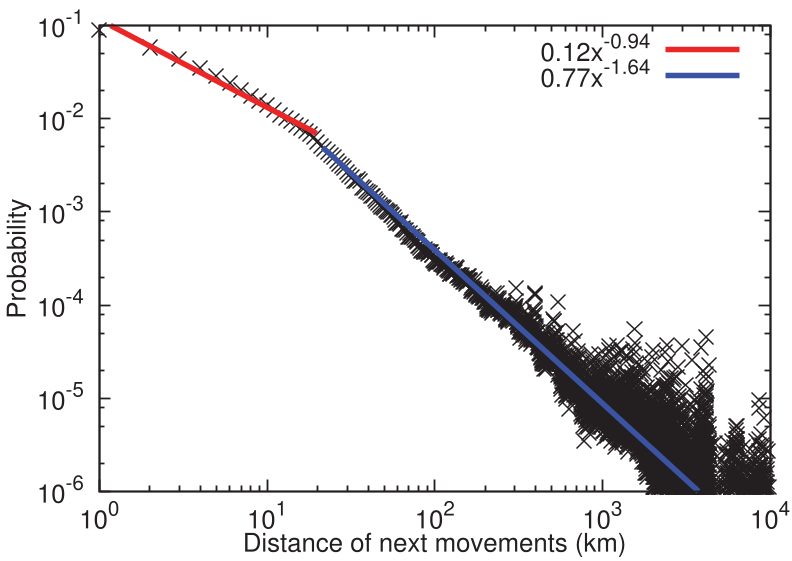 Figure: Comparison of how DMM captures check-in behavior more naturally than Gaussian distributions.
Experiments: Real-World Evidence
The team tested their models on two massive LBSN datasets: Gowalla and Brightkite.
Key Findings:
- DMM vs. GMM: DMMs showed higher log-likelihood, meaning they predict real-world check-ins with significantly more accuracy.
- Influence Propagation: When tasked with predicting who would actually visit locations like Central Park (NYC) or Caltrain Station (SF), DMMs outperformed traditional static methods (like In-degree or Jaccard similarity) by a wide margin.
- Social vs. Locality: Interestingly, the study confirms that social influence in LBSNs is a "trigger" rather than a "driver"—a user's inherent mobility habits are the primary predictor of where they go next.
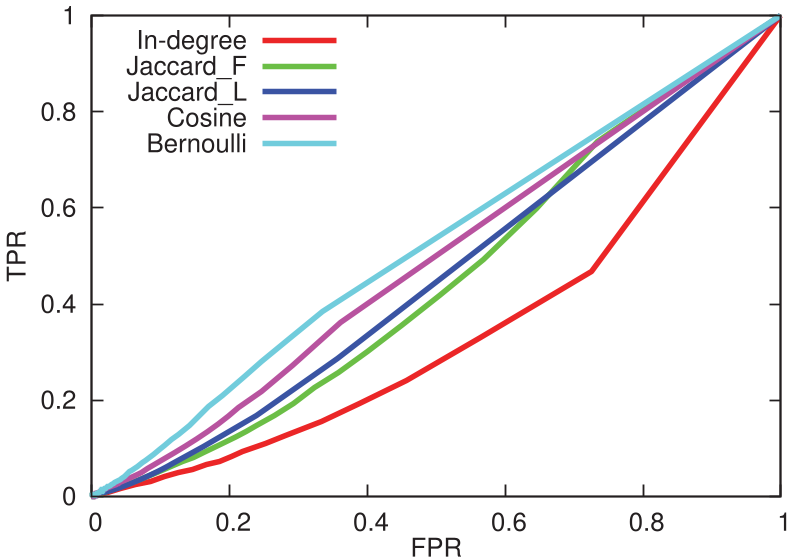 Figure: ROC Curves showing that Distance-based models significantly outperform static network benchmarks.
Critical Insight & Conclusion
The standout takeaway is the Physical Constraint of Influence. In the digital world (Twitter/Facebook), the cost of "accepting" an influence is a click. In the physical world (LBSNs), the cost is distance and time.
Future Implications:
- Precision Marketing: Businesses shouldn't just target "influencers" with high follower counts; they should target "local hubs"—users who frequently visit locations near the target venue.
- Limitations: The model assumes a stationary mobility pattern. It may not account for sudden shifts in behavior (e.g., travel/vacations) without a longer historical window.
By grounding social influence in the reality of physical distance, this paper provides a more scientific, quantifiable approach to location-based viral marketing.