
Beyond Awareness: Optimizing Cross-Sell Revenue in Social Networks
Viral Marketing for Product Cross-Sell through Social Networks
This paper introduces the Budgeted Influence Maximization with Cross-sell of Products (B-IMCP) problem, extending traditional viral marketing models to account for complementary product relationships and resource constraints. The authors propose the Linear Threshold Model for Cross-sell (LT-CP) and a greedy approximation algorithm backed by matroid theory.
TL;DR
In the world of viral marketing, most algorithms focus on a single product. This paper introduces the B-IMCP (Budgeted Influence Maximization with Cross-sell of Products) problem, which explicitly models how buying one item makes a customer more likely to buy a complementary one. By combining the LT-CP model with matroid theory, the authors provide a rigorous way to maximize revenue under real-world budget constraints.
Background: The Gap in Viral Marketing
Classic Influence Maximization (IM) asks: "Which nodes should we seed to maximize awareness?" However, for a business like IBM or Amazon, the math is more complex. Not all products cost the same to promote, and not all customers stop at one purchase.
The authors identify three missing pillars in current literature:
- Cross-sell Dynamics: Buying Product A lowers the psychological barrier to buying Product B.
- Cost-Benefit Asymmetry: Giving away a laptop costs more than giving away a mouse.
- Budget Constraints: You don't have free samples; you have dollars.
Methodology: The LT-CP Model
The core innovation is the Linear Threshold model for Cross-sell (LT-CP). In a standard LT model, a node becomes "active" when the weighted influence of its neighbors exceeds a random threshold .
In LT-CP, the process is two-staged:
- Phase 1: Nodes are influenced to buy a primary product .
- Phase 2: Once a node buys , its threshold for a complementary product is dramatically reduced (e.g., moved from a "near-impossible" state to a range of ).
The Optimization Objective
The objective is to maximize the expected revenue , defined as:

The authors prove that even with these complex cross-product dependencies, the function remains submodular and monotone, which is the "holy grail" for optimization because it allows for greedy algorithms with provable guarantees.
The Algorithmic Challenge
Because this problem involves budgets rather than simple counts, it doesn't fit a standard Matroid structure. Instead, the authors use p-system theory. They prove that the feasible seed sets form a specific type of independent set system that allows a greedy approach to find a solution within a predictable factor of the absolute optimum.
The Greedy Strategy
The algorithm iteratively picks the node-product pair that offers the highest "bang for the buck" (marginal gain divided by cost) until the budget is exhausted.
(Note: Algorithm 1 in the paper details the iterative selection of for and for based on revenue/cost ratios.)
Experimental Insights
The authors tested their approach on several real-world datasets, including WikiVote (7k nodes) and Telecom Call Data (354k nodes).
Key Findings:
- Efficiency vs. Effectiveness: The Greedy Algorithm (GA) is highly effective but computationally expensive. On the HEP dataset, GA took ~66k seconds, while the Maximum Influence Heuristic (MIH) took only ~2.5k seconds.
- Heuristic Performance: Interestingly, MIH and MDH (Maximum Degree) performed remarkably close to the GA in terms of revenue, suggesting that in practical social network topologies, high-degree nodes remain powerful even in cross-sell scenarios.
- Budget Sensitivity: As the budget increases, the revenue gap between random seeding and strategic seeding grows exponentially, highlighting the ROI of influence modeling.
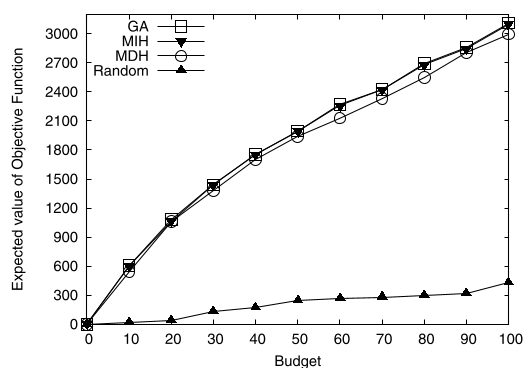 Performance comparison across different cross-sell thresholds and datasets.
Critical Analysis & Conclusion
Takeaway
This paper successfully bridges the gap between graph theory and business logic. By proving that cross-sell dynamics still satisfy submodularity, the authors provide a theoretical safety net for marketers using greedy heuristics.
Limitations
- Function Constraints: The model currently uses an "onto" function for cross-sell (one-to-one mapping). Real-world markets often have many-to-many relationships (e.g., a laptop might trigger sales for bags, mice, and software).
- Scalability: The vanilla greedy algorithm remains too slow for "massive" graphs (millions of nodes) without further optimization like CELF or sketch-based methods.
Future Outlook
The next step for this research is likely moving into Competitive B-IMCP, where multiple companies are competing for the same budget-constrained influencers to cross-sell their own specific ecosystems.