
The Digital Lexicon: How Online Jargon Shapes Group Roles and Community Evolution
Virtual play and communities: the evolution of group roles in electronic trace data
This study investigates the evolution of group roles and the development of shared jargon within an online recreational sports community over four years. By analyzing "the Code" discussion thread, the authors map out how 44 individuals leveraged 53 specific terms to bridge virtual and physical social spaces.
TL;DR
Understanding how online communities form requires looking beyond what people say to how their roles shift as they build a shared language. This paper analyzes four years of forum data from a recreational sports league to show that the development of community-specific jargon is a battlefield of negotiation, where social network positions and functional roles (Task vs. Individual) dictate the community's survival.
Contextual Positioning
Within the landscape of Computer-Mediated Communication (CMC), this work serves as a bridge between classical mid-20th-century social psychology (Benne & Sheats) and modern digital trace data analysis. It moves beyond simple sentiment analysis to look at the functional architecture of online discourse.
Motivation: The Mystery of Online Coordination
Why do some online groups coalesce into tight-knit communities while others dissolve into noise? The authors argue that the "jargon"—the "Code"—is the glue. However, developing this lexicon isn't peaceful. There is a fundamental gap in understanding how the roles people play (e.g., the "Aggressor," the "Information Seeker," or the "Harmonizer") fluctuate as a group tries to define its own identity through language.
Methodology: Marrying SNA with Role Coding
The researchers utilized a hybrid approach to parse 249 comments from 44 key participants:
- Temporal Segmentation: They identified 7 distinct periods of high activity over 4 years.
- Role Coding: Each post was categorized into:
- Task Roles: Focusing on solving the problem of defining the language.
- Maintenance Roles: Strengthening the group bond.
- Individual Roles: Pursuing personal goals, often leading to conflict (e.g., the "Joker" or "Aggressor").
- Network Visualization: Using GEPHI to map "conversational pairs," showing who talked to whom and who sat at the center of the linguistic web.
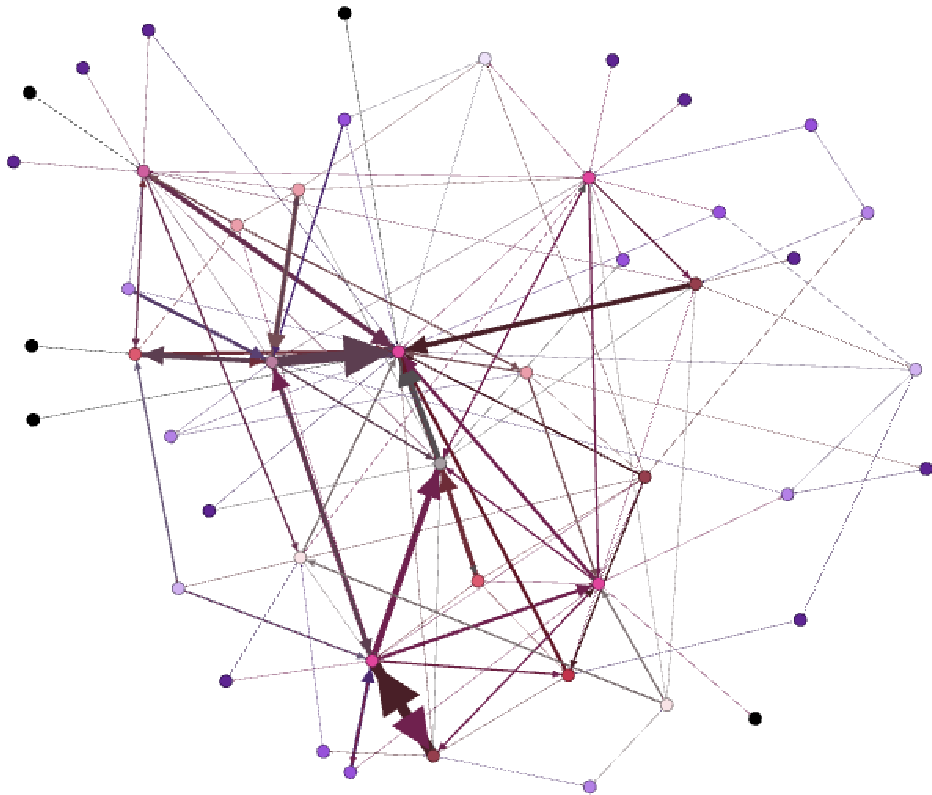 Figure 2: The Social Network Diagram showing the core-periphery structure of the community.
Key Insights from the Data
The study’s most striking finding is the correlation between role volatility and community maturity:
- The Conflict Peak: In time period 4, individual roles spiked to 73.1%. While this looks like "toxic" behavior on the surface, it actually represented the "work" of modifying the network—intense debates over the specifics of jargon that ultimately solidified the group's culture.
- Core vs. Periphery: The network diagram (Figure 2) reveals that a persistent core of actors established the language, while "peripheral" actors joined in bursts, causing fluctuations in the group's dynamic.
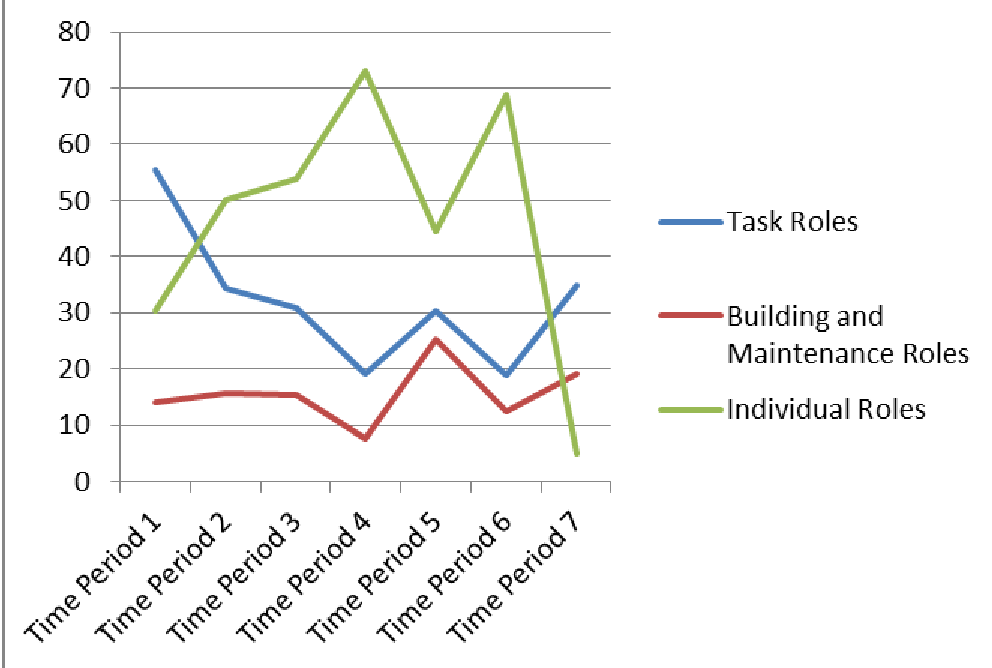 Figure 1: Distribution of Task, Maintenance, and Individual roles across the seven periods.
Critical Analysis & Future Outlook
Contribution: The paper successfully demonstrates that "Individual" roles (often dismissed as counter-productive) are actually vital for the "feedback and learning" phase of a group's evolution.
Limitations: The study focuses on a relatively small subset (44 individuals). In the era of LLMs and massive social platforms, the manual coding used here would need to be replaced by automated NLP classifiers to scale.
Takeaway for the Future: As we build AI agents to participate in human groups, training them to recognize these "Functional Roles" could be the key to creating AI that helps maintain community cohesion rather than just providing information.
References
- Arrow, H., McGrath, J.E. & Berdahl, J.L. (2000). Small groups as complex systems.
- Benne, K. D. & Sheats, P. (1948). Functional roles of group members.