
Virtual Worlds: The New Frontier of Co-creation Design Culture
Exploring the Role of Virtual Worlds in the Evolution of a Co-creation Design Culture
This paper investigates the emergence of co-creation design cultures within social media, specifically focusing on the unique role of 3D Virtual Worlds (VWs) like Second Life. It defines co-creation as a collaborative process where community members and organizations jointly develop products and services, leveraging the immersive affordances of virtual environments.
TL;DR
The shift from passive consumption to active co-creation is redefining the global economy. This paper explores how Virtual Worlds (VWs) like Second Life serve as more than just social platforms—they are sophisticated ecosystems where organizations and individuals co-create value through immersion, real-time feedback, and 3D collaboration.
Contextualizing the Experience Economy
We have moved past the industrial and service economies into the Experience Economy. In this phase, value is no longer found in a static product but in the intensity of involvement and the personal meaning derived from an event.
The author positions Virtual Worlds as a unique sub-category of social media that facilitates "co-presence"—the feeling of sharing a 3D space with others simultaneously. Unlike the asynchronous nature of Facebook or Twitter, VWs allow for synchronous, face-to-face interaction via avatars.
The Problem: The Gap Between Vision and Reality
Despite the potential for innovation, the paper identifies a significant "chasm" in the adoption of these tools:
- The Trust Deficit: Pragmatic business leaders often view virtual worlds as "dangerous" or experimental, preferring to wait for proven results.
- The Incentive Problem: Why should a user spend hours designing a virtual object for a company? Without autonomy and ownership (like the Linden Lab copyright policy), co-creation fails.
- Dimensionality Constraints: Current Web 2.0 tools lack the "ecological" depth required for truly immersive learning and design.
Methodology: The Core Affordances of 3D Worlds
The methodology hinges on a matrix that maps Virtual World Affordances against Co-Creation Challenges.
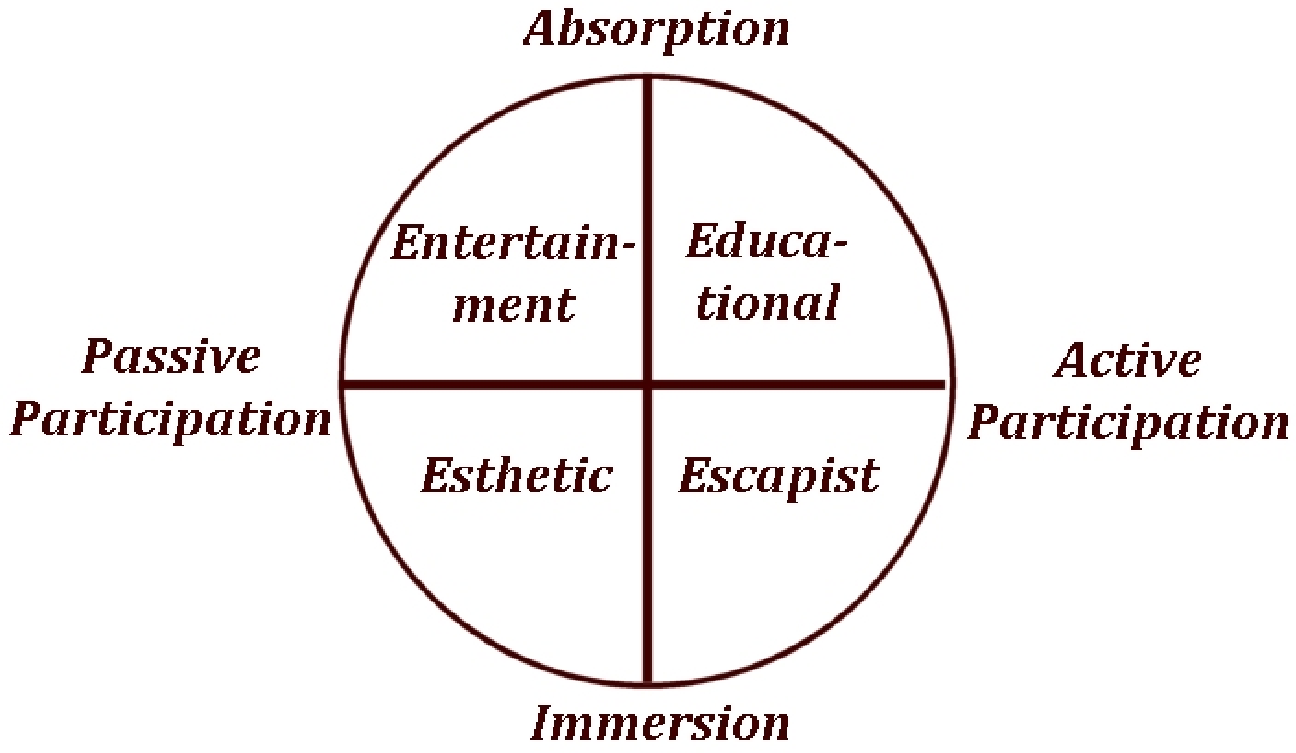 Figure 1: The Four Realms of Experience. VWs lean heavily into the "Escapist" and "Educational" quadrants through active participation.
Key Pillars of the VW Design Culture:
- Real-time Interaction: Multimodal communication (text, voice, gesture) creates a "persistence of state" that increases interest in shared tasks.
- Flexibility of Identity: Avatar embodiment allows participants to explore different facets of themselves, which can "unleash creativity" in ways real-world settings cannot.
- Collaborative 3D Mastery: The ability to modify the environment in real-time (building "prims," scripting objects) transforms the consumer into a "prosumer."
Strategic Enabling Activities
To solve the co-creation challenge, the author proposes a set of activities summarized in the research:
| Challenge | Enabling Activity in VW |
|---|---|
| Relationship Management | Use virtual workshops, brainstorming games, and "sandboxes" to lower the barrier for individual contribution. |
| Individual Investment | Enforce digital copyright ownership and create "expert user" groups with elevated land rights. |
| Skill Acquisition | Provide kits, shared whiteboards (GoogleDocs integration), and immersive role-play scenarios. |
Critical Insight: The Design Science Research (DSR) Approach
The paper advocates for a Design Science Research cycle to improve co-creation. In this model, the "product" is an IT artifact that is continuously consumed and refined.
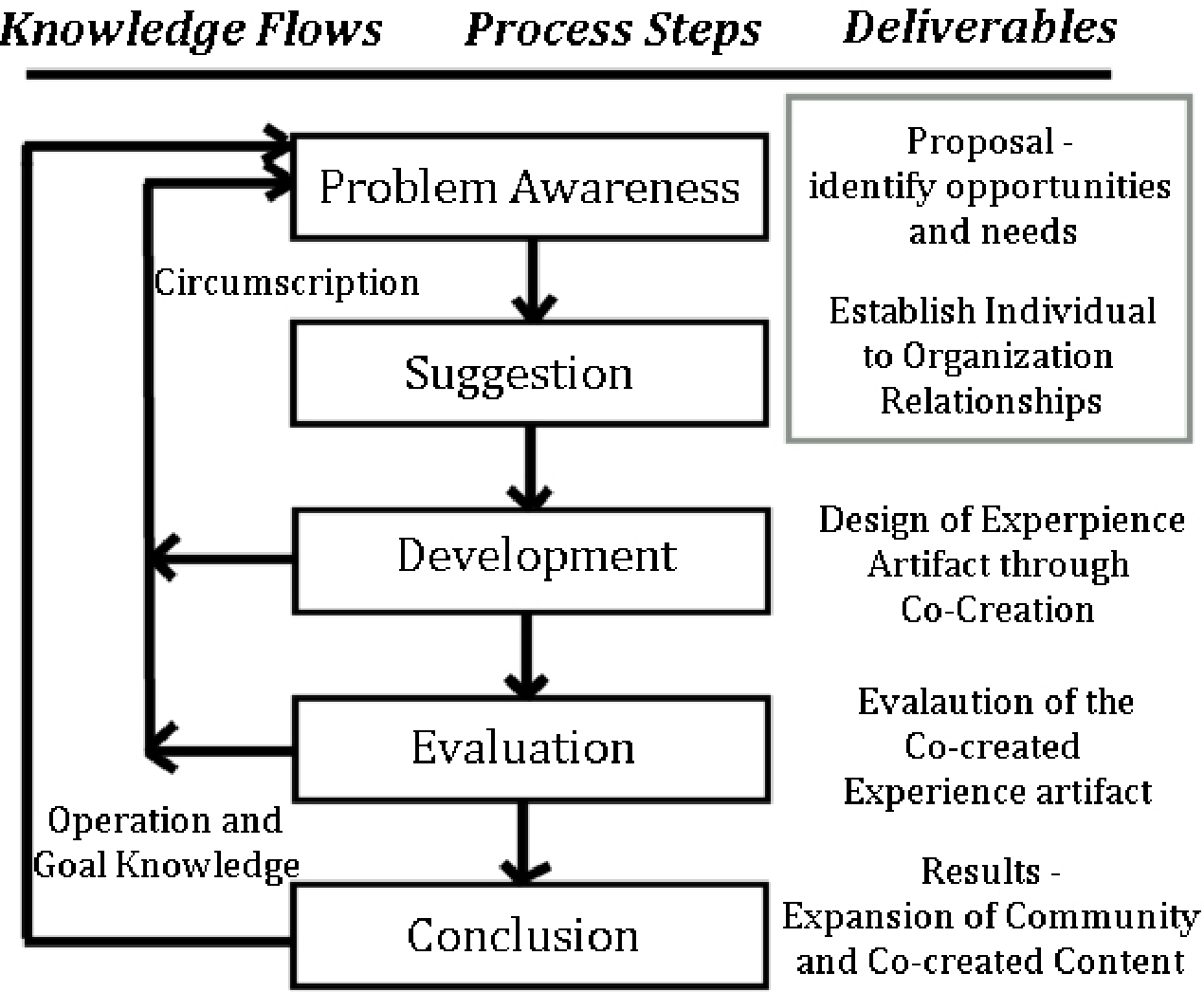 Figure 2: The DSR cycle for co-creating content. It emphasizes a feedback loop of suggestion, development, and evaluation within the virtual community.
Conclusion and Outlook
While the paper acknowledges limitations—such as the lack of "smell or taste" in virtual wine tastings and the security concerns of decentralized platforms—it remains optimistic. The evolution of a co-creation culture is not just about the technology; it is about a societal shift toward Network Individualism.
As we move toward Web 3.0, the lessons from Second Life—particularly regarding user autonomy and the "state of flow"—will be the blueprint for the next generation of global design collaboration.