
SemanticXL: Unmasking Hidden Criminal Networks via Visual Algebra
Visual Analysis of Implicit Social Networks for Suspicious Behavior Detection
The paper introduces SemanticXL, a visual analysis framework for detecting suspicious behavior in implicit social networks derived from large-scale telecommunication data. It combines a hierarchical graph data model (s-Graph and p-Graph) with specialized algebraic operators to enable non-IT expert investigators to identify criminal patterns and communities.
TL;DR
Researchers from Alcatel-Lucent Bell Labs and the French Ministry of Interior have developed SemanticXL, a tool that transforms raw phone logs into "Implicit Social Networks." By using a hierarchical graph model and a set of intuitive visual operators, it allows non-technical investigators to trace kidnappers and terrorists across multiple communication channels like mobile, landline, and VoIP.
Background: The Invisible Iceberg
Modern criminal investigations are drowning in data. When a kidnapping occurs, authorities collect IMEI numbers, SIM card logs, and cell tower pings. Traditionally, these are analyzed in spreadsheets—a "tabular hell" where complex relationships remain hidden. The paper argues that social networks are just the "visible part of the iceberg"; the real value lies in Implicit Social Networks—relationships built automatically from interaction patterns rather than explicit "friend" requests.
Methodology: The s-Graph and p-Graph Architecture
The core innovation is the decomposition of communication data into two logical layers:
- p-Graphs (Property Graphs): These represent specific "linking properties." For example, one p-Graph might represent phone calls (MSISDN), while another represents email exchanges. Each node is a "property" (a phone number), and edges are interactions (calls).
- s-Graph (Super Graph): This is the aggregate layer. It groups various properties into a single "Super Node" representing a real person.
The Formal Operator Set
To make this model searchable, the authors defined a mathematical algebra for investigators:
- (Origin/Target): Captures the directionality of information flow.
- (Neighborhood): Expands the search to identify direct associates.
- (Intersection): A critical tool for finding "common links" between two different suspect groups.
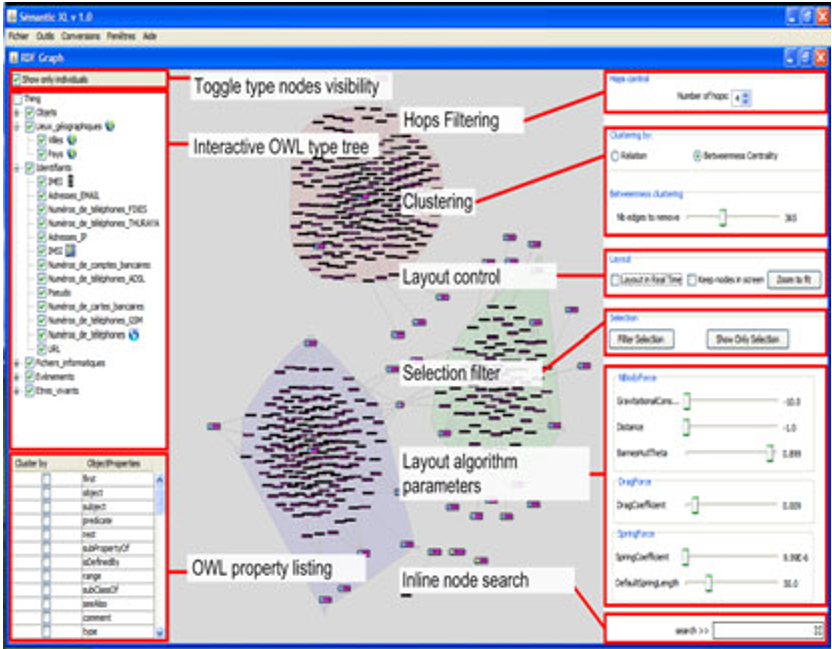 Figure 1: The system architecture showing the translation from User Actions to SPARQL queries.
Experiments: Real-World Kidnapping Scenario
The paper demonstrates the tool using the 2010 kidnapping case of "Wilhelm Gatter." Starting with a damaged mobile phone (IMEI) found in a burned car, investigators used SemanticXL to:
- Identify the SIM cards associated with the IMEI.
- Query service providers for customer details.
- Map call logs to specific geographic "cells" (towers) near the abduction site.
- Visualize the intersection between the victim's history and known police targets.
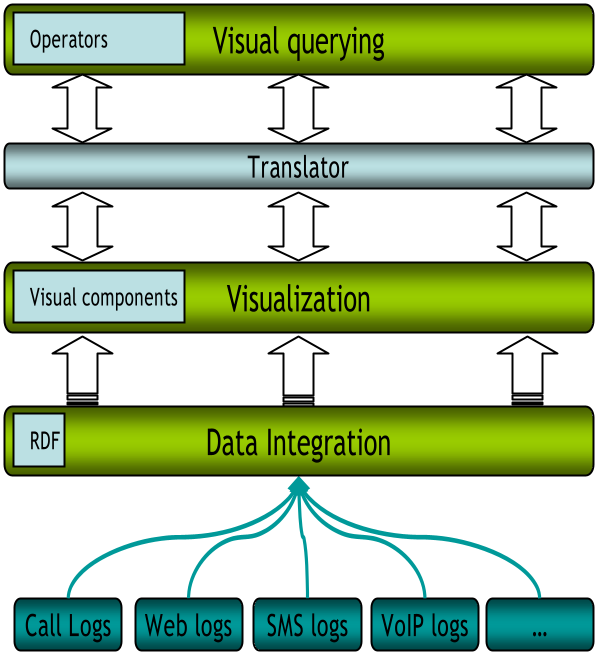 Figure 2: The SemanticXL prototype showing the force-directed graph (center) and the channel filtering (left).
Deep Insight: Beyond Simple Graph Visualization
Most SNA tools suffer from the "hairball" effect—where too many nodes make the visualization useless. SemanticXL solves this via:
- Hops Filtering: Based on the operator, it allows users to specify the degree of separation (e.g., "show me everyone within 2 calls of Suspect A").
- Centralized Attraction: By customizing the Prefuse layout algorithm with an invisible central attraction force, they prevented nodes from "crowding the borders," ensuring the focus remains on the most relevant connections.
Critical Analysis & Conclusion
Takeaway
SemanticXL bridges the gap between raw Big Data and human intuition. By formalizing visual interactions into a set of mathematical operators, it turns a visualization tool into a powerful query engine.
Limitations
- Manual Entity Resolution: The tool relies heavily on manual "ASSOCIATE" operators to link phone numbers to real identities.
- Scaling: While force-directed layouts work for hundreds of nodes, they may struggle with the millions of nodes found in city-wide data retention logs without more aggressive pre-clustering.
Future Outlook
The authors intend to integrate wider web-based data (Social Media logs) to complement telecommunication data, potentially using automated Machine Learning to suggest "suspicious clusters" before the investigator even starts the search.