
PhotoMap: Rethinking Social Photo Indexing via Hasse Diagrams and Content Propagation
Visualizing Social Photos on a Hasse Diagram for Eliciting Relations and Indexing New Photos
The paper introduces PhotoMap, a novel photo management application that utilizes Formal Concept Analysis (FCA) and Hasse Diagrams to visualize and index "social photos." It features an incremental Object Galois Sub-Hierarchy (OGSH) to organize photos by groups of people, enabling rapid indexation through a drag-and-drop "propagation" mechanism.
TL;DR
PhotoMap moves away from the tedious text-based tagging of social photos by treating indexation as a visual navigation task. Using Formal Concept Analysis (FCA), it organizes photos into a Hasse Diagram based on the people they contain. Users can index new photos by simply dragging them onto existing groups, allowing metadata to "propagate" instantly.
Strategic Position: This work provides a human-in-the-loop alternative to face recognition, bridging the gap between manual labor and full automation by optimizing the cognitive load of organizational tasks.
The Motivation: Why Indexing is "Broken"
In the era of social media, "social photos" (parties, weddings, reunions) are abundant, yet their metadata is often poor. The authors identify a "productivity wall":
- Face Recognition Limitations: In 2008 (and often still today), varied lighting and occlusions make auto-tagging unreliable for casual snaps.
- The Multiple-Inheritance Problem: Traditional folders or single-inheritance hierarchies can't represent a photo containing "Alice, Bob, and Charlie" without duplicating it in three places.
- The Boredom Factor: Standard tagging (typing names) is so repetitive that users frequently abandon the task before completion.
Methodology: The Power of the Hasse Diagram
The core innovation is the use of an Object Galois Sub-Hierarchy (OGSH) displayed as a Hasse Diagram.
1. From Concept Lattice to Visualization
In FCA terms, photos are objects and people are attributes. A concept is a unique subset of people found in one or more photos.
- Nodes: Represent a specific group of people.
- Edges: Represent inclusive relationships (e.g., a link from "Alice & Bob" to "Alice, Bob, & Charlie").
2. Maintaining the Mental Map
Unlike static layout algorithms, the authors propose an Incremental Force-Directed Placement (FDP) algorithm. When a new photo is added:
- X-axis: Positioned based on the rank (number of people in the photo).
- Y-axis: Positioned based on the Hamming distance (similarity to other groups). This ensures that the diagram stays stable as it grows, preventing the user from getting lost.
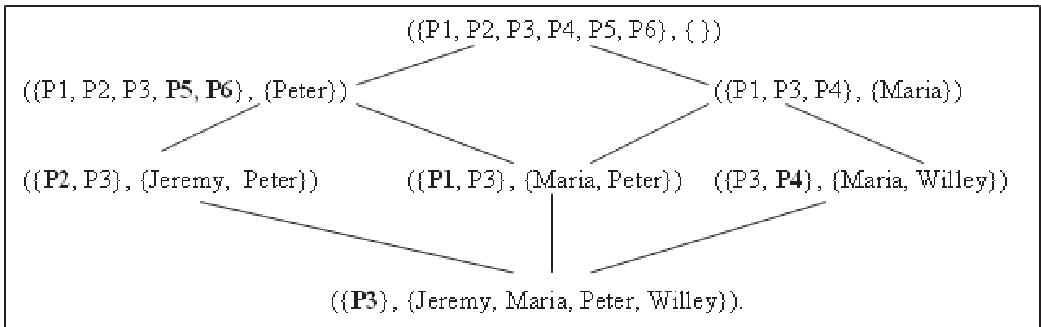 Fig: A Concept Lattice where photos are pruned to create an Object Galois Sub-Hierarchy.
3. Productivity via Propagation
Instead of typing, a user drags an "indexee" (new photo) toward "indexers" (already tagged photos).
- Set Union: If you drag a photo onto a group containing "Jeremy" and another containing "Maria," the system suggests the union: {Jeremy, Maria}.
- Intruder Removal: If an extra person is suggested, the user simply clicks the name in the sidebar to subtract them.
Experiments: Fun vs. Functionality
The researchers conducted comparative tests against Facebook and Flickr using 40 social photos.
Key Results:
- Navigation Speed: PhotoMap was ~45% faster (11s vs 20s) because the Hasse Diagram naturally groups people into recognizable social clusters.
- User Retention: In the Facebook/Flickr groups, 7 out of 17 participants quit because they were "bored." In the PhotoMap group, 0% quit.
- Scalability Tools: Features like the "Spreader" (hovering over a pile to expand photos) and "Bulk Indexing" (tagging containers of photos) were critical for user satisfaction.
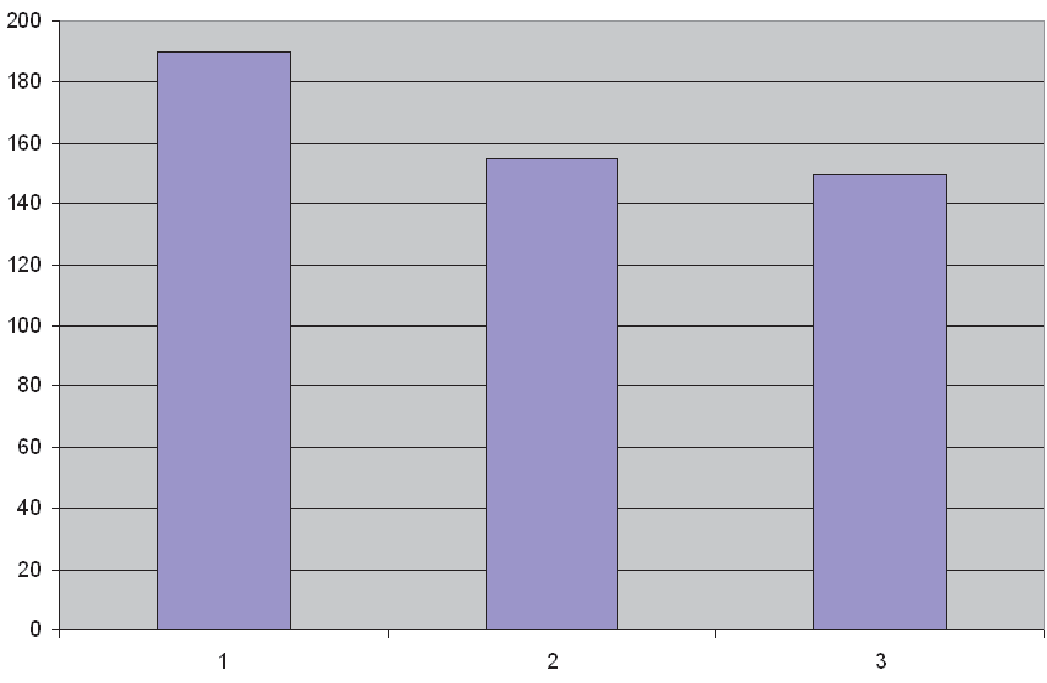 Fig: User feedback ranking PhotoMap high on Simplicity, Quality, Assistance, and Fun.
Critical Insight: The Reward of Metadata
The authors argue that people only index photos if there is a reward. Beyond faster tagging, PhotoMap offers a window into Social Network Analysis. By looking at co-occurrences in the Hasse Diagram, the system can:
- Generate "Personalized Albums" (e.g., everyone Alice is frequently seen with).
- Visualize "Social Clouds" based on group proximities.
Limitations & Future Work
While effective for dozens of photos, the Hasse Diagram faces scalability challenges when handling thousands of shots. The edges may become "spaghetti" (edge crossing). The authors suggest future versions use scrollable grids, pan-and-zoom interfaces, and filtering by specific individuals to manage visual complexity.
Takeaway
PhotoMap proves that complex mathematical structures like Galois Lattices are not just for theoretical computer science—they are powerful UI/UX tools that can align digital organization with our natural social intuition.