
CVM: Empowering Users to Decipher Cultural Nuances in Digital Interfaces
A Vocabulary to Access Users’ Cultural Perspectives in Human-Computer Interaction
This paper introduces a specialized vocabulary based on Cultural Viewpoint Metaphors (CVM) to help users articulate their experiences with cross-cultural interfaces. Tested via the Englishtown platform, the method enables non-experts to provide high-quality feedback on cultural approximation and linguistic mediation in HCI.
TL;DR
Designers often embed cultural "marks" in software, but users lack the words to describe how these marks affect them. This paper introduces the Cultural Viewpoint Metaphors (CVM)—a toolkit of five conceptual metaphors that allow users to evaluate their "journey" through foreign cultural contexts. By giving users a professional vocabulary, the researchers found that even non-experts could provide deep, structural insights into cross-cultural UI design.
Background: The Invisible Wall of Culture
In our globalized digital landscape, every interaction is potentially an intercultural encounter. However, most users experience culture in HCI as a "gut feeling"—they know something feels "foreign" or "uncomfortable," but they can't explain why. Prior work has often focused on localization (translation) rather than the semiotic experience of cultural mediation.
Methodology: The Five Stages of Cultural Journey
The authors propose that interacting with a cross-cultural system is like a traveler's journey. They defined five distinct metaphors representing a continuum of cultural approximation:
- Domestic Traveler: No foreign exposure; the user remains in their cultural comfort zone.
- Observer at a Distance: Cultural markers are provided as "bits of information" or curiosities.
- Guided Tour Visitor: Cultural contrasts are explained in the user's native language.
- Foreigner with Translator: Direct experience of foreign practices but with linguistic support.
- Foreigner without Translator: Total immersion; the user is treated like a native of the foreign culture.
 The CVM continuum showing different levels of cultural mediation.
The Experiment: Testing with Englishtown
The researchers applied this vocabulary to Englishtown (ET), an online language school. The study followed a two-step process:
- Expert Inspection: An HCI evaluator used CVM to map out the ET website's features (e.g., matching videos to "Foreigner without Translator").
- User Evaluation: Five Brazilian users were taught the CVM vocabulary and asked to describe their experience using these terms.
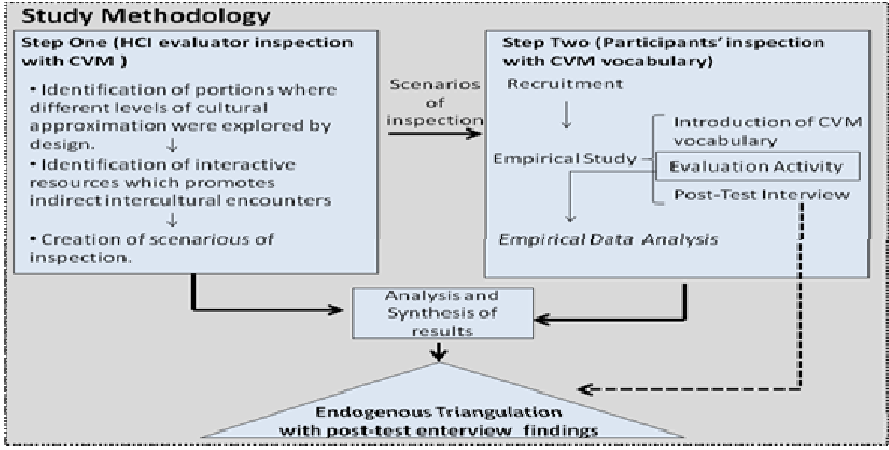 Overview of the research methodology.
Key Insights: Beyond Simple Labeling
What makes this study remarkable is not just that users could use the words, but how they used them.
- Productive Adaptation: One participant (P2) described the "Observer at a Distance" metaphor as a "honeypot"—a way to entice users to learn more.
- Critical Awareness: Users realized that translation is a form of cultural filter. P4 noted that without knowing the language, they were accessing culture through "somebody else’s point of view," losing the authentic essence.
- Design Foresight: Users began suggesting redesigns. For example, suggesting that quizzes should move from simple "Right/Wrong" (Domestic) to a "Guided Tour" approach to explain why an answer is culturally significant.
Critical Analysis & Conclusion
The study proves that vocabulary is power. By providing a semiotic framework, the authors transitioned users from passive consumers to "co-designers" who can pinpoint exactly where cultural mediation fails or succeeds.
Takeaway for Designers: Don't just localize; consider the "cultural viewpoint" you are forcing upon your user. Are you a guide, a translator, or are you throwing them into the deep end?
Limitations: The study was conducted in a "Linguistic Domain" (language learning), where culture is the primary product. The next frontier is testing whether this vocabulary remains as powerful in "neutral" domains like financial software or enterprise tools.
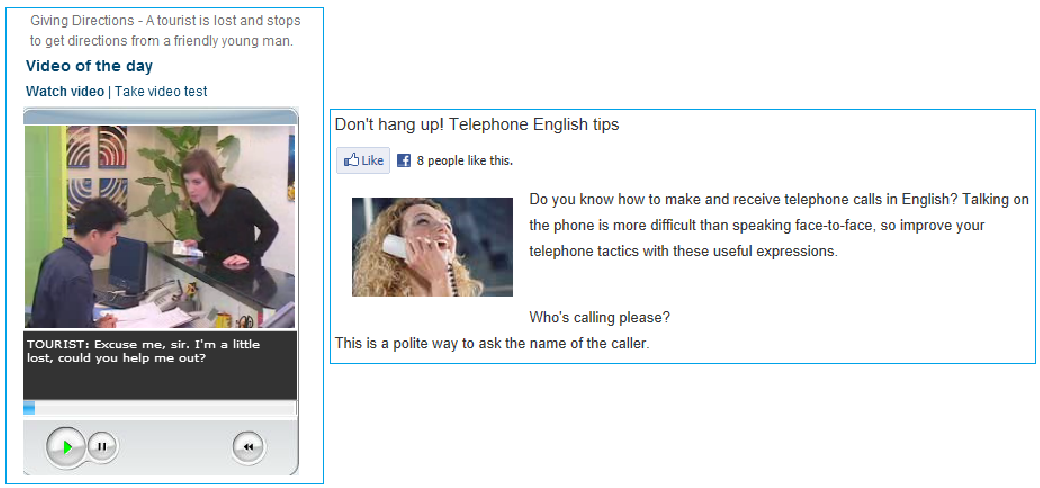 Example of the interactive resources (videos and lessons) evaluated using CVM.