
Beyond the Script: Real-Time Voice Emotion Recognition for the Real World
Voice Emotion Recognition in Real Time Applications
The paper presents a real-time Voice Emotion Recognition (VER) system utilizing ensemble machine learning models trained on both standardized actor-based datasets and a "custom" dataset of non-professionals. It evaluates the impact of "imperfect" real-world data on performance, achieving a high validation accuracy of 89.82% using Gradient Boosting.
TL;DR
Most AI models learn emotion from actors who over-act. This paper breaks that mold by introducing a "custom" dataset of regular people, proving that while "imperfect" data slightly lowers accuracy (from 89.8% to 87.3%), it creates models that actually work in everyday scenarios. Using ensemble methods like Gradient Boosting, the authors achieve SOTA-level performance for real-time applications.
The "Actor Gap" in Affective Computing
Why does your voice assistant feel so robotic? Or why do emotion-detection models fail when used by a stressed student or an Alzheimer's patient? The problem lies in the training data. Standard datasets like RAVDESS or TESS use professional actors. While great for high accuracy, these "perfect" expressions don't reflect the subtle, often suppressed, or "messy" emotions of real life.
The authors argue that for real-time applications—such as adjusters for video game difficulty or assistants for patients with dementia—we need models trained on common people who might not be "perfect" at reflecting their emotions through their voice.
Methodology: The Power of Ensemble Learning
The study utilizes the INTERSPEECH 2010 paralinguistic challenge feature set, a gold standard in the field that extracts various acoustic properties (pitch, energy, etc.) from audio.
The researchers compared five major architectures:
- SVM (Support Vector Machine)
- Random Forest
- Bagging
- Gradient Boosting
- RNN (Recurrent Neural Networks)
Architecture & Data Strategy
The most critical contribution is the addition of a Custom Dataset. Unlike actors, these participants were non-experts asked to imagine scenarios.
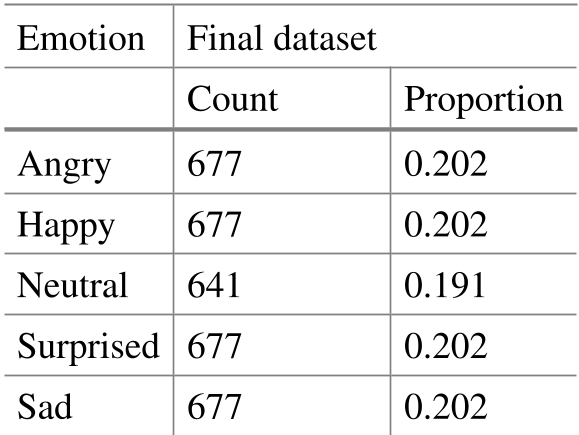 Table 1: The balanced distribution of the final merged dataset ensures no class bias.
Experimental Results: Why Gradient Boosting Wins
Interestingly, despite the massive hype around Deep Learning, traditional Ensemble Methods (Gradient Boosting and Bagging) crushed RNNs in this task.
Performance Comparison
- Without Custom Data: Gradient Boosting reached 89.82% accuracy.
- With Custom Data: It maintained a robust 87.34%.
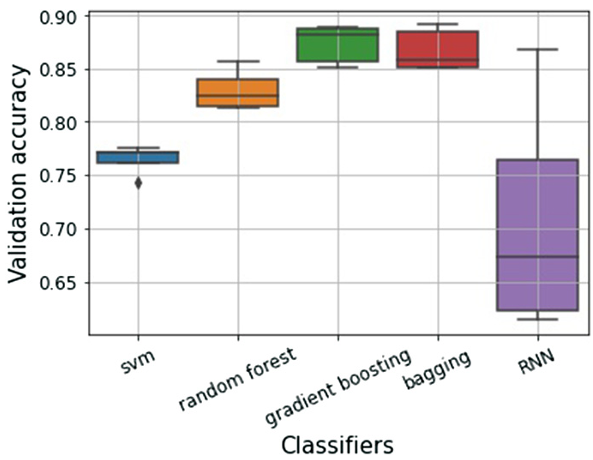 Figure 1: Comparison of classifier performances. Notice the consistent lead of Ensemble methods over RNNs.
As seen in the tables, the RNN performed poorly (70.8% with custom data), likely because the dataset size, while rich, wasn't sufficient for the high-parameter demands of deep recurrent architectures compared to the efficient feature-based learning of Gradient Boosting.
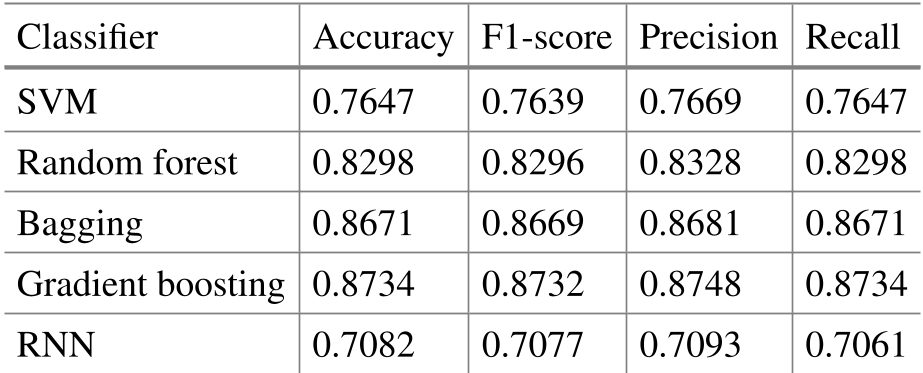 Table 3: Results including the "Imperfect" custom dataset.
High-Level Insights & Nuance
The authors performed a deep dive into the Confusion Matrix. They found that:
- Neutrality is the easiest to detect (93% accuracy).
- Happiness is the most elusive (84%), often confused with Surprise or Anger. This makes sense: high-arousal emotions share similar acoustic profiles (loudness, rapid pitch changes).
Critical Analysis & Future Directions
The paper makes a compelling case for realism over perfection. By deliberately "corrupting" a clean dataset with non-actor recordings, the resulting model gains an Inductive Bias towards everyday human speech patterns.
Limitations:
- The study is limited to 5 emotions.
- It primarily relies on acoustic features rather than semantic content (what is actually being said).
Future Work: The authors plan to integrate Speech-to-Text (STT) to analyze the semantic meaning of words alongside their acoustic properties. Furthermore, they intend to use EEG (Brain-Computer Interface) experiments to provide a physiological "ground truth" for emotions, moving beyond subjective labels.
Final Verdict
For engineers building real-time voice interfaces, the takeaway is clear: Don't just trust actor-based SOTA. Mix in real-world data and favor Ensemble Methods like Gradient Boosting for a better balance of speed and generalized accuracy.