
VoteTrust: Turning Rejections into Weapons Against Social Network Sybils
VoteTrust: Leveraging Friend Invitation Graph to Defend against Social Network Sybils
VoteTrust is a scalable defense system designed to identify fake accounts (Sybils) in Online Social Networks (OSNs) by modeling friend invitation interactions as a directed, signed graph. It employs a two-stage mechanism—voting-based Sybil detection and Sybil community detection—achieving significant precision gains (up to 32.9% - 50.1% over TrustRank) and successfully detecting over 190,000 colluding Sybils in a real-world Renren deployment.
TL;DR
Sybils (fake accounts) have evolved; they no longer live in isolated clusters but actively "infiltrate" real user circles by exploiting human curiosity to accept friend requests. VoteTrust shifts the defense paradigm from the Social Graph (who you know) to the Friend Invitation Graph (who rejected you). By combining PageRank-style trust propagation with rejection-based weighting, it identifies stealthy, colluding Sybil communities that traditional SOTA methods like SybilRank miss.
The "Infiltration" Problem: Why Social Graphs Are Failing
For years, the academic consensus was that Sybils are isolated. We assumed a "bottleneck" existed where fakes couldn't bridge the gap to real users. The reality is harsher: the authors’ study on Renren revealed that 50% of Sybils have more than 32 real friends.
The core problem is that traditional defenses (SybilLimit, SybilRank) only look at positive edges. If a Sybil successfully tricks a few real users, those positive edges act as bridges for trust to leak into the Sybil region. Furthermore, real users who are simply "unpopular" look mathematically identical to Sybils in a pure trust-propagation model.
Methodology: The Power of Persistent Rejection
VoteTrust's innovation lies in its treatment of a friend request as a signed interaction. While a Sybil can forge 1,000 "acceptances" from its own fake clones, it cannot force a real user to accept its request.
1. Trust-Based Vote Assignment (Pruning the Clones)
The system starts by assigning "Vote Capacity" to users, starting from known trusted seeds. Because the Sybil region has limited "In-links" (genuine requests from real users to Sybils), the total vote capacity that can leak into the Sybil cluster is strictly bounded. This prevents Sybils from "vouching" for each other with high-weight votes.
2. Global Vote Aggregation
Instead of a simple acceptance rate, VoteTrust calculates a Global Acceptance Rate (GAR).
 Fig 1. The Friend Invitation Graph: Solid lines are accepted, dashed are rejected.
A vote (acceptance or rejection) from a highly trusted user carries more weight. If a trusted user rejects you, your GAR drops significantly. The formula uses a Wilson score interval to ensure that new users with few interactions aren't unfairly banned before they have enough "conclusive" feedback.
3. Sybil Community Detection (The Cleanup)
Once the voting phase identifies "Seed Sybils," the system uses Bad Score Propagation. It flips the graph and propagates a "maliciousness score" backwards. It then expands the community by looking for nodes that are accepted by the Sybil core but rejected by the outside world.
Experiments: Real-World Superiority
The authors tested VoteTrust against SybilRank and TrustRank on the Peking University (PKU) Renren sub-network.
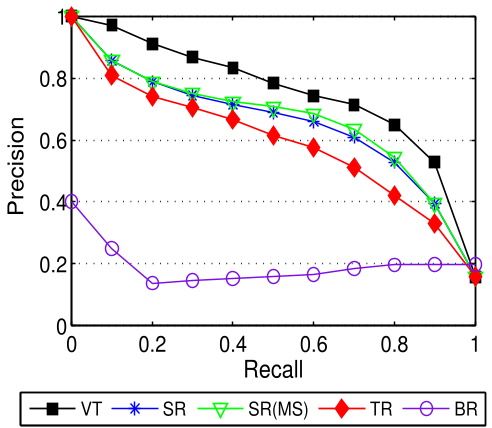 Fig 2. Precision-Recall Comparison. VoteTrust (VT) consistently outperforms TrustRank (TR) and SybilRank (SR).
Key Findings:
- Higher Precision: VoteTrust reached significantly higher precision because it could distinguish between "unpopular real users" (who have low trust but few rejections) and "Sybils" (who have low trust and many rejections).
- Massive Scale: In full deployment on Renren using a distributed Giraph implementation, it unmasked a single community containing 112,538 colluding Sybils.
- Resilience: The system proved mathematically that an attacker’s ability to send requests (attack-links) is linearly bounded by the number of requests they receive from real users—a much harder metric for an attacker to manipulate.
Critical Insight & Perspectives
The most profound takeaway from VoteTrust is the asymmetry of adversarial effort. It is easy for an attacker to generate positive signals (cloning accounts, "liking" each other). It is incredibly difficult for them to minimize negative signals from a vigilant population.
However, the paper highlights a rising threat: Compromised Accounts. If an attacker buys a "venerable" account with a high existing trust score, VoteTrust may struggle during the initial phase of the takeover. Future work must likely combine this graph-based approach with behavioral change detection (e.g., a sudden shift in request patterns).
Conclusion
VoteTrust proves that the best way to catch a liar is not just to see who they talk to, but to see who refuses to talk to them. By leveraging the "Friend Invitation Graph," OSN providers can turn the simple act of "ignoring a request" into a powerful signal for platform integrity.