
Wallop: Reclaiming the Digital Space for Real-Life Friendships
Wallop: designing social software for co-located social networks
This paper introduces Wallop, a social software application designed specifically for co-located social networks. It leverages shared media (photos, blogs) and communication metadata to foster social awareness and streamline the planning and re-experiencing of local social events.
TL;DR
In an era where the Internet was feared to be an isolating force, Wallop emerged as a pioneering research project from Microsoft Research. It was designed not to connect strangers, but to deepen the bonds of co-located friends. By integrating shared media with implicit social mapping, Wallop proved that technology can significantly enhance friendship satisfaction and community awareness when built around real-world social circles.
Problem & Motivation: The "Internet Paradox" vs. Social Reality
In the late 90s and early 2000s, academic sentiment toward social technology was surprisingly grim. Scholars like Kraut and Nie argued that the Internet was making people lonely by replacing face-to-face time with "weak ties" and anonymous chat rooms.
The authors of the Wallop paper noticed a different trend: active, social people in urban centers (like Seattle) weren't using the web to escape reality—they were using it to coordinate it. However, they were forced to "hack" together disparate tools:
- Email lists for planning.
- Phone calls for urgent coordination.
- Early photo sites for re-experiencing events.
The insight here was powerful: There was no single framework that exploited the collective content and behavior of a known, local social network.
Methodology: Engineering Social Awareness
Wallop was built to create a "socially translucent" space where interactions were visible and meaningful.
1. Implicit Social Mapping
Unlike modern platforms that require a "Follow" or "Friend" request, Wallop experimented with inferred connections. By analyzing who talked to whom and who appeared in photos together, the system generated a Social Map.
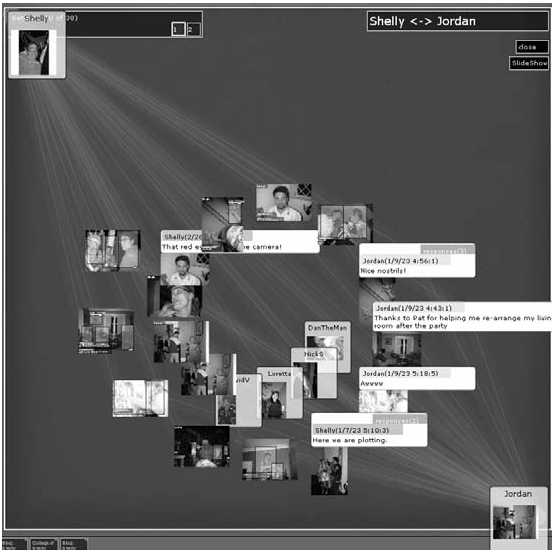 Figure: The Social Map places the user at the center, dynamically positioning friends based on interaction similarity.
2. The Halo Editor & Contextual Conversations
The "Core" of Wallop's engagement was the Halo Editor. It allowed users to tag specific areas of photos and start conversations directly on the media. This mirrors what we now see in Instagram comments or Facebook tags, but in 2003, it was a radical shift toward making media "conversational."
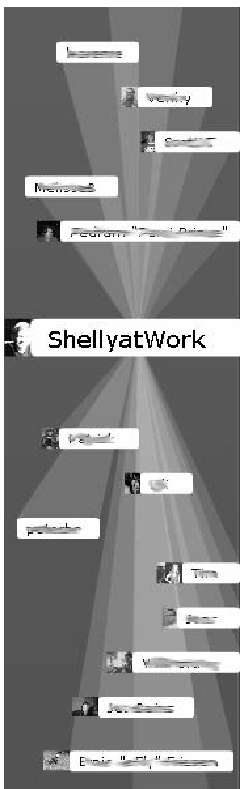 Figure: Conversations are anchored to specific objects or photos, fostering "social overhearing."
Experimental Results: Technology as a Social Catalyst
Before deploying the app, the researchers conducted a questionnaire that debunked several myths about "Internet isolation":
- Planning Dominance: People used email and mailing lists (33%) as much as the phone for planning social lives.
- Positive Correlation: Increased email use was tied to higher Intimacy and Community scores.
- Physical Connectivity: The majority of people interacted with online were also seen face-to-face.
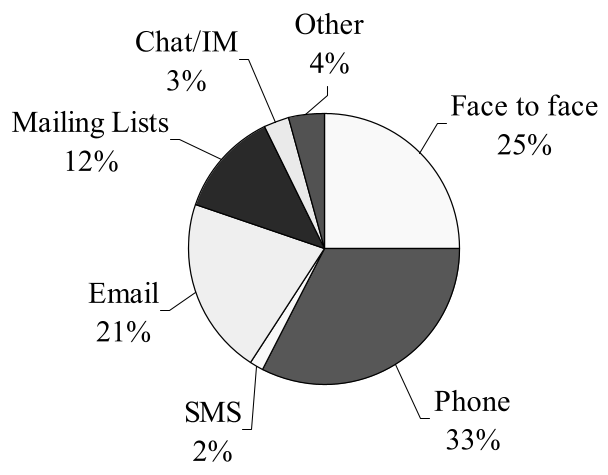 Figure: Quantitative data showing that digital tools were already primary drivers for real-world activity coordination.
Critical Analysis & Conclusion
Wallop provided a blueprint for what we now take for granted in social media, but with a crucial distinction: it prioritized the existing group over the algorithm.
Key Takeaways:
- Social Translucence: Making social "behavior" visible (who is talking to whom) promotes accountability and trust.
- Conversations > Profiles: The authors correctly predicted that we learn more about people by "overhearing" their interactions with others than by reading their self-written "About Me" sections.
- Limitations: The initial UI was criticized for being complex, and users were wary of "undesirable connections" appearing in their social maps—a precursor to the privacy and "blocking" debates of today.
Future Outlook: As we move toward more immersive "metaverse" or AR-driven social spaces, the lessons of Wallop remain relevant: the most powerful social apps are those that simplify the path back to face-to-face connection.