
Stabilizing the Chaos: Distributed Selfish Routing with Time-Varying Delays
11016_Wardrop Equilibrium in Discrete-Time Selfish Routing With Time-Varying Bounded Delays.
This paper presents a distributed, discrete-time routing algorithm for multicommodity flows that converges to a Wardrop equilibrium under heterogeneous, time-varying, and unknown bounded delays. The authors propose two variants: a local measurement-based approach and an information-sharing approach, both proven stable using LaSalle’s invariance principle.
TL;DR
Achieving a Wardrop Equilibrium—where no agent can reduce their travel time by switching paths—is a cornerstone of network efficiency. However, in the real world, delays in feedback often lead to "selfish" agents making poor decisions. This paper introduces a robust discrete-time algorithm that forces multicommodity network flows to converge to an equilibrium even when latency measurements are stale, time-varying, and unknown.
Background: The Price of Stale Information
In a "selfish routing" scenario, every packet or vehicle picks the fastest route. In theory, this leads to a Wardrop Equilibrium. But there is a catch: if the observation of network congestion is delayed (stale information), agents might all switch to a seemingly "clear" path simultaneously, creating new bottlenecks and leading to system-wide instability.
The authors tackle two major hurdles:
- Discrete-Time Dynamics: Most theoretical models assume continuous adjustments, which don't exist in digital controllers.
- Heterogeneous Delays: Different commodities might see different parts of the network with varying delay bounds.
Methodology: The (ε, δ)-Wardrop Equilibrium
The core innovation lies in the definition of an -Wardrop Equilibrium. Instead of demanding perfect equality in path latencies, the authors recognize that:
- (Tolerance): A small difference in latency is acceptable and prevents "jitter" in routing decisions.
- (Significance): We only care about equalizing latencies on paths that actually carry significant traffic.
The Control Law
The algorithm moves traffic from high-latency paths to low-latency paths using a specific Migration Policy. The migration only happens if the measured latency difference exceeds the threshold .
 The network is modeled as a set of edges and paths where multiple commodities (source-destination pairs) compete for capacity.
Ensuring Stability via Lyapunov Theory
To prove that this wouldn't oscillate, the authors used the Beckmann Potential—a mathematical "energy function" of the network. They proved that their specific control gain (which accounts for the maximum possible delay ) ensures that this potential function always decreases over time, eventually landing the system in a stable state.
Experiments and Insights
The researchers simulated a complex network with 17 edges and 2 distinct commodities.
- Fixed Tolerance: Using a constant lets the system reach a "neighborhood" of the equilibrium quickly but prevents it from getting perfectly optimized.
- Dynamic Tolerance: By allowing to decay as the system stabilizes (requiring minor communication between commodities), they achieved much tighter convergence.
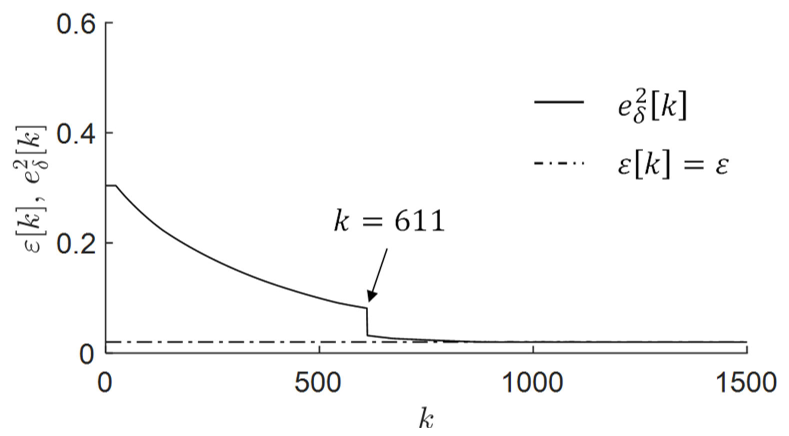 The middle plot shows latencies converging over time, while the lower plot demonstrates the 'mismatch' error dropping towards the tolerance threshold.
Critical Analysis & Conclusion
The beauty of this work is its robustness. It doesn't require agents to know the "latency functions" (how congestion grows with traffic); they only need to measure the current delay.
Limitations: The algorithm currently assumes a constant traffic demand . In future smart cities or volatile data networks, this demand fluctuates. Integrating "Time-Varying Demand" into this delayed-feedback loop will be the next frontier for this research.
Takeaway for Engineers
If you are building decentralized load balancers or routing protocols, don't chase perfect equilibrium. By introducing a "dead-band" () and a significance threshold (), and tuning your gains based on the worst-case communication lag (), you can guarantee stability in an unruly, delayed environment.