
WARP: Reclaiming Social Data Sovereignty through Information-Centric Networking
WARP: A ICN architecture for social data
This paper introduces WARP, a decentralized Social Network architecture based on Information-Centric Networking (ICN). WARP shifts data ownership from centralized providers to users by utilizing "Butlers" for local storage and "Thread Updates" for dynamic access control, achieving privacy-preserving content distribution without sacrificing the performance benefits of network caching.
TL;DR
The current social media landscape is built on a "data-for-service" trade-off that compromises user privacy. WARP is a research framework that leverages Information-Centric Networking (ICN) to flip the script. By separating data generation from distribution, WARP allows users to keep their content on personal "Butlers" while using efficient network caches (Distributors) to reach friends—all while maintaining the power to revoke access to "wild" data via specialized control channels called Thread Updates.
Background: The Price of "Free" Social Networks
Centralized OSNs like Facebook or Twitter are the custodians of digital identities. They own the social graph and the data, often sharing it for profit or government monitoring. Decentralization is the obvious cure, but it has historically faced a "trilemma" of Privacy, Performance, and Scalability.
- P2P models (like Tribler) suffer from high latency.
- DHT-based models (like Cachet) face unsustainable computational overhead for key revocation.
- Standard ICN (like NDN) secures data but lacks a mechanism for the producer to control replicas once they are cached in the network.
The Core Insight: Securing the Data, Not the Channel
The authors argue that ICN is mature enough to solve these issues if we stop trying to secure the "pipe" and start securing the "object." WARP introduces a two-tier overlay:
- The Butler: A personal server (hardware or cloud-based) that manages your identity, social links, and encryption.
- The Distributor: Third-party caches (could even be an OSN provider) that store encrypted blobs.
Methodology: Dynamic Access via Thread Updates
The "secret sauce" of WARP is the Thread Update (TU) protocol. In a standard ICN, once a piece of content is cached, it stays there until it expires. In WARP, every content object is linked to a TU—a control channel.
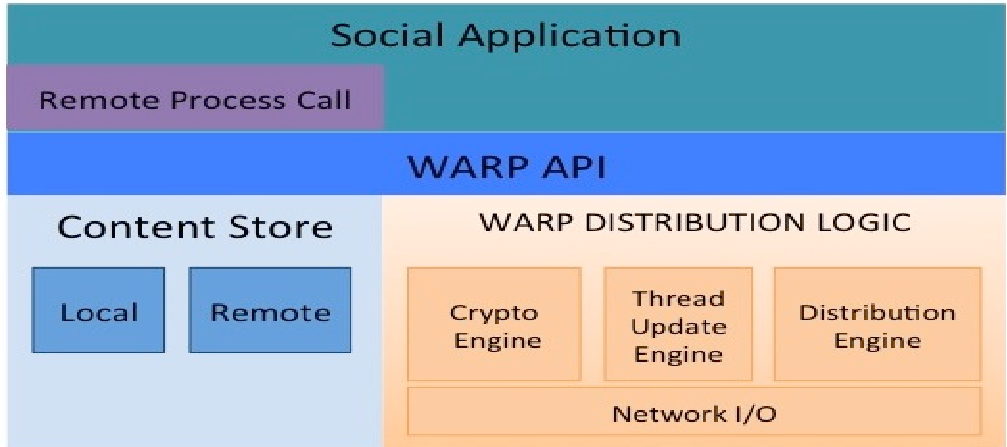 Fig 1: The Butler stack, showing how Social Apps interact with the Distribution Logic via APIs.
When Alice wants to revoke Bob's access to a photo, she doesn't just change a local setting. Her Butler sends a DELETE(X) or UPDATE(X, Y) command through the Thread Update channel. Distributors monitoring this channel are obligated to purge the old content (X) and optionaly prefetch the new version (Y).
Fine-Grained Privacy with ABE
WARP uses Attribute-Based Encryption (ABE). Unlike standard PKI where you encrypt for a specific person, ABE allows you to encrypt for a policy (e.g., (Friend AND HighSchool) OR Family).
- Efficiency Trick: Since ABE is computationally heavy, WARP encrypts the actual data with a symmetric key and then encrypts that key with ABE.
- Bucket-Based Revocation: To avoid re-encrypting for 500 friends individually, users are grouped into "buckets," allowing for logarithmic scaling of policy updates.
Experimental Insights
The evaluation focuses on three critical areas:
- Revocation Efficiency: Unlike previous works that used expensive "Proxy Re-encryption" (requiring a middleman for every single read), WARP uses a "lazy" re-encryption. It only updates content when policies change and a new request arrives, significantly reducing idle CPU load.
- Scalability: By utilizing a hierarchical name resolver rather than a flat DHT, WARP achieves constant-time lookups for distributors, even as the network scales to millions of users.
- Protection Against Probing: The protocol includes a Request Ban Window (RBW) to prevent malicious users from "polling" the network to grab versions of data before a revocation command clears the cache.
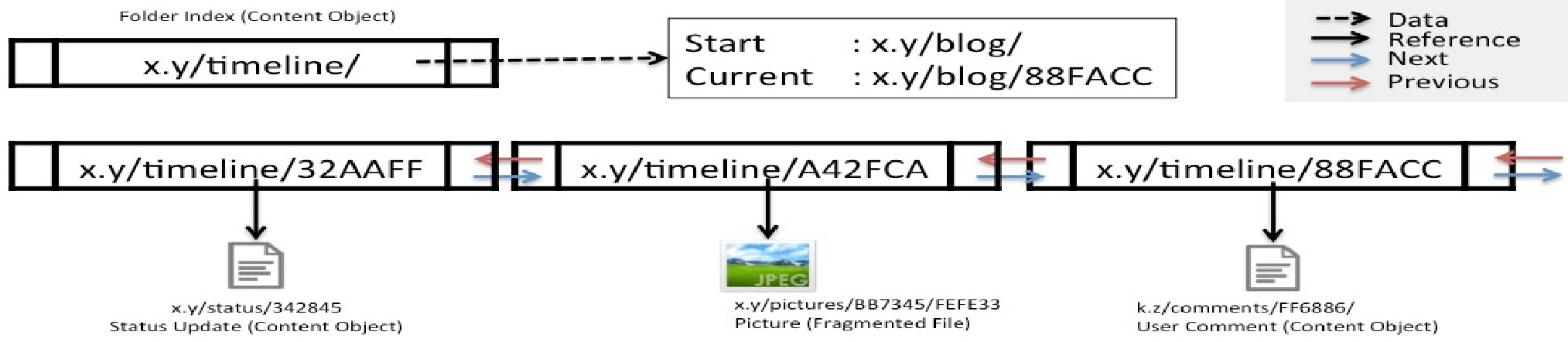 Fig 2: Mapping a Facebook-like timeline onto WARP's Feed and Fragmented File structures.
Critical Analysis & Conclusion
WARP succeeds in creating a middleware that allows legacy OSNs to transform into mere "distribution pipes" while users retain the keys to their digital lives.
Takeaway: The power of WARP lies in its pragmatism. It doesn't ask Facebook to disappear; it asks Facebook to become a Distributor—providing the bandwidth and speed users crave, without the access to the unencrypted data they fear.
Limitations:
- Physical Control: If a user downloads and saves a "persistent" copy outside the Butler, WARP cannot "self-destruct" that data on the user's hard drive.
- Butler Availability: If a user's local Butler goes offline and they haven't paid for a cloud distributor, their data becomes inaccessible.
Future Work: The authors aim to explore "Social Caching," where the network uses the social graph's structure to predict and pre-position content closer to likely consumers, further reducing latency in localized social bursts.