
Hashtags vs. Crowdsourcing: Is "Weak" Labeling Good Enough for Emotion AI?
Influence of Weak Labels for Emotion Recognition of Tweets
The paper evaluates the effectiveness of using hashtags as "weak labels" for emotion recognition in tweets compared to "strong labels" derived from crowdsourcing. Using a corpus of over 340,000 tweets across seven emotion categories, the authors benchmarks five machine learning classifiers (SGD, SVM, MNB, NC, and Ridge) to quantify the performance gap between these two annotation strategies.
TL;DR
Is the high cost of manual data labeling truly necessary for sentiment analysis? This paper investigates the performance gap between Strong Labels (expensive human crowdsourcing) and Weak Labels (free Twitter hashtags). By testing five classification algorithms on 341,931 tweets, the researchers discovered that while crowdsourced labels are superior, the "weak" hashtag-based approach only suffers a minor 9.25% drop in F1-score—a trade-off often justified by the ability to process massive, real-time datasets for free.
Background: The Annotation Bottleneck
In the world of Supervised Machine Learning, the quality of your model is bound by the quality of your labels. For emotion recognition, this presents a paradox:
- Manual Annotation: Highly accurate but doesn't scale.
- Crowdsourcing: Scalable but expensive and requires complex quality control (trust scores).
- Weak Labeling (Hashtags): Infinite and free, but prone to noise, sarcasm, and "Data Leakage" (where the model learns the hashtag itself rather than the emotional content of the text).
The authors ask: Exactly how much accuracy do we lose when we stop paying for labels and start trusting the users' own hashtags?
Methodology: A Controlled Comparison
The researchers created a unique experimental setup using a single corpus of English tweets categorized into seven emotions: joy, fear, sadness, thankfulness, anger, surprise, and love.
The Two Label Sets
- Weak Set: Labels derived from emotional hashtags (e.g., #sad, #annoying).
- Strong Set: Labels generated via CrowdFlower, where at least 3 contributors annotated each tweet. To ensure "Strong" meant "Quality," they only kept samples where 100% of annotators agreed for the training set.
The Pipeline
To make the comparison fair, the authors used:
- Preprocessing: Porter Stemming to reduce vocabulary size.
- Feature Extraction: A combination of N-grams (1, 2, and 3-grams) and TF-IDF to capture syntactic patterns.
- Data Leakage Prevention: Removing the hashtags themselves from the text so the model couldn't "cheat."
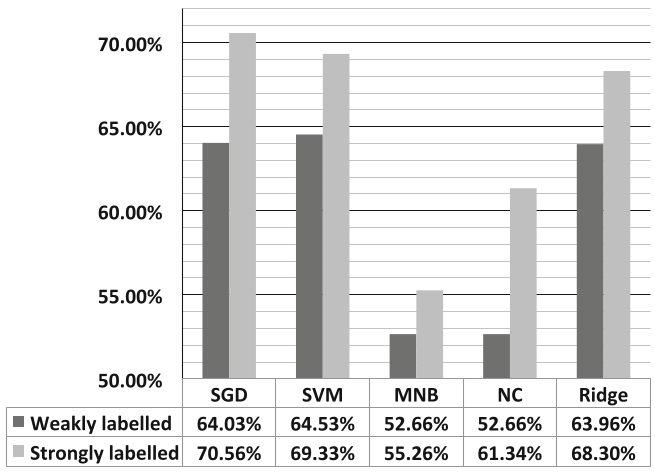 Figure: Comparison of Weighted F1-scores across different algorithms using Strong vs. Weak labels.
Key Insights: Where Weak Labels Fail
The study revealed a fascinating "Relabeling Matrix" showing that while humans and hashtags often agree on the valence (is the emotion positive or negative?), they struggle with nuance.
- The Surprise Problem: Only 8.12% of tweets tagged by users as #surprise were actually classified as "surprise" by the crowd. Most were relabeled as "sadness" or "joy."
- Joy vs. Love: There is a high overlap; 19.63% of tweets with #love hashtags were perceived as "joy" by humans.
- Valence Consistency: Despite specific category mismatches, the "emotional polarity" remained consistent over 90% of the time.
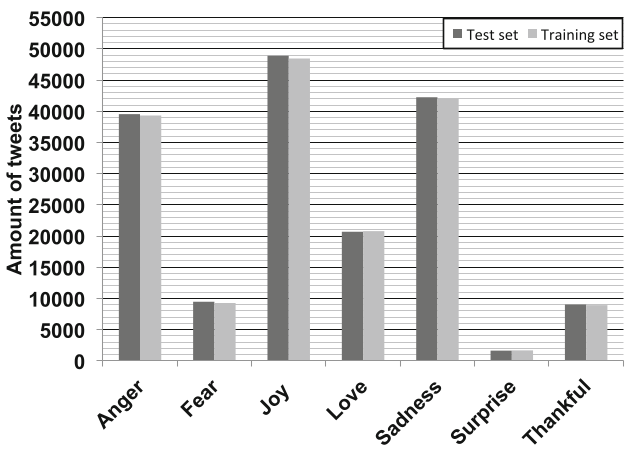 Figure: Distribution of labels showing the inherent class imbalance in social media data.
Experimental Results
The authors tested five linear classifiers: SGD, SVM, Multinomial Naive Bayes (MNB), Nearest Centroid (NC), and Ridge Regression.
- Winner: Stochastic Gradient Descent (SGD) with modified Huber loss performed best.
- The Gap: Using strong labels yielded an F1-score of 70.56%. Using weak labels dropped this to 64.03% (a relative 9.25% decrease).
- Efficiency: The confusion matrices showed that after confidence filtering, the models were remarkably clean, avoiding the overlapping errors seen in previous, unfiltered studies.
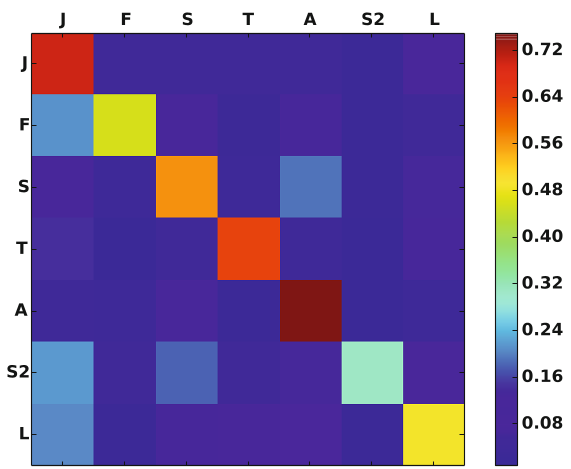 Figure: Confusion matrix for the SGD classifier using Strong Labels.
Critical Analysis & Conclusion
This paper provides a pragmatic "green light" for researchers working with limited budgets.
Takeaway
If you are building an emotion recognition system for a domain where high-volume data is more important than surgical precision (like real-time stock prediction or movie trend monitoring), weak labels are sufficient. The 9.25% performance penalty is a small price to pay for a zero-cost, infinite data stream.
Limitations
- Static Lexicons: The weak labels relied on pre-defined word lists for hashtags, which might miss evolving slang.
- The "Surprise" Noise: The study highlights that "surprise" is a particularly difficult emotion to capture via distant supervision (hashtags).
Future Work
The authors suggest that future weak labeling shouldn't just look at hashtags, but at a "combination of words" within the tweet to better approximate human consensus. In the era of LLMs, this work lays the groundwork for understanding how "distantly supervised" data can still drive high-performance AI.