
JESI: Decoding the Tribal Language of Political Twitter through Weakly Supervised Topic Modeling
Weakly Supervised Joint Entity-Sentiment-Issue Model for Political Opinion Mining
The paper introduces Joint Entity-Sentiment-Issue (JESI), a novel weakly supervised probabilistic topic model based on LDA, designed for fine-grained political opinion mining on Twitter. It simultaneously identifies target entities, discussed issues, and the associated sentiments by leveraging a few seed words and a sentiment lexicon.
TL;DR
Researchers have developed JESI (Joint Entity-Sentiment-Issue), a probabilistic framework that dissects political tweets without requiring massive human-labeled datasets. By assuming that sentiment is a function of both a specific politician/party and a specific policy issue, JESI outperforms traditional models like JST, offering a more granular look at public opinion during election cycles.
Background: The Messy Reality of Political Twitter
Mining opinions from Twitter is a "holy grail" for political analysts, but it presents two massive hurdles:
- The Labeling Bottleneck: Deep learning and supervised methods need thousands of labeled examples. In an election where issues change weekly, human labeling is too slow.
- Contextual Entanglement: A tweet isn't just "negative." It’s negative about a candidate because of a specific policy (e.g., "I hate [Entity]'s stance on [Issue]").
Existing models like JST (Joint Sentiment-Topic) often flip the logic—they generate topics based on sentiment. JESI argues this is backwards for politics: your sentiment is a reaction to the entity and the issue.
Methodology: The "Who-What-Feel" Hierarchy
JESI is an evolution of Latent Dirichlet Allocation (LDA). While standard LDA purely finds "topics," JESI uses three latent variables: Entity (e), Issue (i), and Sentiment (s).
The Generative Logic
The core "secret sauce" of JESI is its conditional probability structure. In JESI, the model assumes a tweet is generated in this order:
- Pick a Political Entity (e.g., The Liberal Party).
- Pick a Political Issue (e.g., Refugees).
- Pick a Sentiment based on that specific Entity-Issue pair.
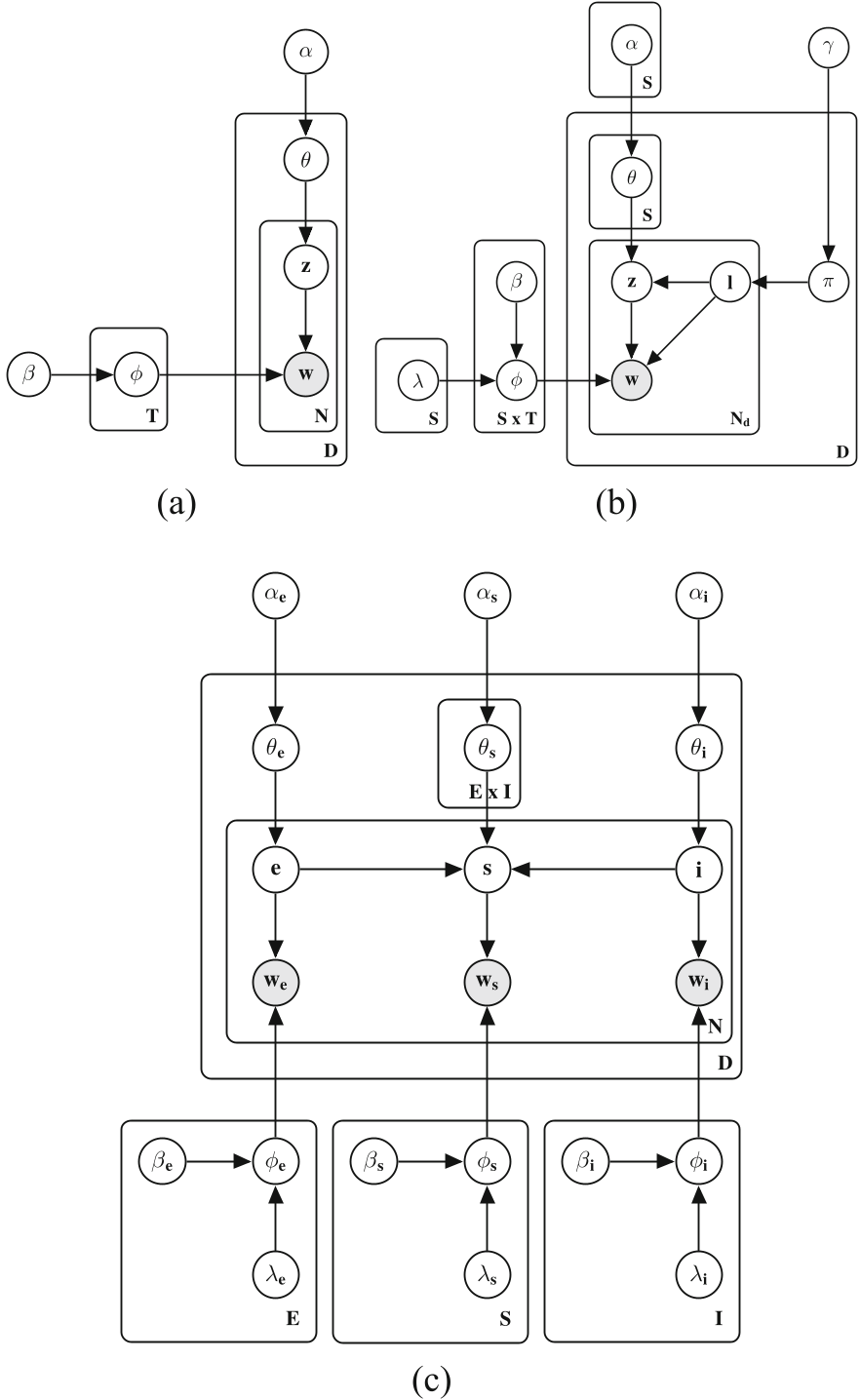 Figure 1: Comparison of LDA, JST, and the proposed JESI model (c). Note the dependency of sentiment (s) on both entity (e) and issue (i).
Weak Supervision via Seed Words
Rather than starting from scratch (unsupervised), JESI uses "Seed Words."
- Entity Seeds: Names of candidates, party acronyms (e.g., "Turnbull", "LNP").
- Issue Seeds: Policy keywords (e.g., "tax", "medicare").
- Sentiment Lexicon: Integration with SentiStrength to provide a baseline for "good" vs "bad" words.
Performance: Crushing the Baselines
The researchers tested JESI against the 2016 Australian Federal Election dataset. The results were stark, particularly in how well the model identified Entities and Issues.
| Task | Model | Precision | Recall | F1-Score |
|---|---|---|---|---|
| Entity Classification | JST | 23.3 | 44.6 | 30.6 |
| JESI | 77.9 | 52.4 | 62.6 | |
| Issue Classification | JST | 37.6 | 36.3 | 36.9 |
| JESI | 76.6 | 61.7 | 68.4 |
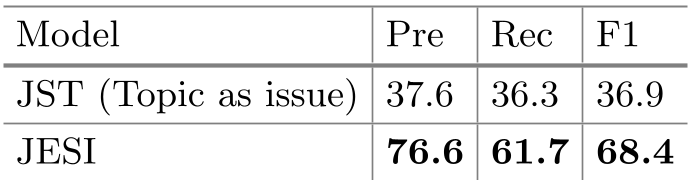 Table 1: Issue Classification performance. JESI shows a massive jump in Precision compared to the JST baseline.
The model's ability to maintain high precision (76-77%) in a weakly supervised setting is significant. It suggests that the structural inductive bias (making sentiment depend on entity and issue) is much more powerful for short texts than just adding more data to a poorly structured model.
Qualitative Insight: What is the Model Actually Learning?
One of the most impressive aspects of JESI is the "coherence" of its extracted topics.
- Under the Refugee issue, the model automatically associated names like "Peter Dutton" (the Immigration Minister), even if he wasn't in the initial seed list.
- Under Negative Sentiment, it successfully identified words like "lie," "cut," and "fail" specifically when associated with the ruling party's entities.
Critical Analysis & Conclusion
The Takeaway: JESI proves that "structure is everything" in probabilistic modeling. For specialized domains like politics, generic topic models fail because they don't respect the inherent relationships between the actors and the subjects.
Limitations:
- Sarcasm: Like most topic models, JESI likely struggles with "Irony" or "Sarcasm," which is rampant in political Twitter.
- Seed Dependence: While it needs "only a few" seed words, the quality of those seeds significantly dictates the ceiling of the model's performance.
Future Outlook: The next step for this research is Stance Detection. It's one thing to know a tweet is "negative" about "Turnbull" on "Tax"; it's another to know if the user supports a specific alternative or is just venting. As we move toward the 2026 election cycles, models like JESI provide a vital, automated "thermometer" for public sentiment.