
Walking Together Apart: Breaking Distance Barriers with Wearable Haptics
Wearable Haptics for Remote Social Walking
The paper presents a novel wearable haptic system for "Remote Social Walking," allowing users in different locations to synchronize their gait. It utilizes vibrotactile anklets to stream heel-strike timing between partners, achieving bi-directional cadence alignment via an Internet-connected server and smartphone application.
TL;DR
Researchers have developed a wearable haptic system that allows two people to "feel" each other's walking rhythm from miles away. By transmitting the timing of heel-strikes via vibrating anklets, the system enables users to synchronize their gait, recreating the social and motivational benefits of walking together without being in the same location.
Background: The Social Power of the Stride
Walking is more than just exercise; it is a social ritual. From religious gestures to training in sports, synchronized movement fosters group cohesion and motivation. However, our modern lifestyle often separates us from our ideal walking partners. While "Social Walking" groups significantly improve health outcomes, the requirement of being in the same park at the same time is a major bottleneck.
This paper bridges that gap by using Haptic Telepresence. Unlike audio cues that clog the ears, haptic feedback at the ankles offers an intuitive, private, and non-obtrusive way to maintain a "connection" with a remote companion.
The Problem: Why Current Solutions Fail
Previous attempts at remote exercise, such as "Jogging over a distance," relied heavily on audio headsets. This is problematic because:
- Safety: Walkers need to hear their surroundings (traffic, other people).
- Cognitive Load: Constantly processing audio instructions during a conversation or while thinking can be exhausting.
- Intimacy: Audio lacks the "physicality" of walking side-by-side.
The researchers hypothesized that since walking is a tactile and rhythmic activity, the feedback should be tactile as well, leveraging the human body's natural tendency for sensory-motor entrainment.
Methodology: Engineering the Remote Connection
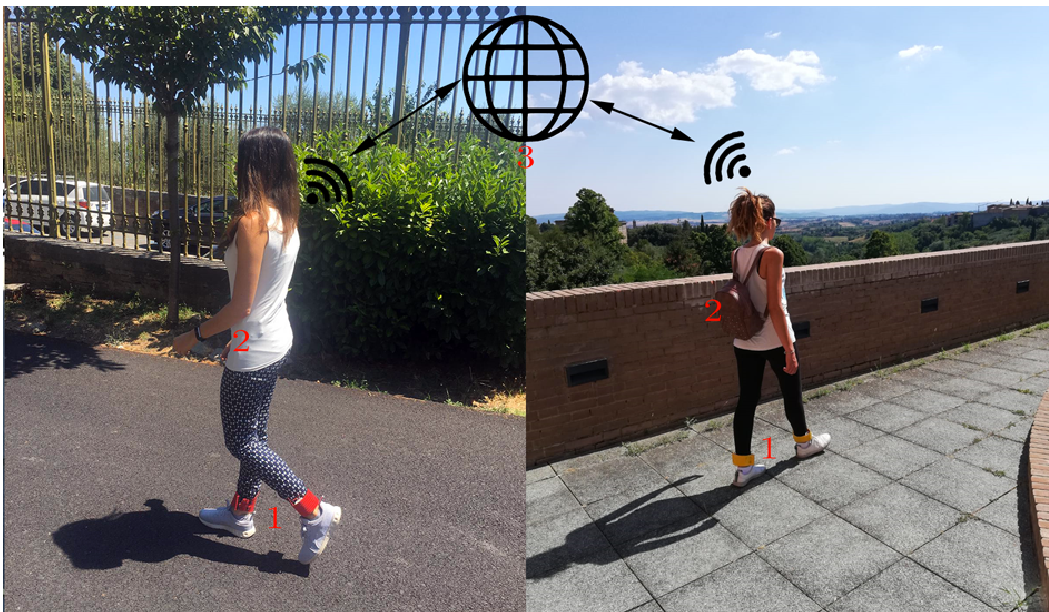
The system architecture consists of a master anklet (with a pressure sensor), a secondary anklet (vibrotactile only), a smartphone app, and a remote cloud server.
1. Hardware Architecture
The device uses a pressure-sensitive insole (FSR 400) placed under the heel. When the "Master" user steps down, the signal is processed and sent via Bluetooth to the phone, then via 4G/LTE to the partner's phone, finally triggering a 150ms vibration on the "Follower's" anklets.
2. The Negotiation Dynamics (Peer-to-Peer)
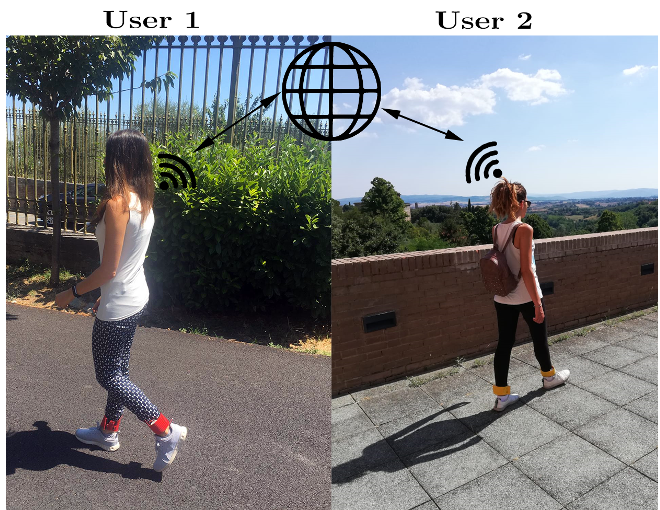
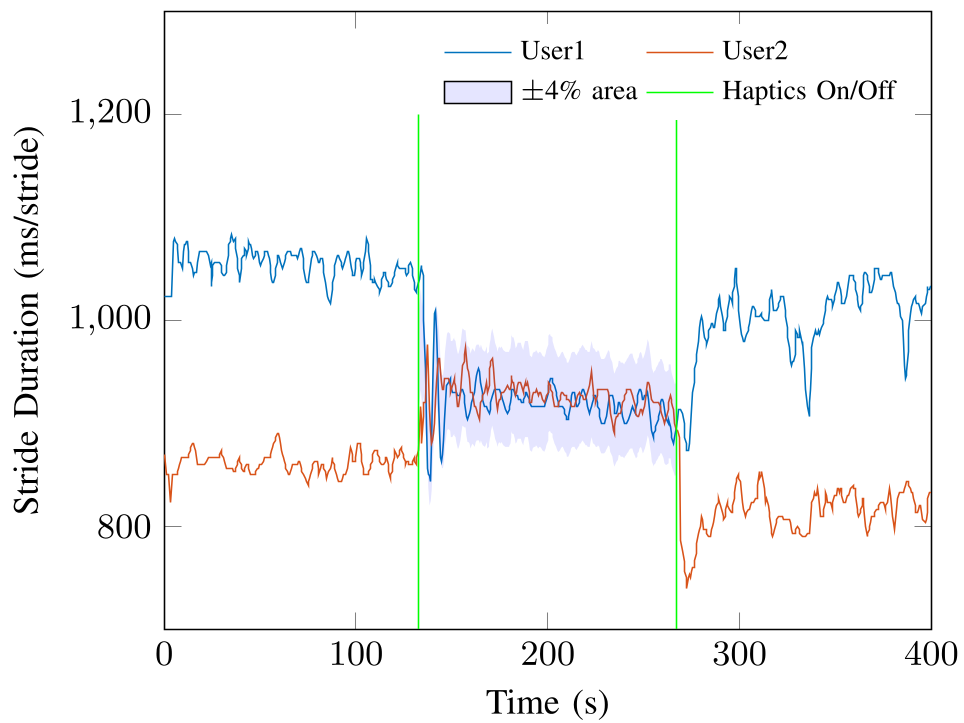
In the most advanced test scenario, both walkers influenced each other. There was no designated "leader." Instead, users "negotiated" a common pace through touch. The study found that users naturally gravitate toward a cadence that is the average of their two individual natural paces.
Key Results: Can We Truly Align?
The experimental validation was rigorous, involving 50 participants.
- Speed of Synchronization: In the peer-to-peer mode, users reached a "locked" cadence in approximately 4.9 seconds.
- Accuracy: Users stayed "in sync" (within a 4% tolerance of their partner's rhythm) for 94.5% of the walk.
- Low Cognitive Overhead: Even when asked to solve complex math problems while walking, participants' ability to stay synchronized barely wavered. This confirms that haptic rhythm following is a near-subconscious process.
Deep Insight: "Feeling" the Presence
Perhaps the most striking finding was qualitative. On a 7-point Likert scale, users reported a high sense of Telepresence (perceiving the remote partner as "there"). There was a direct correlation between how much a user was willing to adapt their pace and how positive they rated the experience. This suggests that the "act of synchronizing" itself is what creates the emotional bond, not just the exercise.
Future Outlook & Limitations
While successful, the study notes that significant differences in height or fitness levels might make synchronization difficult. Future iterations might suggest a "scale factor" (e.g., a child walking with a tall adult).
This technology opens the door for:
- Remote Physical Therapy: Therapists "leading" a patient's pace from a clinic.
- Blind Marathon Support: Guides remotely helping runners maintain rhythm.
- Social Connectivity: A new way to feel close to long-distance loved ones through the simple, shared act of walking.
Conclusion
Remote Social Walking is no longer a sci-fi concept. By moving gait cues from the ears to the ankles, Lisini Baldi et al. have demonstrated a robust, low-latency system that proves that even when we are miles apart, we can still walk in the same rhythm.