
Intelligent Fog-IoT Architecture: A New Frontier in Chikungunya Outbreak Control
Wearable IoT sensor based healthcare system for identifying and controlling chikungunya virus
This paper presents a three-layer wearable IoT-based healthcare system (Sensor, Fog, and Cloud) designed for the early detection and control of the Chikungunya virus (CHV). The system employs Fuzzy C-Means (FCM) clustering at the fog layer for rapid diagnosis and Social Network Analysis (SNA) at the cloud layer to track and predict the outbreak's spread.
TL;DR
The sudden outbreak of the Chikungunya virus (CHV) often overwhelms healthcare infrastructures in developing regions. This paper proposes a robust, three-tier IoT framework—Wearable Sensor Layer, Fog Layer, and Cloud Layer—that utilizes Fuzzy C-Means (FCM) for rapid diagnosis and Social Network Analysis (SNA) to calculate an "Outbreak Role Index." By processing data at the network edge, the system achieves lower latency and higher accuracy than traditional cloud-centric models.
Executive Summary
Chikungunya is a mosquito-borne disease that transitions rapidly from acute illness to chronic phases. This research positions itself as a specialized SOTA (State-of-the-Art) framework for pandemic monitoring. The brilliance of the work lies in its "Health Fog" concept: instead of sending massive amounts of raw sensor data to a distant cloud, it performs critical "Infected vs. Uninfected" classification at the fog nodes, ensuring patients at high risk receive diagnostic alerts in milliseconds.
Problem & Motivation: The Cloud Bottleneck
Prior remote healthcare systems rely heavily on Cloud Computing (CC). However, for a virus like CHV, timing is everything. The authors identify three major flaws in the status quo:
- Network Latency: Transmitting "Big Data" from thousands of wearable sensors to a central cloud causes packet drops and delayed diagnosis.
- Context Blindness: Traditional systems often fail to merge health data with environmental (mosquito density) and meteorological (rainfall/humidity) variables.
- Data Security: Centralized storage of highly sensitive health data is a prime target for breaches.
Methodology: The Three-Tier Intelligence
The architecture is divided into three distinct logical layers:
1. Wearable IoT Sensor Layer
This layer is not just about heart rate. It aggregates Health Data (fever, joint pain), Environmental Data (water quality, CO2 levels near breeding sites), and Meteorological Data (rainfall).
2. Fog Computing Layer (The "Brain" at the Edge)
This tier acts as a bridge. It runs the FCM (Fuzzy C-Means) algorithm. Unlike "hard" clustering, FCM assigns a degree of membership to clusters.
- Physical Intuition: A user isn't just "sick" or "healthy"; they might have a 0.8 membership in the "Infected" cluster based on symptom intensity, allowing for more nuanced medical triage.
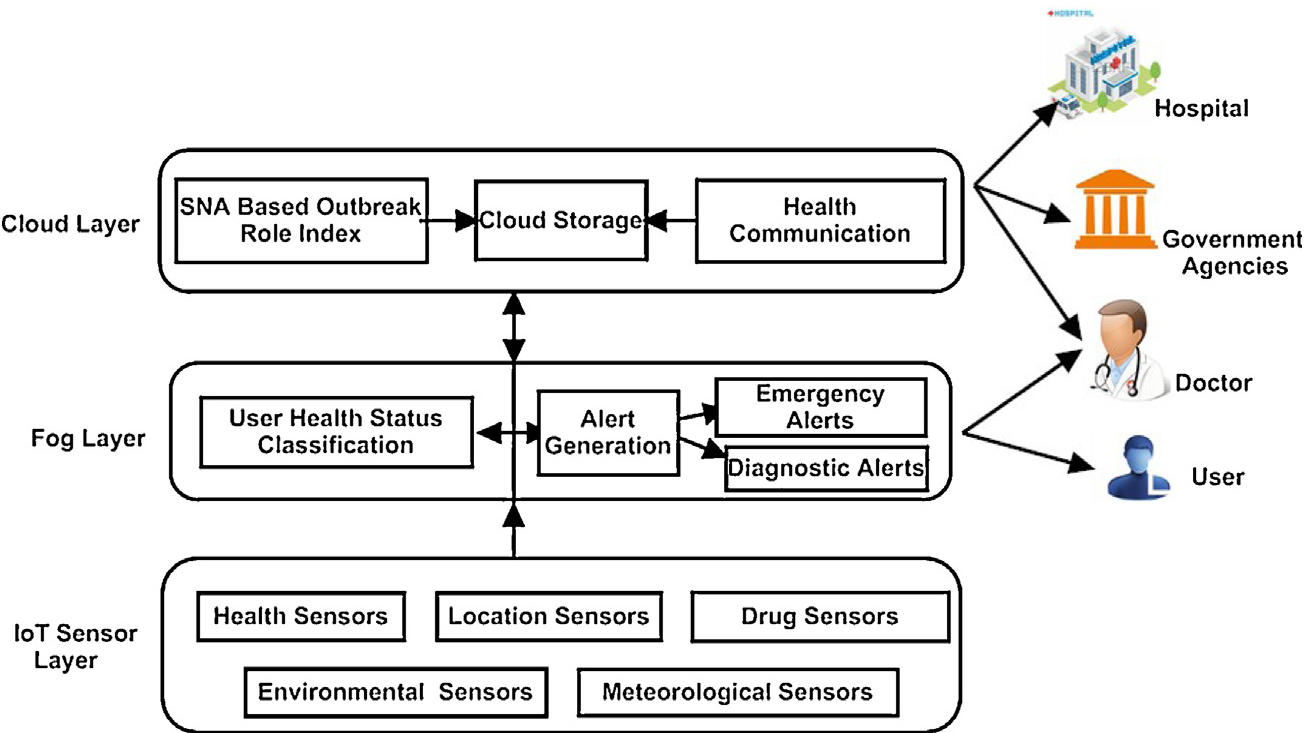
3. Cloud Layer (Global Analytics & Privacy)
The Cloud handles heavy lifting:
- SNA & ORI: It builds a Social Network graph where nodes are people and locations. The Outbreak Role Index (ORI) determines if an uninfected person is at high risk because they recently visited a "Red Zone."
- Security: It uses a Secret Sharing Mechanism where data is fragmented into levels (1 to 3). Reconstructing a patient's identity requires matching keys from multiple secure servers, ensuring no single point of failure.
Experiments & Results
The system was validated using a synthetic dataset of 5,000 cases integrated with real-world climate data.
- Accuracy: The FCM algorithm outperformed Naive Bayes and Neural Networks, reaching an accuracy of 93.40%.
- Latency & Power: The "Fog + Cloud" model showed a drastic reduction in power consumption and delay compared to "Cloud Only" (as shown in the figures below).
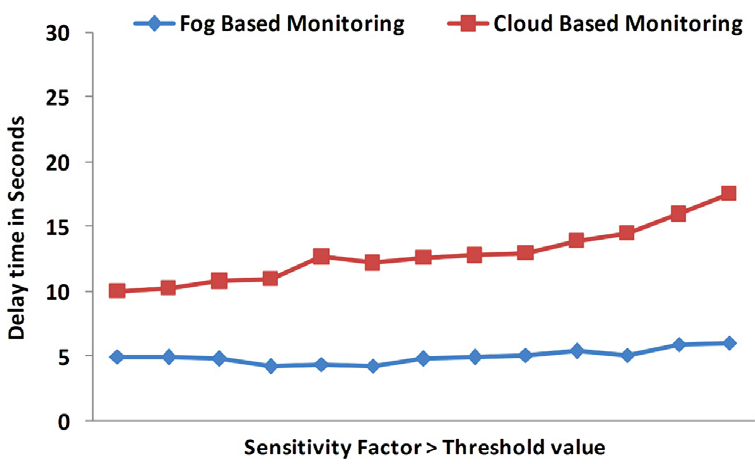 Fig. 4: Efficiency of delay time - Fog nodes respond significantly faster than Cloud servers during emergency events.
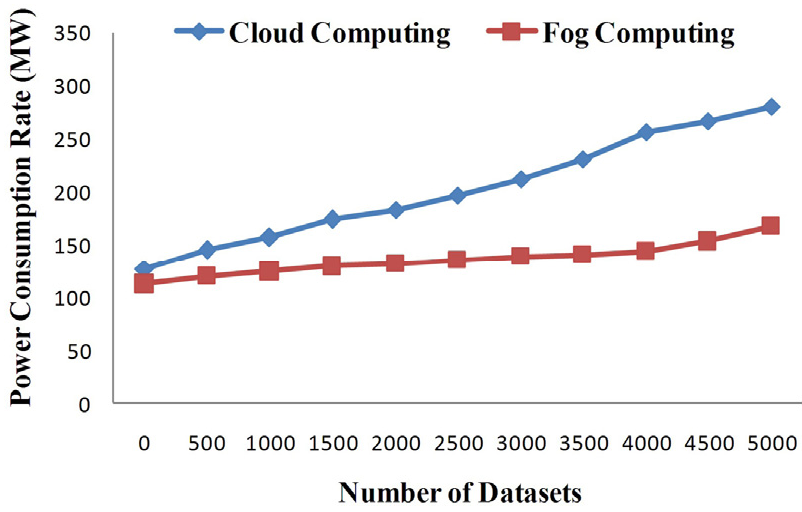 Fig. 6: Power consumption is minimized in the Fog model due to reduced data transmission across the wide-area network.
Critical Analysis & Conclusion
Takeaway
The synergy between Edge Computing (Fog) and Graph Theory (SNA) creates a proactive rather than reactive healthcare system. By calculating the ORI, the system doesn't just treat the sick; it warns the healthy to avoid "Risk Prone" regions.
Limitations
While the system is technically sound, its success depends on the massive adoption of wearable sensors—an economic challenge in the very "developing countries" the paper aims to help. Furthermore, FCM, while effective, can be sensitive to outliers if the initial centroids are poorly chosen.
Future Outlook
The next logical step for this research is the integration of Autonomous Routing. As shown in the study, Google Maps could suggest "Safer Routes" that bypass infected hexagonal zones, effectively using AI to navigate a pandemic in real-time.