
Diagnosing Childhood Anxiety in 20 Seconds: The Rise of Digital Biomarkers
Wearable sensors and machine learning diagnose anxiety and depression in young children
This paper presents a novel digital biomarker approach for diagnosing internalizing disorders (anxiety and depression) in children aged 3-7. By leveraging a wearable IMU sensor during a 90-second "Snake Task" and a k-Nearest Neighbor (kNN) classifier, the system achieves a diagnostic accuracy of 75%.
TL;DR
Researchers have developed a way to diagnose internalizing disorders (anxiety and depression) in children using a single wearable sensor and just 20 seconds of behavioral data. By monitoring a child's micro-movements during a brief "fear induction" task, the system achieves 75% accuracy—comparable to gold-standard clinical interviews that take weeks to complete.
The Problem: A Bottleneck in Pediatric Mental Health
Early childhood is a critical window for intervention, yet nearly 20% of children suffer from untreated internalizing disorders. The current diagnostic process is plagued by three major issues:
- Subjectivity: Self-reports from children under eight are unreliable, and parent reports are often biased.
- Inaccessibility: Golden-standard interviews require hours of highly trained clinical labor.
- Waitlists: The scarcity of specialists leads to month-long delays, during which conditions often worsen.
The authors propose that objective motion data can bypass these human biases, providing a "stress test" for the nervous system that reveals underlying psychopathology.
Methodology: The "Snake Task" and Kinematic Analysis
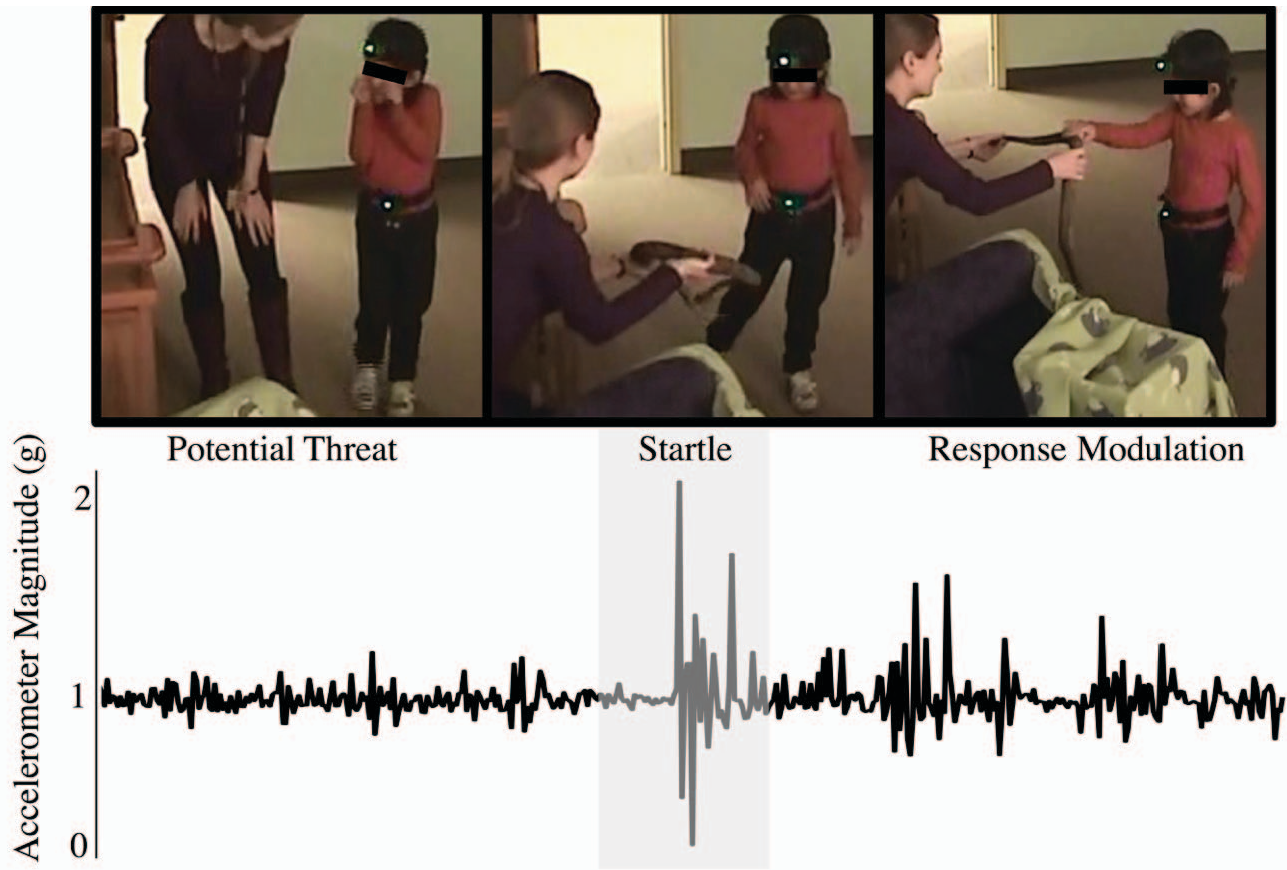
The study utilized a 90-second experimental design known as the "Snake Task." While the child wears an Inertial Measurement Unit (IMU) on their waist, they are led into a room to encounter a covered terrarium.
The researchers focused specifically on the Potential Threat phase (the 20 seconds before a fake snake is revealed). Why? Because anticipation and avoidance behavior—key indicators of anxiety—are most visible when a threat is imminent but not yet present.
From Raw Data to Diagnosis
The IMU captures 3-axis acceleration and angular velocity. The software then:
- Fuses data to determine the child's orientation (Tilt and Yaw).
- Extracts features: Mean, RMS, skew, and spectral power across different frequency bands.
- Classifies: Uses a k-Nearest Neighbor (kNN) algorithm to map these movements to a clinical diagnosis.
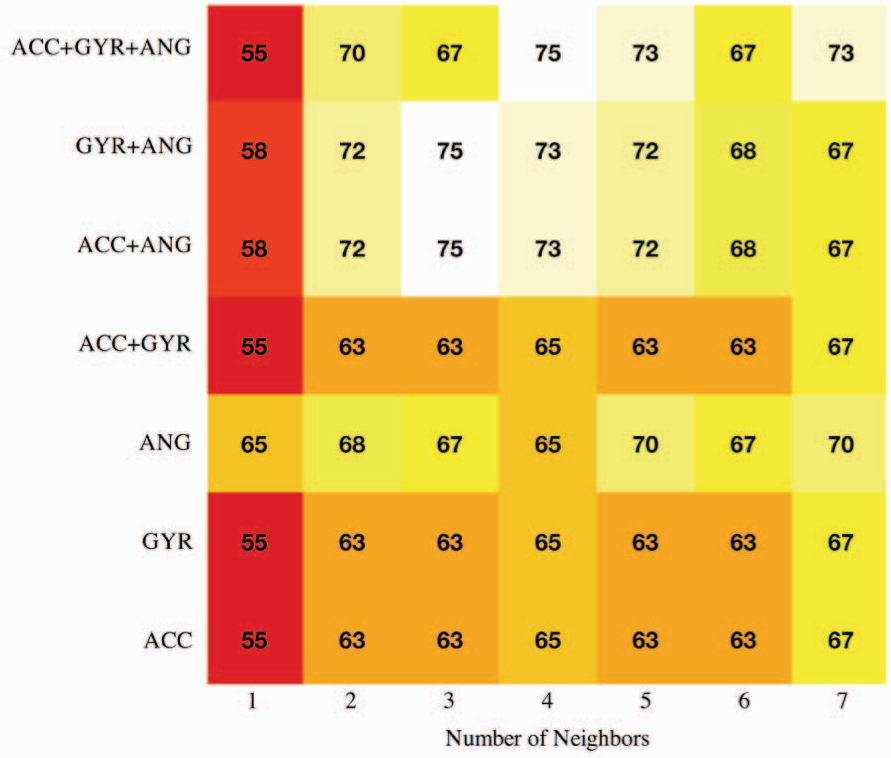
The core insight here is that "Angle" (ANG) features—the way a child shifts their posture and center of gravity—are more predictive of anxiety than simple raw acceleration.
Results: Precision in Movement
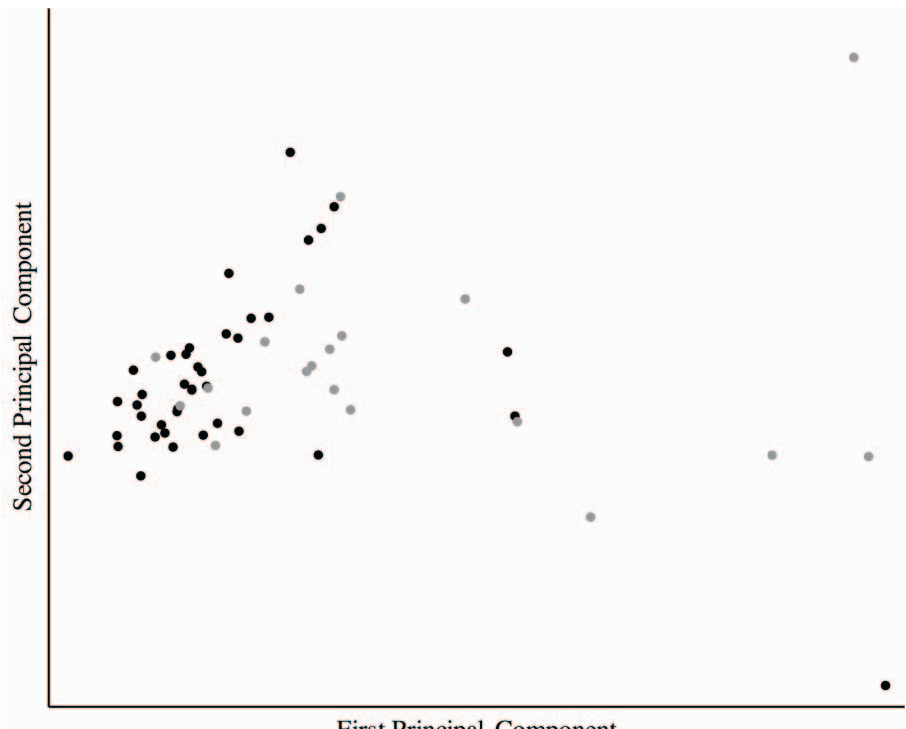
The study found a striking difference in the "movement manifold" of healthy vs. diagnosed children. As shown in the Principal Component Analysis (PCA) below, children without disorders (black dots) cluster tightly, indicating a standard, calm response. In contrast, children with internalizing disorders (gray dots) show high variability, suggesting erratic or inhibited defensive posturing.
Key Performance Metrics:
- Optimal Configuration: Combining Angle (ANG) and Accelerometer (ACC) data with 3 neighbors ().
- Peak Accuracy: 75%.
- Efficiency: The diagnosis is derived from just 20 seconds of data, compared to traditional methods that consume hours of clinical time.
Critical Analysis: The Future of Clinical Care
While 75% accuracy might seem lower than some computer vision tasks, in the context of psychiatry, it is a breakthrough. The inter-rater agreement between two human doctors is often in the 80-90% range, meaning this automated system is approaching human-level reliability.
Limitations:
- The sample size () is relatively small for machine learning.
- The model acts as a binary classifier (Internalizing vs. Control) but cannot yet distinguish between specific conditions like PTSD and Separation Anxiety.
The Road Ahead: This technology paves the way for a "Mental Health Thermometer." Imagine a pediatrician’s office where a child wears a belt for two minutes during a routine check-up, and the doctor receives an immediate risk score for anxiety. By lowering the barrier to entry, we can ensure that no child falls through the cracks.
Conclusion
This research demonstrates that our bodies "speak" our mental state through micro-kinematics. By quantifying the physics of fear, we can move psychiatry from a purely subjective discipline to an objective, data-driven science.