
From Wearables to Smart Implants: The Architecture of Pervasive, 4P Healthcare
From Wearable Sensors to Smart Implants-–Toward Pervasive and Personalized Healthcare
This paper reviews the historical trajectory and future roadmap of pervasive healthcare, tracing its evolution from basic wearable activity trackers to advanced "Third Generation" smart implants. It introduces a comprehensive framework for integrating continuous sensor data with multi-omics, EHRs, and social media to achieve 4P medicine: Personalized, Predictive, Preventive, and Participatory.
TL;DR
The paradigm of healthcare is shifting from episodic hospital visits to continuous, pervasive monitoring. This paper explores the transition from simple wearable devices to a "Third Generation" healthcare ecosystem where smart implants, multi-omics data (genomics), and real-time stream processing converge to provide predictive and personalized medical care.
Background: Breaking the Episodic Monitoring Cycle
Modern medicine has a "sampling" problem. Most clinical data is collected during brief, unrepresentative snapshots (hospital appointments), leaving critical transient events—like early-stage postoperative sepsis or cardiac arrhythmias—to go undetected until they manifest as emergencies. Pervasive sensing aims to bridge these gaps, turning healthcare into a continuous, data-driven discipline.
The Three Generations of Pervasive Sensing
The authors categorize the evolution of this field into three distinct architectural phases:
- First Generation: Single-modality sensors (e.g., a simple accelerometer) providing offline batch processing for basic activity recognition.
- Second Generation: Multi-modal "agents" that offer context-awareness (e.g., combining motion sensors with heart rate to determine if a spike is due to exercise or stress).
- Third Generation (The Frontier): Total integration. This involves fusing real-time sensor streams with Electronic Health Records (EHR), genomic profiles, and even social media trends to manage health at both the individual and population levels.
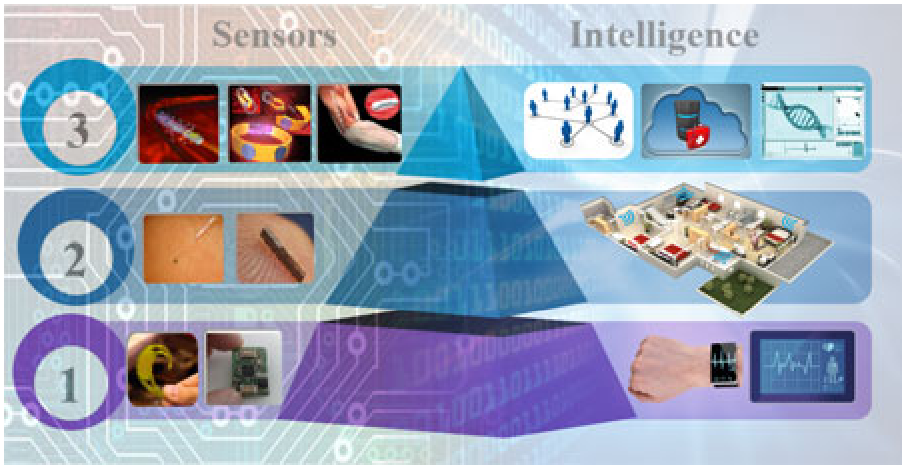 Fig 1: The roadmap from simple sensors to integrated Big Data care.
Methodology: The Hardware-Software Convergence
The leap from "gadgets" to "clinical-grade tools" is driven by two parallel tracks:
1. Advanced Material Science & Miniaturization
- Epidermal Electronics: Ultra-thin (20μm) "patches" that mimic the mechanical properties of skin, utilizing Soft Lithography to integrate sensors for pH, temperature, and ECG.
- Bioresorbable Implants: The development of transient electronics that can monitor a surgical site (e.g., checking for infection) and then safely dissolve in the body, eliminating the need for extraction surgery.
- ASIC Evolution: Application-Specific Integrated Circuits allow for on-node processing, reducing "Data Volume" by extracting features locally rather than transmitting raw, power-hungry signals.
2. Sensor Informatics & Big Data
Processing "The 5 V’s" (Volume, Velocity, Variety, Veracity, Variability) requires moving beyond standard databases. The paper discusses:
- Stream Learning: Algorithms like "Adaptive Very Fast Decision Trees" that process data in one pass, adapting to "Concept Drift" (e.g., changes in a patient's baseline due to aging or medication).
- Bayesian Networks: Crucial for dealing with the inherent "noise" and uncertainty of real-world wearable data.
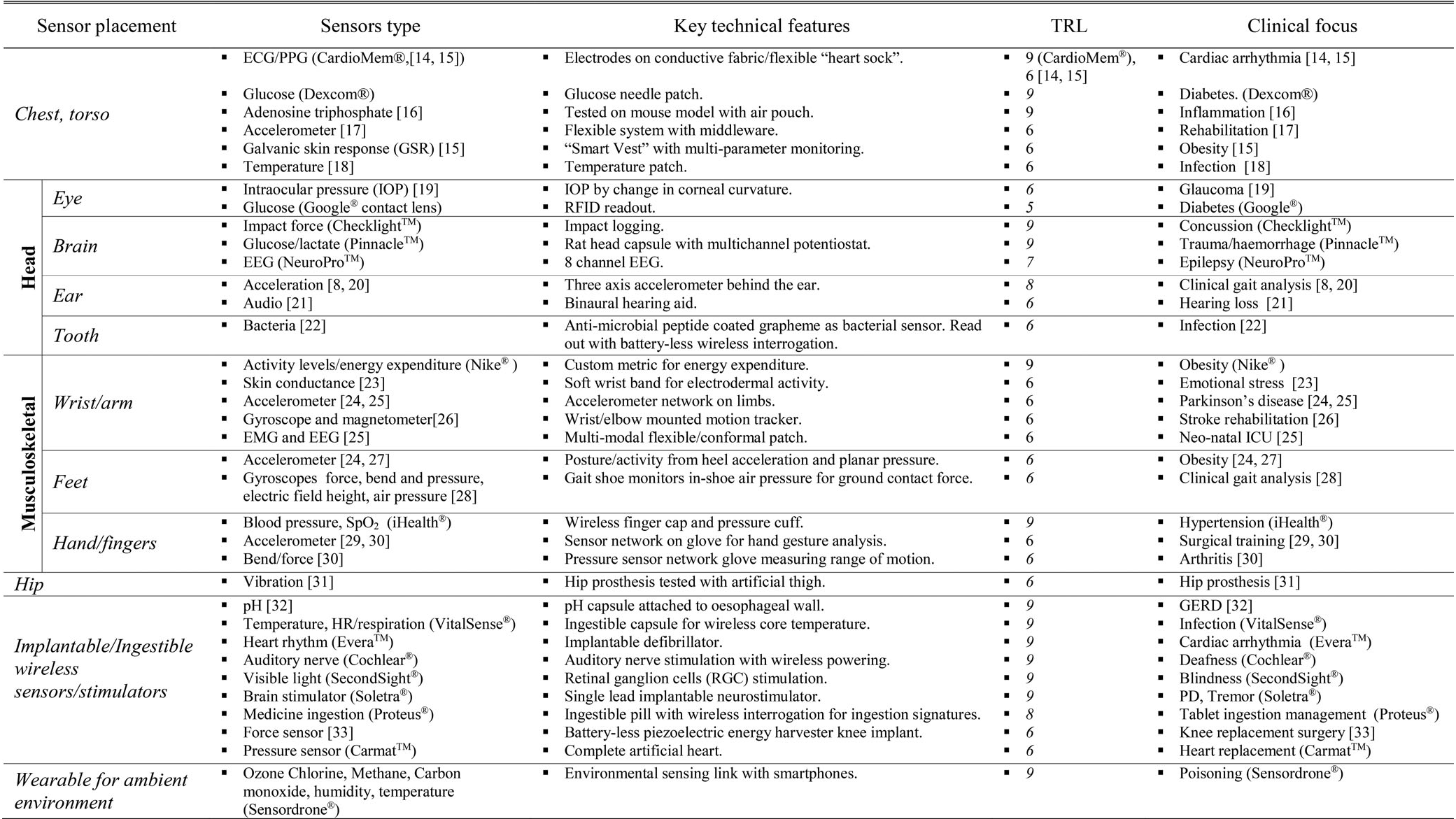 Table 1: State-of-the-art developments across different sensor placements and Clinical focuses.
Clinical Insight: The PIP Implant Case Study
One of the paper's most compelling arguments for "Third Generation" sensing is its application in public health crises. Using the PIP Breast Implant Scandal as a case study, the authors show how combining social media trends (Twitter hashtags) with geolocation and surgical registries could have flagged high-risk rupture zones months earlier than traditional reporting, potentially saving thousands from complications.
Critical Analysis & Future Outlook
While the technical roadmap is clear, the authors acknowledge significant hurdles:
- Biofouling: The body's natural immune response often coats implants in fibrous tissue, causing "sensor drift" over time.
- Energy Autonomy: Moving toward biologically powered micro-implants or ultrasonic power transfer is essential for long-term sustainability.
- Data Privacy: As we link personal genomes with real-time location and physiological data, the need for robust anonymization and per-node biometrics becomes a primary ethical constraint.
Conclusion
The evolution from "wearables" to "smart implants" is not just about smaller hardware; it is about the semantic integration of data. By shifting from reactive "sick-care" to a proactive balance of wellness (4P Medicine), pervasive sensing stands as the cornerstone of sustainable global healthcare.