
Weather with You: Can We Trust the Crowd to Predict the Rain?
Weather with you: evaluating report reliability in weather crowdsourcing
This paper introduces Atmos, a participatory sensing Android application designed to crowdsource highly localized weather data. By comparing manual user reports and short-term predictions against official meteorological ground truth, the study validates the reliability of humans as mobile sensors for temperature and wind conditions.
TL;DR
Researchers developed Atmos, a mobile app that treats humans as localized weather sensors. The study found that while we aren't perfect meteorologists, the "crowd" is surprisingly adept at reporting current wind speeds and predicting temperature trends for the next 2–4 hours, potentially outperforming coarse-grained official forecasts in specialized microclimates.
Background Positioning
In the landscape of Participatory Sensing, this work moves away from fully automated background sensing (which often fails due to the "phone-in-pocket" problem) and centers on Experience Sampling (ESM). It sits as a critical evaluative study of human reliability in environmental monitoring, bridging the gap between subjective perception and objective meteorological data.
Problem & Motivation: The "In-Pocket" Sensor Dilemma
Most modern smartphones are packed with sensors, but they are terrible at measuring weather. Why? Because your phone is usually in your pocket, a bag, or an air-conditioned office. To get a true reading of a "Microclimate"—the specific weather on your street corner—we need data from people actually experiencing it.
The authors identified that while apps like Waze succeeded for traffic, weather crowdsourcing faced a "Ground Truth" problem: Are human observations accurate enough to be useful?
Methodology: Humans as Sensors
Atmos utilizes a streamlined UI to minimize user friction. Instead of typing numbers, users interact with three qualitative bars:
- Temperature: A sliding scale from -20°C to +40°C.
- Phenomena: An 8-point icon-based scale (from Clear to Thunderstorm).
- Wind Intensity: A 5-point scale ranging from "Calm" to "Very Windy."
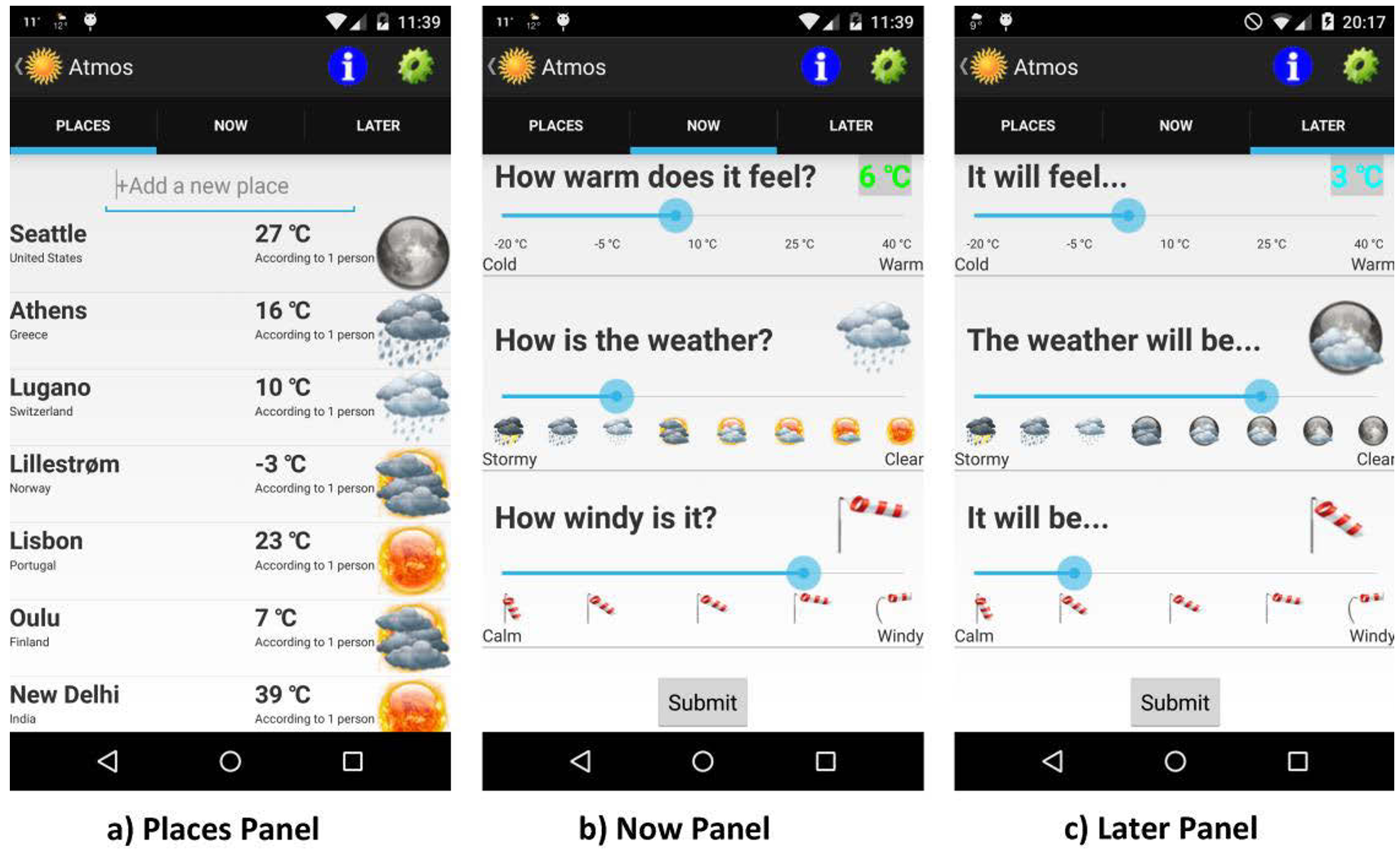
The system doesn't just ask "What is it now?" but also "What will it be later?" without enforcing a strict timeframe, encouraging intuitive "LATER" predictions.
Experiments & Results: The Accuracy of the Crowd
The study analyzed 464 reports and 300 predictions across 38 countries.
1. Temperature Accuracy
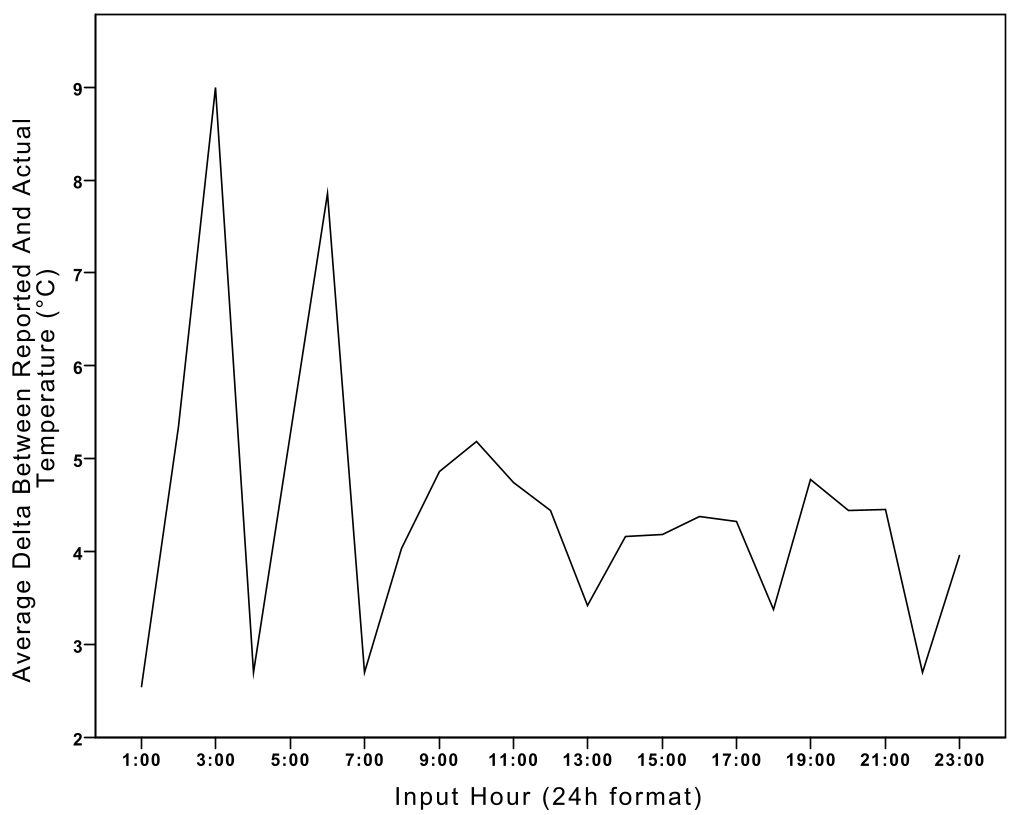
The correlation between user reports and ground truth was strong (r = .616). On average, humans were off by about 4.3 °C. Interestingly, accuracy fluctuated by the hour.
- The Stress Effect: Accuracy was lower during morning commute hours (10:00), which the authors attribute to "rush hour stress" interfering with environmental perception.
- Nighttime Precision: Accuracy actually improved at 01:00, possibly due to fewer distractions.
2. The Sweet Spot of Prediction
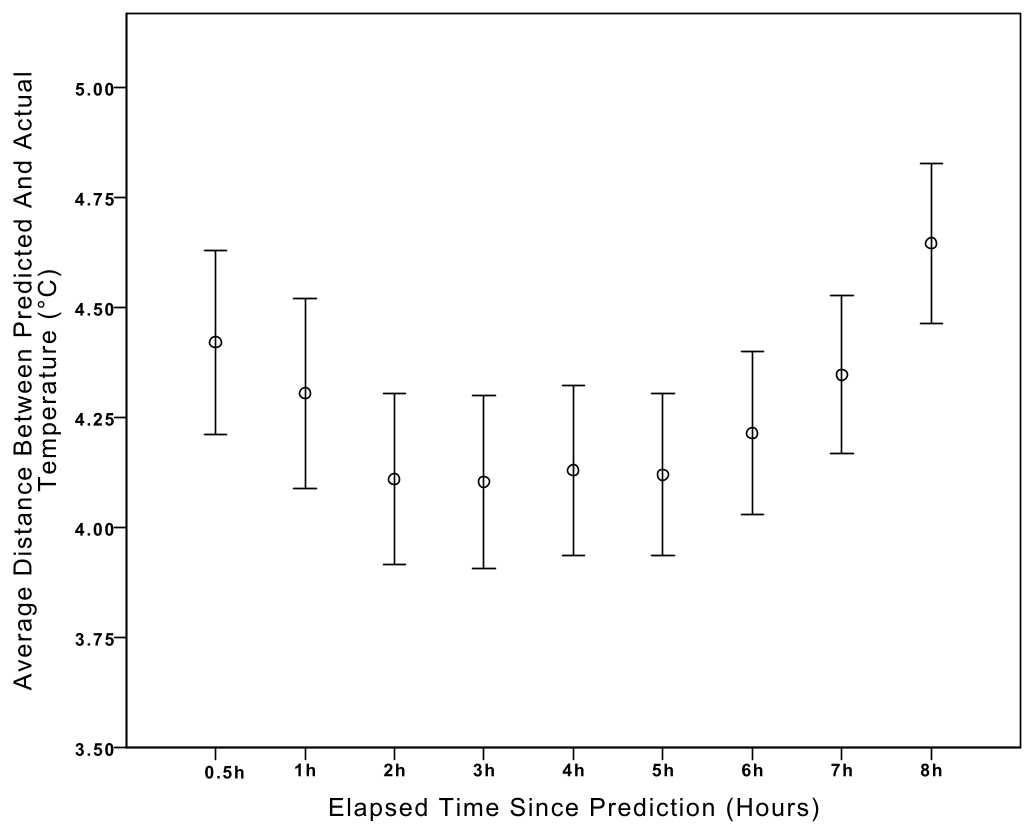
When does human intuition fail? The data shows a "sweet spot" for forecasting.
- Users were most accurate for 2 to 4 hours into the future.
- Accuracy for wind intensity was remarkably high, with a mere 8.5 km/h error margin in short-term predictions.
- By the 8-hour mark, human predictive power significantly degrades, falling back to baseline uncertainty.
Deep Insight & Conclusion
The study reveals a fascinating intersection of psychology and meteorology. While users work indoors (87% of the survey sample), the weather still dictates their Productivity and Clothing choices.
Takeaway: Crowdsourcing weather isn't just about replacing thermometers; it's about capturing the impact of weather. Atmos proves that people can provide reliable short-term "Nowcasts."
Limitations: The study struggled with "User Retention." Frequent prompts (ESM) led to app uninstalls. Future crowdsourcing efforts must find a better "Incentive-to-Interrupt" ratio, perhaps by gamifying the "Weather Guru" status or linking reports to personalized clothing tips.
Future Outlook: The future of Atmos lies in Microclimates—islands, mountains, and dense urban canyons—where official stations are blind, but humans are ever-present.