
Weaving Social Networks from Smart Card Data: The "On-Journey-Accompanying" Paradigm
Weaving Social Networks from Smart Card Data: An On-Journey-Accompanying Approach
This paper introduces the "on-journey-accompanying" approach to extract social networks from Smart Card Automatic Fare Collection (SCAFC) data. Unlike previous "in-vehicle encounter" models, it identifies passengers who share identical spatiotemporal footprints for their entire journey, achieving a high-fidelity representation of social ties in public transit.
TL;DR
Most urban mobility studies treat "being on the same bus" as a social connection. This paper argues that's too shallow. By introducing the on-journey-accompanying metric, the authors extract passengers who share the exact same start, end, and duration of a trip. This produces a sparser but far more meaningful social graph, revealing how massive connected components emerge from individual daily routines.
Problem & Motivation: Beyond the "In-Vehicle Encounter"
In the realm of Trajectory Mining, the "encounter" is a well-studied phenomenon. However, existing literature often suffers from network over-saturation. If 50 people are on a bus, an "in-vehicle encounter" model creates a fully connected clique of 50 people. But do they all have the same mobility pattern? Likely not.
The authors' insight is grounded in Spatiotemporal Footprints. They differentiate between two types of ties:
- In-Vehicle Encounter: Partial overlapping (meeting for a few stops).
- On-Journey Accompanying: Complete coincidence (traveling together from origin to destination).
The former implies physical proximity; the latter implies a reciprocal relation or shared travel demand, which is a much stronger indicator of social proximity or shared life patterns.
Methodology: The Logic of "Total Matching"
The methodology relies on a strict definition of a trajectory as a sequence of spatiotemporal pairs: .
1. Spatial-Equality & Temporal-Proximity
The system uses two primary filters:
- Spatial-Equality: The stop sequence must be identical.
- Temporal-Proximity: Because smart card sensors have a processing lag (one card at a time), they use a tolerance (5 minutes) rather than exact equality.
2. Network Construction
By applying these filters, the authors move from raw logs to an adjacency matrix , where the weight represents how many times two IDs have accompanied each other.
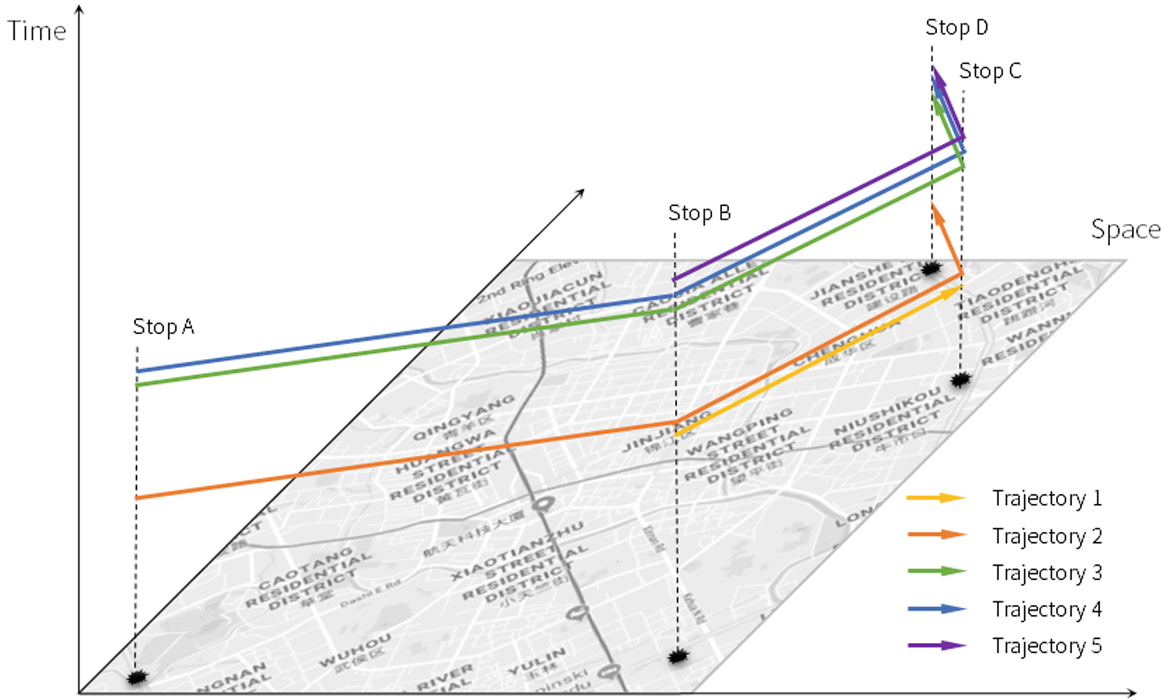 Figure 1: Conceptual difference between in-vehicle encounters (partial) and on-journey accompanying (full).
Experiments & Results: The Anatomy of a City
Using data from the Chengdu Bus Rapid Transit (BRT) system, the study reveals several fascinating "Phase Transitions" in urban social networks:
- Synchronization of Growth: The growth of nodes and connections is almost perfectly linear (). As more people board, the network density increases predictably.
- The Temporal Pulse: Connectivity peaks sharply during morning and evening rush hours. Outside these times, the network consists of "tiny islands" (small subnetworks).
- Weak Regularity: By tracking a specific node over five days, the authors found that while a passenger might meet 44 people on Monday, only one person might consistently accompany them throughout the entire week. These persistent "strong ties" are the "Golden Nuggets" for recommendation systems.
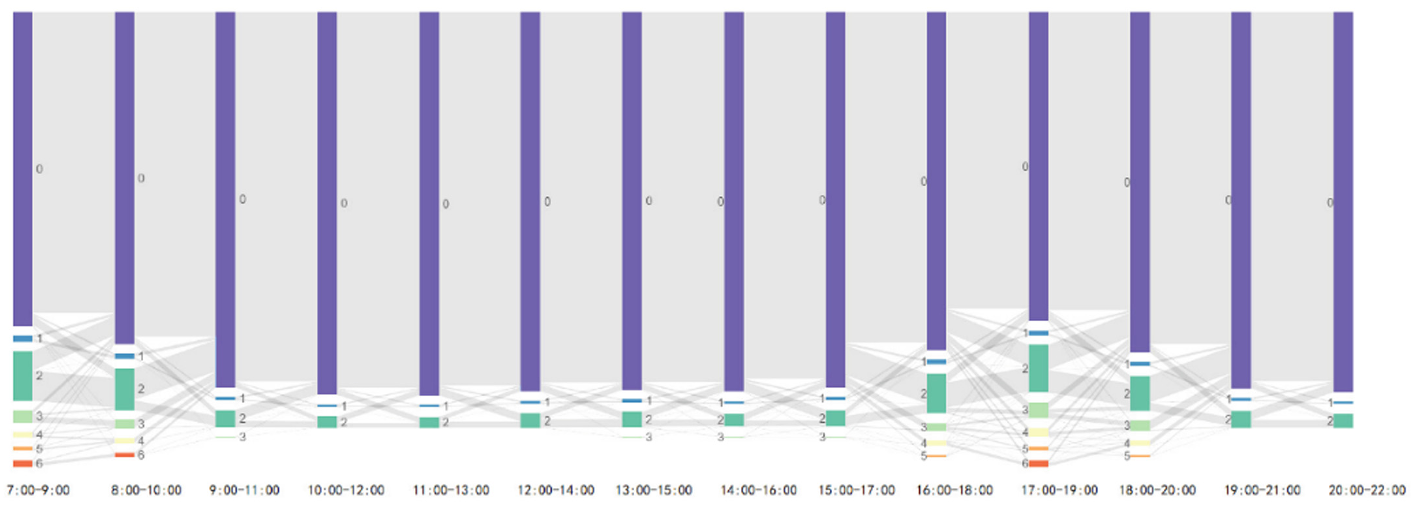 Figure 2: Evolution of connected component sizes across a 24-hour cycle.
Critical Analysis & Conclusion
Takeaway
This work shifts the focus from "Co-presence" to "Co-pathing." By raising the bar for what constitutes a social edge, the resulting network becomes a high-precision tool for understanding the "hidden" social fabric of a city.
Limitations & Future Work
- Sparsity vs. Meaning: The focal network is extremely sparse compared to encounter-based networks. While this increases "signal," it may miss "weak ties" that are still relevant for disease contagion.
- Anonymity: The data is strictly anonymous. The next step would be integrating this with semantic Point-of-Interest (POI) data to understand why these people are accompanying each other (e.g., are they co-workers or classmates?).
Final Verdict: A foundational piece for any researcher looking to move beyond simple proximity-based mobility models toward true social-mobility integration.