
Crowdsourcing Traceability: A New Framework for Missing Child Recovery
A web based crowdsourcing framework: Lost child case
The paper introduces a web-based crowdsourcing framework designed to facilitate the search for missing children by leveraging public participation and mobile technology. The core method utilizes a collaborative information system that connects government authorities with the "crowd" to generate real-time traceability maps, significantly narrowing down search perimeters.
TL;DR
This paper presents a specialized crowdsourcing framework designed to help government authorities locate missing children by harnessing the collective observations of the public. By utilizing a responsive web-based platform, the system captures real-time location data from citizens, processes facial and clothing attributes, and generates a chronological "traceability map" to visualize the child's movement and narrow the search area.
Problem & Motivation: The Golden Hour Dilemma
In cases of child abduction or loss, time is the most critical factor. According to the FBI and international statistics cited in the paper, hundreds of thousands of children go missing annually. While systems like AMBER alerts exist, they are primarily one-way communication channels.
The authors identify a significant gap: how to effectively organize the massive but uncoordinated power of a crowd in a public area. The challenge is not just alerting the public, but capturing and sanitizing their feedback into actionable intelligence that shows where the child is moving, rather than just where they were lost.
Methodology: Turning the Crowd into a Distributed Sensor Network
The framework is built on a tripartite architecture: Campaign Organizers (Authorities), Participants (The Crowd), and End Users (Police/Rescuers).
1. Structured Data Capture
Instead of relying on vague descriptions, the framework uses a sub-divided identification form based on academic facial cue studies (Klare et al.). This ensures that the data fed into the system by the public is granular and searchable:
- General Information: Age, gender, hair.
- Facial Attributes: Specific physiological markers.
- Clothing Specifications: The most reliable short-term identifier in crowded public spaces.
2. The Traceability Engine
The core innovation is the translation of discrete reports into a movement vector.
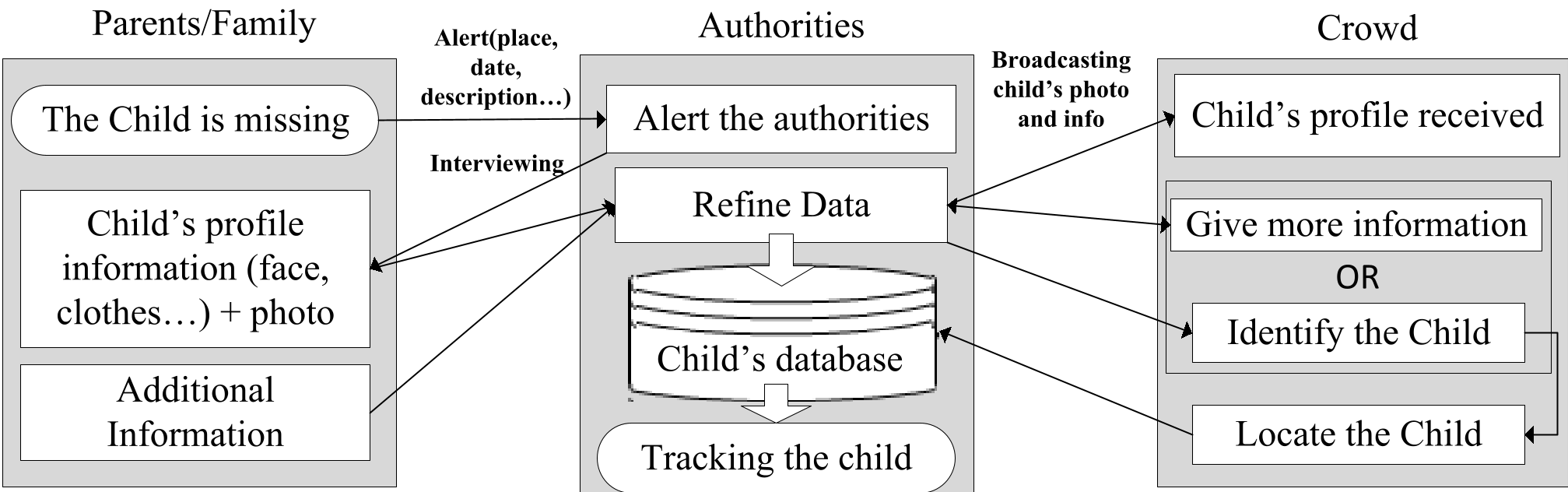
As shown in the architecture above, when a participant identifies a child, the system captures the GPS coordinates and timestamp. By linking these points, the authorities gain a "traceability" view, effectively seeing the child's path across a city or event venue.
Experiments and Implementation
The authors implemented the solution using a responsive web design (utilizing PHP and MySQL) to ensure compatibility across all mobile devices without requiring the installation of a native app—a crucial design choice for spontaneous "crowd" participation.
Performance Visualization: The Search Perimeter
The most striking result of the framework is the customized interface using the Google Maps API.
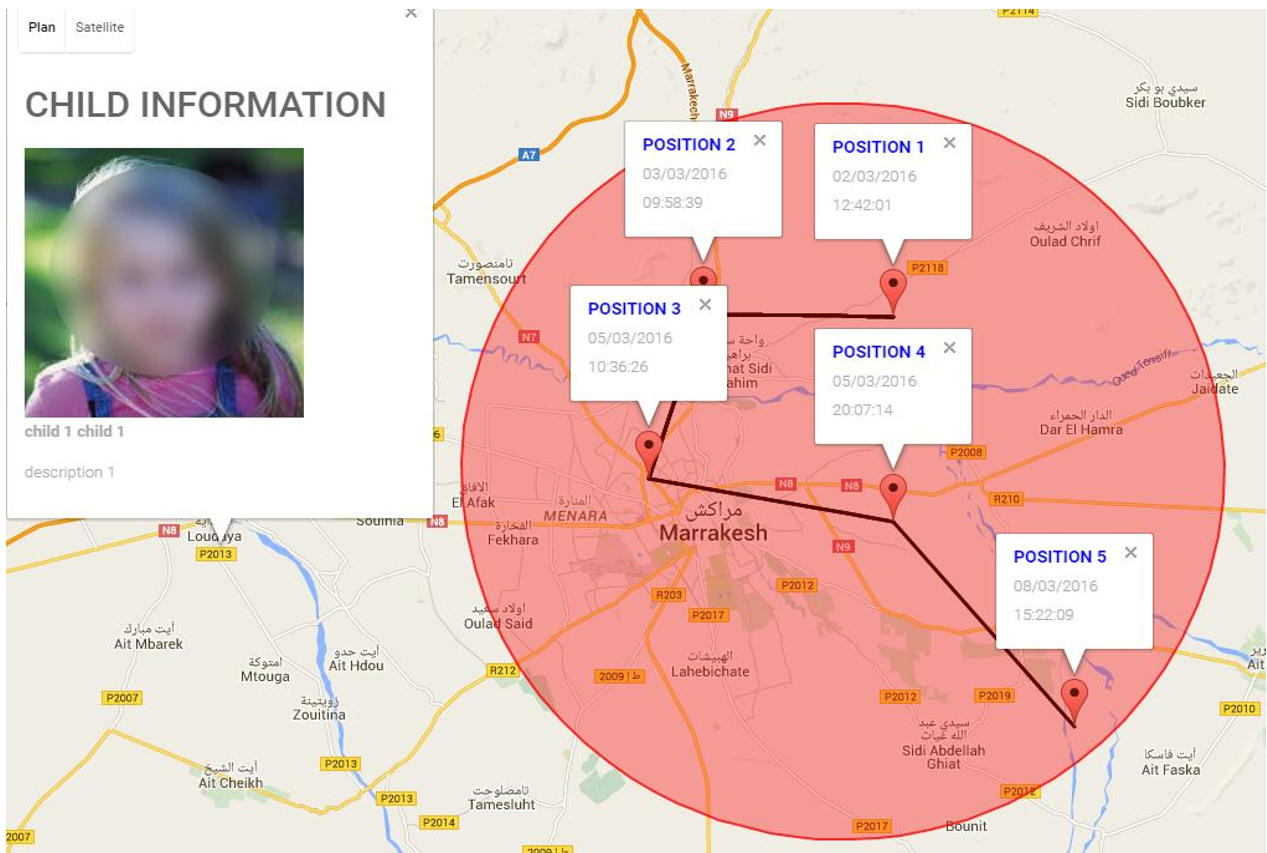
In the resulting visualization:
- Markers indicate specific sightings.
- The system calculates a search radius (red circle) based on the time elapsed since the last sighting and the maximum possible distance traveled.
- This allows police officers to see their own proximity to the potential path of the child in real-time.
Critical Analysis & Conclusion
Takeaway
The paper successfully demonstrates that crowdsourcing in e-governance is most effective when it provides structured feedback loops. By moving beyond simple alerts to chronological pathing, the framework provides law enforcement with a "live" search grid rather than a "cold" historical record.
Limitations & Future Work
The authors honestly address a major hurdle: Data Credibility. In any crowdsourcing task, "noise" or malicious false reports are a threat. The paper suggests that future iterations will need to integrate Big Data analytics to cross-reference multiple reports for verification. Furthermore, there is a clear opportunity to integrate modern AI-based facial recognition to verify photos uploaded by the crowd automatically.
As mobile connectivity becomes ubiquitous, frameworks like this serve as a blueprint for "Crowd Computing," where human effort and digital sensors merge to solve urgent social crises.