
The Myth of the Solitary Hero: Decoding the DNA of Web Founding Teams
Going it all alone in web entrepreneurship?: a comparison of single founders vs. co-founders
This study investigates the determinants of founding configurations in 91 Web startups, comparing 183 single founders versus co-founders. Using data from CrunchBase and LinkedIn, it evaluates whether individual traits or team dynamics drive startup formation, ultimately confirming that co-founder teams are primarily formed to achieve skill complementarity.
TL;DR
Is the "Lone Wolf" founder a reality or a myth in the digital age? This research analyzes 91 Web startups to find out if single founders are truly "Jacks-of-all-trades" or if they are just co-founders who haven't found a partner yet. The verdict: Solo founders aren't necessarily more skilled or better connected; instead, successful teams are mathematically proven to be built on complementary skill sets.
Problem & Motivation: Why Go It Alone?
In the tech world, we often idolize the "lone genius." Academic theories like Entrepreneurial Self-Efficacy (ESE) and the Jack-of-all-trades theory suggest that for an individual to start a business alone, they must possess a rare, balanced mix of management, marketing, financial, and technical skills.
The researchers set out to test a provocative question: What actually differentiates a single founder from a co-founder? Does the solo founder have more experience? Better connections? Or is team formation simply a way to fill "skill gaps" that an individual cannot bridge alone?
Methodology: High-Tech Data Mining
To solve this, the authors moved beyond traditional surveys. They combined:
- CrunchBase: For funding data and company milestones.
- LinkedIn: To scrape the actual career trajectories, education, and social network sizes of 183 founders.
They mapped these profiles to 8 core dimensions of "Computer and Entrepreneurial Self-Efficacy," including Innovation, Risk-taking, and Web Technology skills.
 The study focused on US-based Web 2.0 startups that received seed funding, ensuring a homogeneous sample.
Methodology: The Core Finding
The most striking result of this study is what it did not find. Contrary to popular belief:
- No Skill Gap: Single founders do not have a higher degree of entrepreneurial skills than individual co-founders.
- No Experience Advantage: Solo founders aren't more educated or more "veteran" than those in teams.
- No Social Edge: While single founders had slightly more LinkedIn connections (852 vs 703), the difference was not statistically significant.
The "Complementarity" Logic
However, when looking at teams as a unit, the data sang a different tune. Using Binary Euclidean Distance, the authors proved that co-founders are selected specifically to "plug holes."
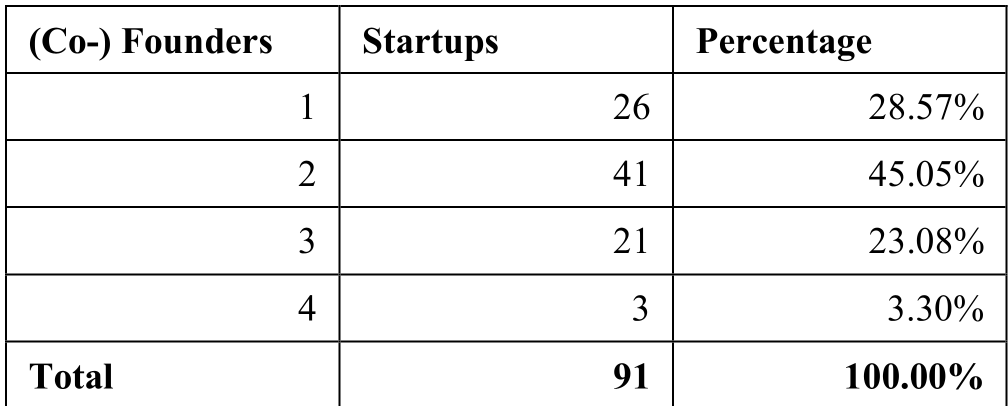 Most startups (45%) opt for a duo, and for good reason: the jump from 1 to 2 founders provides the most significant boost in total skill coverage.
Experiments & Results: Funding and Diversity
Does having more founders lead to more money? Surprisingly, no. The study found that single founders actually received the highest average seed funding (~$700k), though the variance was huge. This suggests that investors at the seed stage value the quality of the idea and the specific skill-match of the team over the mere number of people on the slide deck.
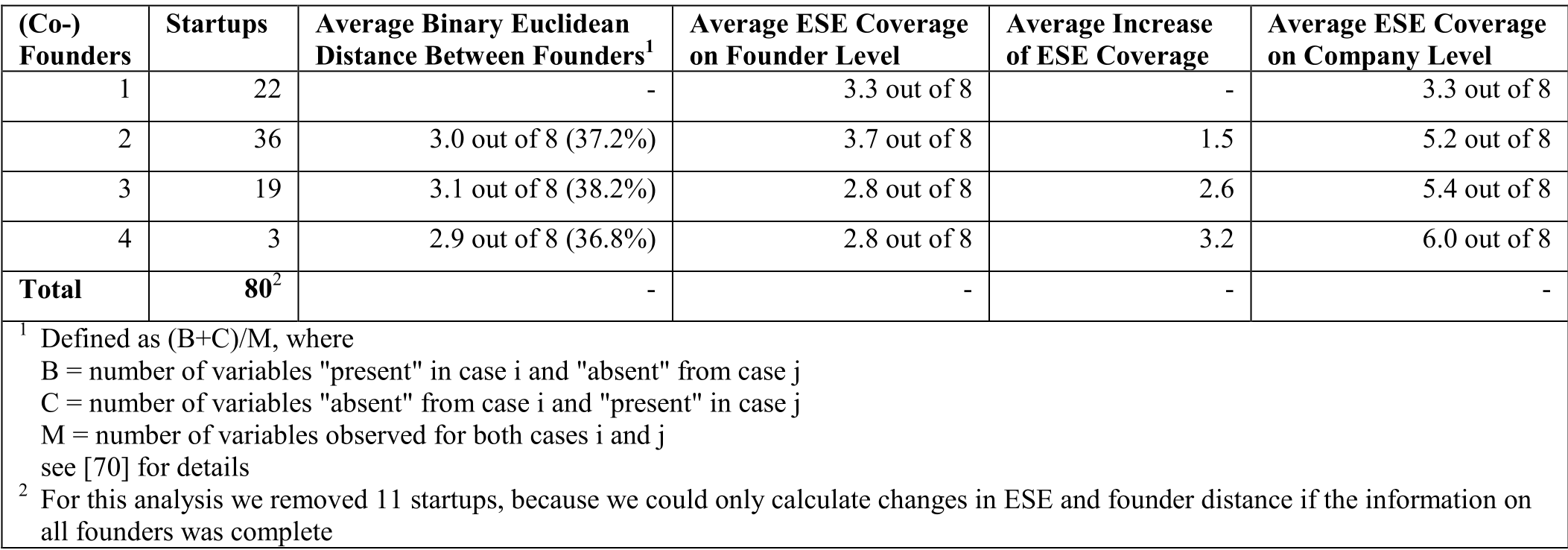 This table shows that while an individual co-founder might only have 3.7 skills, the Company Level coverage jumps to 5.2 in a duo. That +1.5 increase is the "synergy" that justifies giving up 50% equity.
Critical Analysis & Conclusion
Takeaway
The "Jack-of-all-trades" theory needs a reboot. In the complex Web industry, it's nearly impossible for one person to be the master of everything from Financial Control to Web Technology. Team formation is a calculated resource-seeking behavior.
Limitations
- The Gender Gap: The study highlighted a glaring 14% female founder rate and a massive underrepresentation of Black founders (only 1 out of 171).
- The "Venture Capitalist" Signal: There was a slight indication (p=0.063) that former VCs are more likely to fund alone, perhaps because they already possess the "social capital" to hire experts rather than recruiting co-founders.
Future Outlook
For future founders, the message is clear: You don't need to be a superhero. If you lack a skill, don't just study harder—find a co-founder whose "Binary Euclidean Distance" from your skill set is as high as possible. That is the mathematical path to a robust startup.