
Bridging the Semantic Gap: Transforming Metadata Forests into Linked Webs via Personal Ontology
A Web Mining Method Based on Personal Ontology for Semi-structured RDF
The paper introduces a "Hybrid RDF Mining" method that transforms semi-structured RDF data into well-linked Semantic Web structures using a "Personal Ontology." By combining local concept dictionaries (initialized with WordNet) and text mining techniques like the Lead method, it enables automated resource mapping for disconnected metadata such as RSS feeds.
TL;DR
Current Semantic Web data often exists as "Semantic Forests"—isolated clusters of metadata like RSS feeds that lack meaningful links to other resources. This paper proposes a Hybrid RDF Mining approach that utilizes a Personal Ontology (a localized, CF-rated concept dictionary) to automatically analyze text and map it to structured web resources, effectively turning semi-structured data into a fully connected Semantic Web.
The Motivation: Escaping the "Semantic Forest"
The ideal Semantic Web is a vast, interconnected network where agents can traverse links between resources. However, the reality is fragmented. Most real-world RDF data (like RSS) contains "blobs" of natural language text in fields like <rss:description>.
Because these documents don't link to external definitions, they form "Semantic Forests"—isomorphic to simple XML trees but lacking the "Web" characteristic. The authors identified that the bottleneck isn't the data format, but the manual effort required to create metadata and the rigidity of global ontologies that ignore personal context.
Methodology: The Personal Ontology & Lead-Method
The core innovation is the Personal Ontology, which serves as a local "brain" for the user's agent.
1. Architecture of Personal Ontology
Unlike global ontologies that aim for a single truth, the Personal Ontology uses Certainty Factors (CF). It maps natural language terms to Web Resources (URIs) using WordNet as an initial backbone.
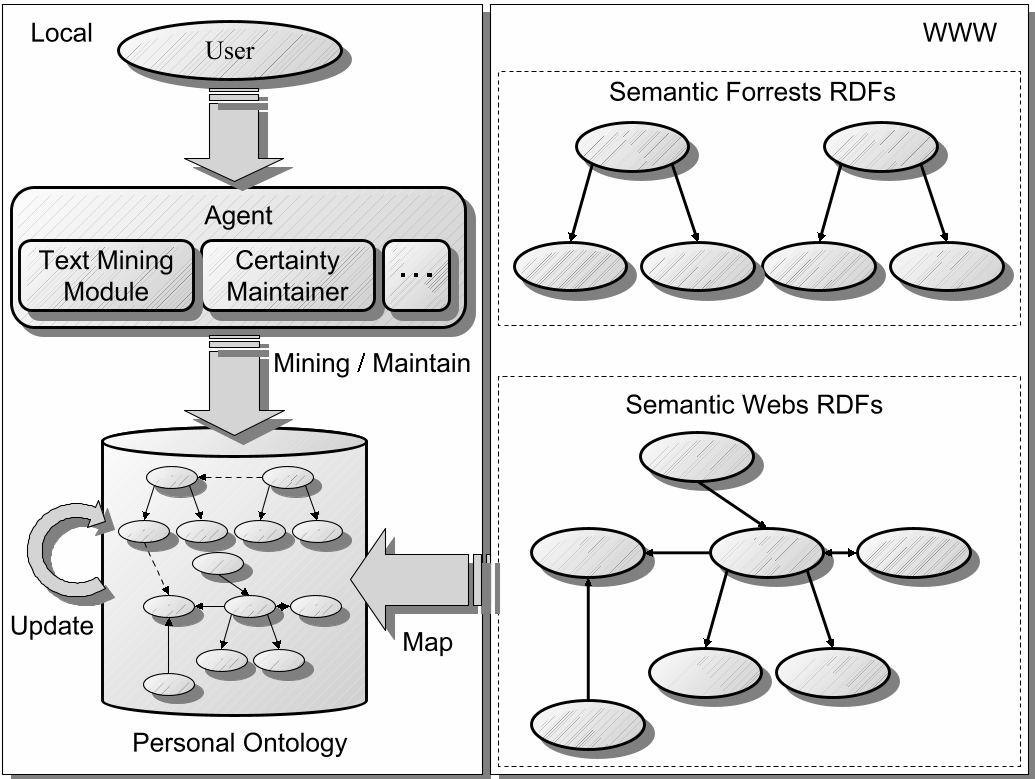
2. The Resource Mapping Algorithm
To link a text-heavy RSS feed to the Semantic Web, the system follows a 3-step pipeline:
- Lead-Method Extraction: It assumes the first few sentences and titles are the most important. It assigns an initial importance score () based on word position and frequency.
- Recursive Recalculation (RE): It traverses the Personal Ontology. If keywords overlap or relate to existing concepts (e.g., "Thinkpad" is a kind of "PC"), the importance of related concepts is boosted according to the relation type.
- Dynamic Update: If the system identifies strong new co-occurrences, it updates the local ontology, creating new "relates-to" edges.
3. Relation Coefficients
The system weighs the strength of semantic links differently to ensure precision:
- Same-as: 1.00
- Is-a-kind-of: 0.75
- Relates-to: 0.25
Experiments: Auto-Annotation in Practice
The authors implemented the system using Brill’s Tagger for real-time POS tagging and utilized WordNet IDs as URIs. By mapping the term "hospital" via rdfs:label, the agent could successfully resolve unstructured text into structured RDF/OWL fragments.
Critical Analysis & Conclusion
Takeaway
This work highlights a critical early insight in Web 3.0 research: Scalability comes from localization. By moving the "inference" and "mapping" workload to a local Personal Ontology, the system avoids the "World Model" bottleneck while allowing for highly personalized knowledge discovery.
Limitations
- Word-Level Only: The system ignores phrases (N-Grams), which can lead to ambiguity (e.g., "Apple" the fruit vs "Apple" the company).
- Ontology Bootstrapping: While WordNet is a great start, the system's ability to learn highly specialized technical terms remains limited without external encyclopedia lookups.
Future Outlook
As we move into the era of Personal AI agents, the concept of a "Personal Ontology" coupled with text mining is more relevant than ever. Integrating these methods with modern N-Gram analysis and Weblog mining (as suggested by the authors) could provide the "semantic glue" needed to finally achieve the vision of a machine-understandable web.
Senior Editor's Note: This paper serves as a foundational bridge between traditional Text Mining and the Semantic Web, proving that metadata is only as useful as the links it provides.