
Web Prosumers: Unlocking the Intangible Wealth of the Third Wave Economy
Web Prosumers: The Intangible Wealth of Education and Economics
This study investigates the "Web Prosumer" phenomenon in the context of the "Third Wave" economy, focusing on the transition of university students from passive consumers to active content creators. Using a quantitative descriptive approach, the research identifies systemic barriers to digital content production in the Ecuadorian cantons of La Libertad and Salinas.
TL;DR
The shift from a "Second Wave" industrial economy to a "Third Wave" information economy has transformed users from passive consumers into "Prosumers" (Producer + Consumer). However, a study of university students in Ecuador reveals a stark reality: despite having the tools, a massive "content creation gap" exists. This post explores why young digital natives are stuck in consumption mode and how educational policies must evolve to treat information as the ultimate exhaustible resource.
Contextual Positioning
This research sits at the intersection of Digital Sociology and Educational Economics. It moves beyond the technical specifications of Web 2.0 to analyze the human behavior—the "why" and "why not"—behind the creation of intangible digital wealth. It challenges the "Second Wave" school-factory model, advocating for a decentralized, active learning framework.
The Problem: The Ghost Economy of Passive Consumption
Alvin Toffler’s "Third Wave" theory suggests that the economy is split into Sector A (unpaid work/prosuming) and Sector B (the market). The authors argue that while technology allows us to move activity from Sector B to Sector A, creating "intangible wealth," the potential is being wasted.
In the regions of La Libertad and Salinas, university students—who should be the "anonymous heroes" of the new economy—are largely relegated to searching and downloading. The "Invisible Wealth" is not being generated because the leap from consumer to "hypertext producer" involves barriers that simple internet access cannot solve.
Methodology: Identifying the "Fishbone" of Inactivity
The study utilizes a quantitative survey of 379 students, but the analytical core is the Ishikawa (Cause-Effect) Diagram. The authors dissected the low content production problem into four critical categories:
- Social/Institutional: Lack of government policies and institutional "culture" regarding web use.
- Users: Lack of interest and technical knowledge.
- Time: High perceived time cost of creation vs. consumption.
- Technology: Access points and tool familiarity.
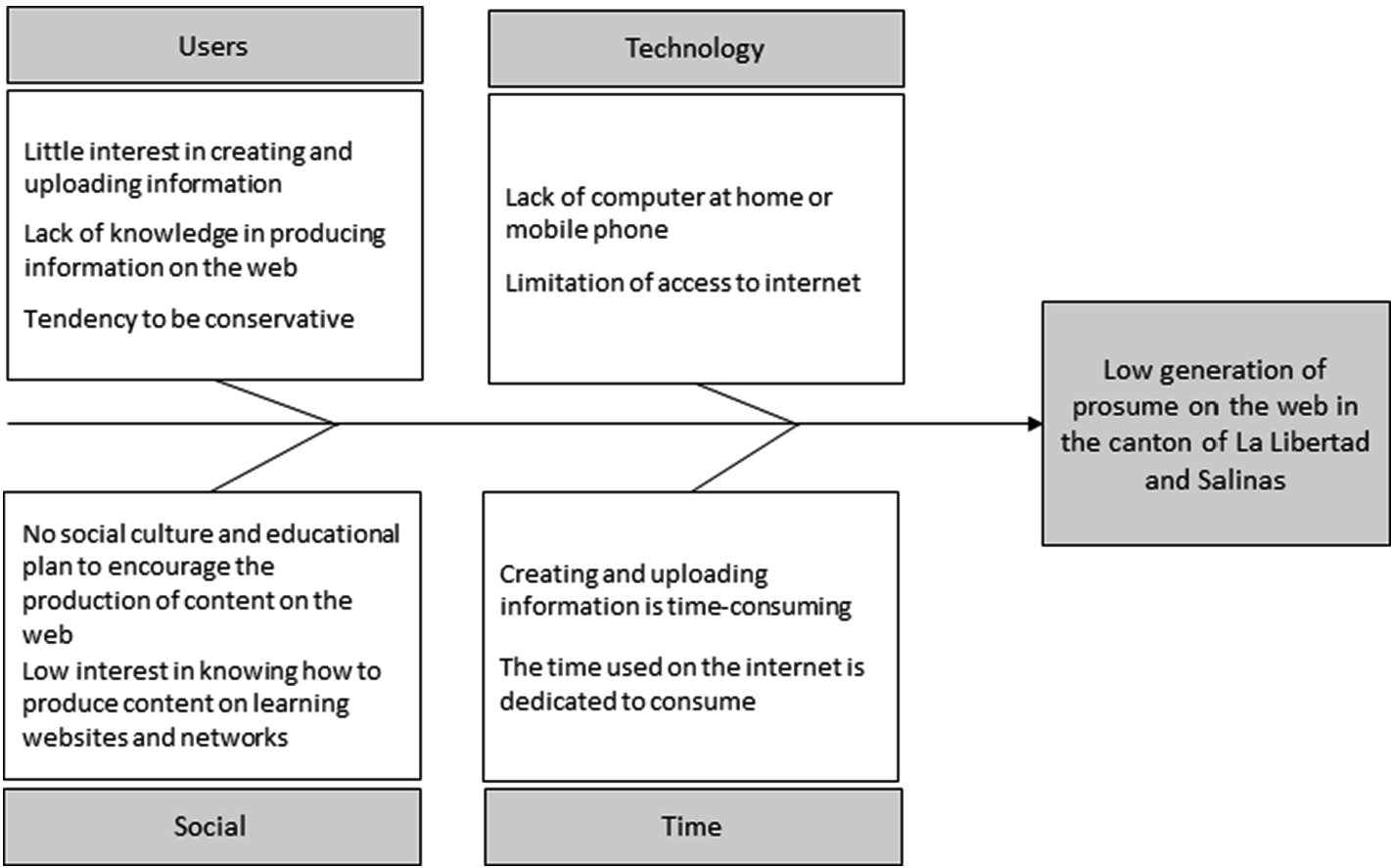 Figure: The Ishikawa Diagram used to map the root causes of low prosumer activity.
Key Insights & Experimental Results
The findings reveal a contradiction in the digital native lifestyle:
- High Access, Low Output: 46.4% access the web from home, providing the "comfort" needed for creation, yet they don't produce.
- The Content Hierarchy: Most students qualify their internet use as "normal" or "much" for socialization and study (downloading), but "little" or "nothing" for actual work or production.
- The "Prosumer Paradox": 55% of participants want to create but blame time constraints. This suggests that content creation is still viewed as an "extra" burden rather than a core component of the learning process.
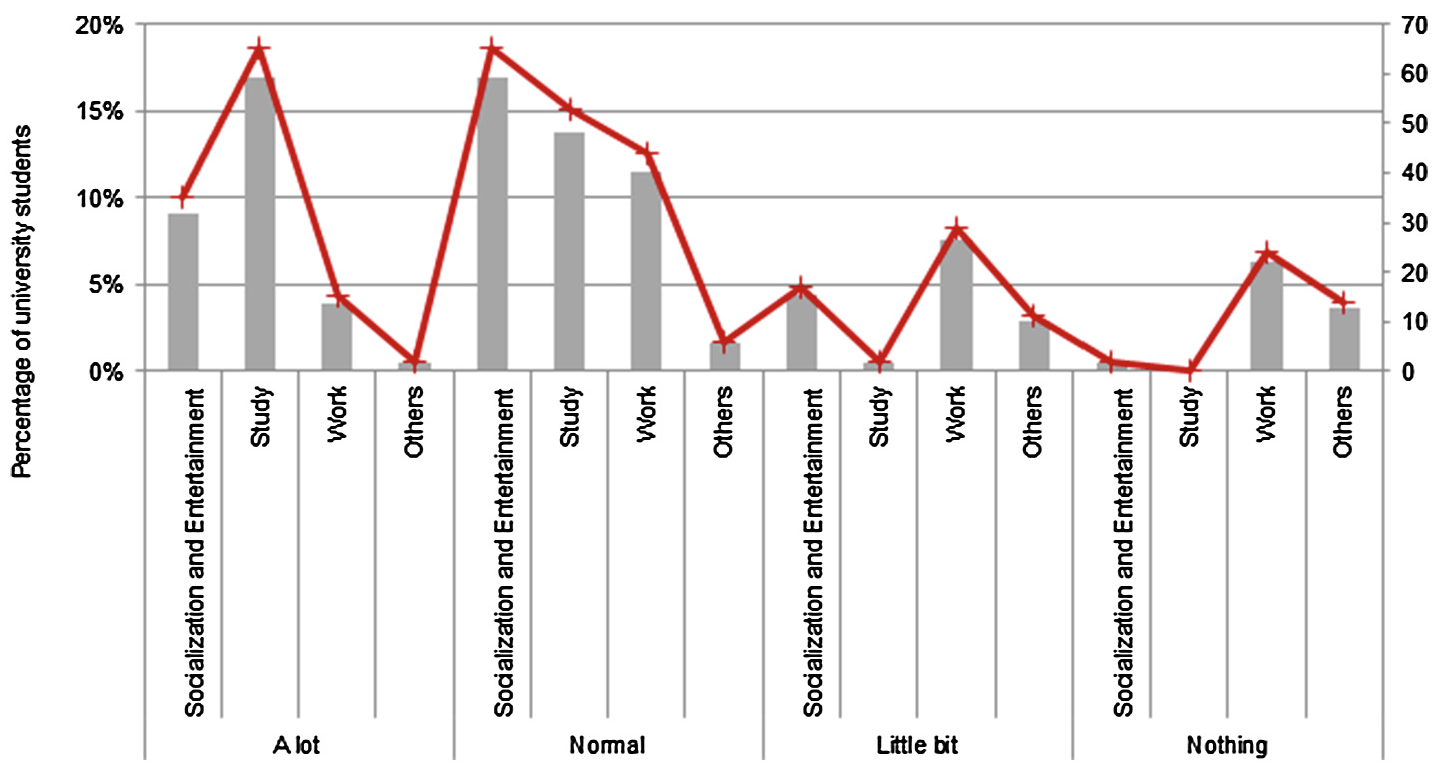 Figure: Analysis of internet use categories showing the dominance of passive consumption.
Critical Analysis: From Factories to Mashups
The paper’s most profound insight is the critique of Second Wave Educational Models. Modern schools are still "factory-style" imitations. To fix the low prosume generation, the authors suggest:
- Policy Intervention: Governments must define "Educational Web Policies."
- Incentivized Creation: Moving beyond search tasks to "Mashups" where students participate in product/knowledge creation as part of their curriculum.
- The Role of the Teacher: Teachers must transition from information dispensers to "production motivators."
Limitations
The study is geographically limited to a specific demographic in Ecuador. Socio-economic factors unique to this region might not be universally applicable to more digitized or affluent economies.
Conclusion: Information as Raw Material
The wealth of the future is built on information and imagination. As this paper demonstrates, providing the "raw material" (internet access) is insufficient. We must provide the "industrial tools" (skills and motivation) for students to become prosumers. The "Third Wave" is here; the question is whether our educational institutions are still trying to swim with "Second Wave" anchors.